Congratulations to our friend and occasional contributor Colin Khoury and to his co-authors on the paper “An Inventory of Crop Wild Relatives of the United States.” The paper has been named “Outstanding Paper on Plant Genetic Resources in 2014″ by the Division C-8 Plant Genetic Resources of the Crop Science Society of America. Richly deserved. The data on which the paper is based can be found on the Crop Wild Relatives and Climate Change webpage.
Nibbles: Farmers’ markets, Pacific news, Solanaceae news, Globally Important Agricultural Heritage Systems, Tibetan barley, Rice roundup, David Lobell interview, Native American crops, Mesopotamian recipe, Insectophagy, Cities, Land purchases, Dormancy in evolution, Bad news from some crops, Good news from others, Creative Commons at Gates
- Hell of a week in the office again, so catching up on accumulated Nibbles on a Sunday. Because we’re here to serve.
- Cynical, funny take on farmers’ markets: “No, I don’t save seeds. That’s time-consuming nonsense for backyard gardeners. Yes, I’ve heard of Monsanto. I’m a farmer. I know about goddamn Monsanto.”
- Uncynical double from the Pacific: Samoa’s agricultural show and more detail on the aroid breeding work.
- High tech breeding of solanaceous crops. Nothing like this for aroids yet, alas. Yeah, but first you have to collect the little blighters.
- On the other hand, you also need an awareness of the past. Ask the Tibetans.
- And here’s kind of an example of that involving rice in India. Compare with that first Nibble: seed saving not just for backyard gardeners after all? Convinced? Go do it, no, really. Or read Bob Zeigler; you can listen to him too. We could go back and forward on this forever. I know: let’s get some data.
- And another example involving wild not-rice in the US and Canada. Though there are some things that haven’t survived quite as well among Native Americans as those wild rice recipes.
- And speaking of ancient recipes, here’s one from another wetland, far far away from the above.
- Yeah but not all ancient recipes are so resilient, take beetles for example.
- Urban farming is big, needs to be bigger.
- Meanwhile, agricultural land is being bought up all over the place, for what it’s worth, so maybe cities will be all we have to grow stuff.
- International Cocoa Organization calls bullshit on all those chocolate-is-running-out stories.
- Maybe we should chill about wine too? I dunno, I think I’d prefer to play it safe with both. Or get help from above. Or from the Fascists.
- The banana was going extinct too, wasn’t it?
- British apples (and other trees, to be sure) are of course perennially in trouble, but help is on the way, courtesy of Kew. And not just British or apples that get help from that quarter.
- “The potato will not only survive climate change, it will help us to survive it as well.” Good news at last.
- Mapping cassava, all of a sudden an exciting new crop, if you can believe it. No stopping it now that Bill Gates has called it the world’s most interesting vegetable.
- Incidentally, he’s also decided to go totally CC-BY.
- And that’s all she wrote. For now.
Action for Nutrition at last, maybe
The Second International Conference on Nutrition (ICN2) drew to a close yesterday, having promulgated the Rome Declaration on Nutrition and endorsed a Framework for Action. From the latter, let us all applaud Recommendation 10 (of sixty):
Promote the diversification of crops including underutilized traditional crops, more production of fruits and vegetables, and appropriate production of animal-source products as needed, applying sustainable food production and natural resource management practices.
FAO is putting its (donors’) money where its mouth is by establishing an Action for Nutrition Trust Fund.
Twice per year the PCU will make a Call for Proposals based on the size of the Fund at the time. The SC will decide which proposals will be funded based on the recommendations from the PCU.
With sixty recommendations to choose from the Programme Coordinating Unit (PCU) will have its work cut out for it.
Have your say on international agricultural research priorities
(The) CGIAR is/are making a big push to elicit input on the new Strategy and Results Framework (SRF). You know the drill: a barrage of surveymonkeys, blogposts, tweets, Facebook posts, targeted emails, webinars, e-consultations, you name it, is coming your way. For all I know they’ll be knocking on doors in carefully selected neighbourhoods around the world. I’m always a little ambivalent when research organizations ask for help in prioritizing their work. On the one hand, it’s always good to ask. On the other, you’d have thought they would know by now.
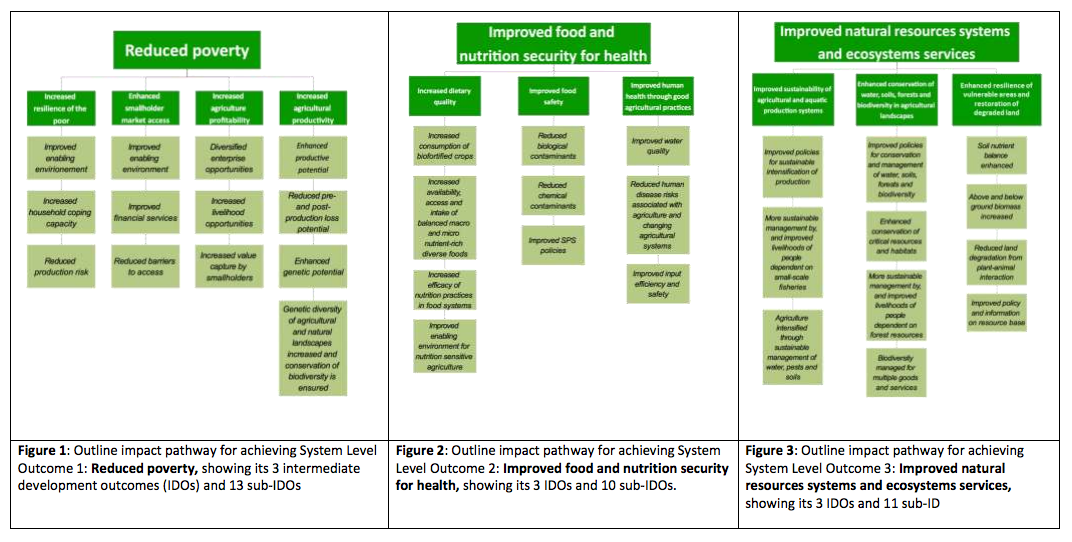
Anyway, the outcomes of CGIAR’s work are now listed as:
1. Reduced poverty
2. Improved food and nutrition security for health
3. Improved natural resources systems and ecosystems services
And it is good to see the importance of the international genebanks in achieving these system-level outcomes recognized in the section of the SRF describing the particular niche of CGIAR:
The CGIAR community holds in trust globally unique genetic resources for a subset of agriculturally significant species of central importance to sustaining and advancing productivity and yield stability for the world’s smallholders in the 21st century.
Less good, however, to note that use of genetic diversity is thought to only contribute to the reduced poverty outcome, and then only via increased agricultural productivity. Sorry about the poor quality of the image showing this below, click on it to improve it a bit, but it wasn’t that much better in the original document:
There are “cross-cutting topics of global importance — women and youth; climate change; and capacity development — [that] will systematically strengthen and build coherence in research across all domains and Intermediate Development Outcomes (IDOs).” Should not conservation and sustainable use of agricultural biodiversity be one of these? Maybe I’ll respond to one of those tweets from @CGIAR.
What should be the priorities for International Agricultural Research for Development? http://t.co/OPWbKjFciV #ag4dev pic.twitter.com/ftQfg5WOAf
— CGIAR (@CGIAR) November 21, 2014
Moroccan medicinal mint tea
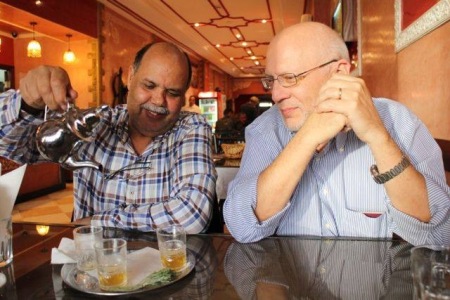
That’s me on the right in Rabat last week, having a post-prandial drink with Dr Ahmed Amri, head of the ICARDA genebank. I post the photo (taken by my colleague Charlotte Lusty) by way of explanation for the lack of blogging lately, and also as an excuse to link to the beta version of Kew’s Medicinal Plant Names Service, which I have just become aware of. You see that bit of greenery on the tea tray? It’s a plant that’s sometimes added to mint tea in Morocco during the winter. It’s called “absinthe” there. If you want to know the Latin name, you can look it up here.