- Coffee rust is doing a number on livelihoods in Central America.
- Wheat blast could do the same in South America.
- ILRI DG on smallholder livestock producers: one-third don’t have the conditions in which to be viable, one-third can go either way and one–third can be successful. I suppose all of them are going to need adaptation options.
- Not to mention extension services.
- Meanwhile, bureaucrats busy protecting the Mediterranean diet.
- The inevitable productivity penalty of organic.”
- Douglas fir ready for its genomic closeup.
- Cryopreservation update, with video goodness.
- Lots of ways to skin the malnutrition cat: zinc and rice.
Micronesian memories
Jonathan Gourlay’s wonderful dissection of his predictably disastrous experience as an outsider running a shop in Micronesia, One Small Store, struck a chord for a number of reasons. First, the great writing. Here’s a sample, chosen from many possibilities:
In Kitti, giant flat basalt stones are still lined up in two rows of three in the center of the feast house, each clanging with its own tone as shirtless men pound stone on stone, mashing up the thick, strong kava (called sakau) for the feast. The musical clacking and clanging of stones begins chaotically and then, as the kava turns gray and viscous, coalesces into one rhythmic song, calling the gods and people to the feast house. You can still join this song. You sit and mash the sakau root with the other sakau pounders around the ancient rock. But you cannot lead the song of the stones. The song just happens, as it has for centuries, when it happens. And when it is complete, you can still drink the sakau. If the sakau is strong, you become the stillest thing in the universe. An observer of life from outside of life. Everything, the ocean, the mango and mangrove trees, the barking dogs, the sweep of time, seems abstract and small because you also feel abstract and small. And perhaps there is a foreigner, a mehn wai, in this group of sakau drinkers. A teacher or a lawyer, someone useful but ultimately unimportant. They are welcome to stay and welcome to leave. What has remained, for hundreds of years, is the clang of the rocks. What has remained, through waves of sailors, missionaries, and invading armies, is the calm of the sakau root sinking into the drinkers, whether they bear a centuries-old title like soum or soulik or souwel or the simple title of mehn wai. They sneak into the ceremony, these interlopers, and they always sneak away again, one way or another.
Then there are the numerous references to the biodiversity of Pohnpei, including of the agricultural kind — such an important part of island life. Kava, as in the extract above, for sure; but also, say, sea cucumbers and betel nut. 1 And, as well, the evocation of how the traditional foods and way of life this biodiversity represents and underpins are being eroded by “things like spam, corned beef, …rice, and something called ‘coco’—a mixture of unripe mango, sugar-free Kool-Aid, and soy sauce.” It all brought back memories of my own time in the region; although thankfully it was not as challenging as Mr Gourlay’s, I think I know how he feels.
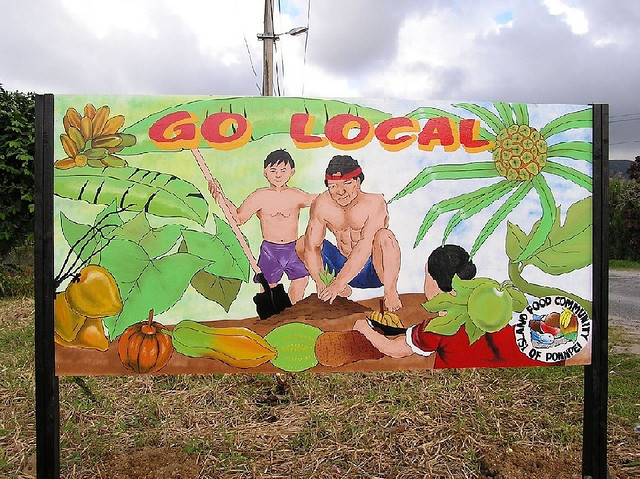
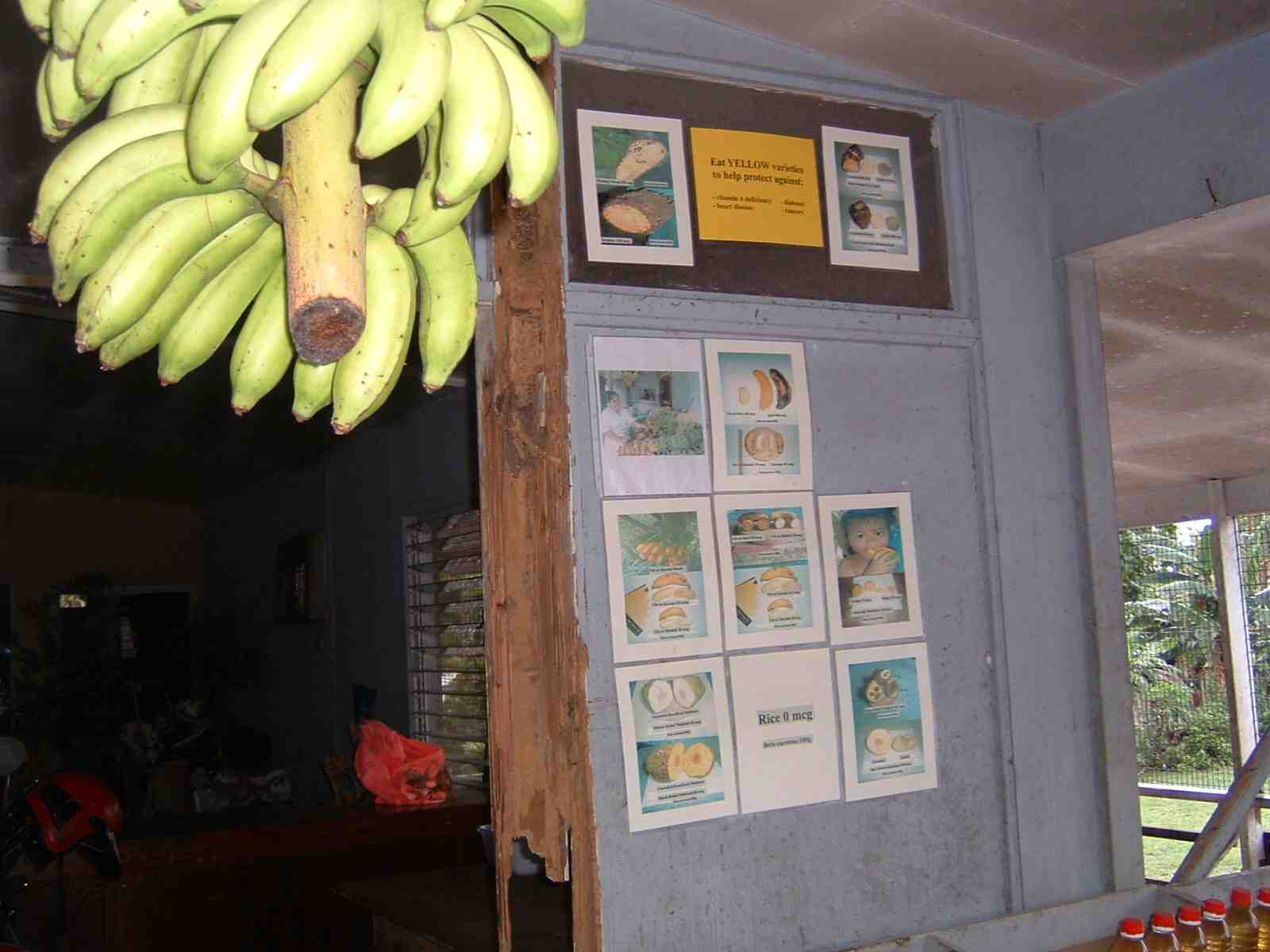 And among those memories are many — both happy and painful — of my friend the late Lois Englberger, who worked so hard for the health and nutrition of the people of Pohnpei. For all I know, it was in Mr Gourlay’s very shop that I took this photo, when I visited the island back in 2004. You’ll have to click on it to see it properly, but it’s an example of Lois’ efforts to communicate the evidence that people on the island could improve their nutrition and well being by going back to eating Pohnpei’s unfortunately neglected — and disappearing — orange bananas (and other crop varieties high in Vitamin A precursors, for that matter). That’s ten years ago. Wow. Let me leave you with Lois’ photo of one of the billboards spreading her message on the island, and which Mr Gourlay would, I suspect, find amusing now, if he didn’t then.
Resilience of indicators of resilience being discussed
The Third International Science and Policy Conference on the Resilience of Social & Ecological Systems is taking place in Montpellier, France. And yes, there’s a hashtag, settle down. Agricultural biodiversity features, thankfully, not least in the indicators of resilience (here’s the presentation). This just in:
Eyzaguirre: Communities embedded in a landscape mosaic can shift focus according to context and reinforce resilience #Resilience2014
— Alliance of Bioversity International and CIAT (@BiovIntCIAT_eng) May 6, 2014
Giant White Cuzco Maize DOC
Peru has made further moves to protect a maize variety typical of Cuzco:
The Foreign Ministry reported that the designation of origin “Giant White Cuzco Maize” was protected by the Peruvian government in Chile, through its registration with the National Institute of Industrial Property (INAPI) of that country, which culminates a legal process started a few years ago and will adequately promote in the Chilean market one of our most representative agricultural products.
Four years ago the Peruvian government declared the variety part of the country’s cultural patrimony. It is being used by WIPO as a case study of the use of denomination of origin to revive communities. Giant White Cuzco Maize joins a whole series of other typical products “enjoying” denomination of origin protection in South America. 2 Though one does wonder to what extent this particular move was a reaction to the controversy between Peru and Chile over pisco.
Anyone willing to hazard a guess as to whether, and if so to what extent, this will affect exchange of germplasm of this maize variety for research and breeding? Will Amazon have to stop selling it?
South Pacific genebank overture, take 2
For those of you who were disappointed by the strange ending to that video about the Centre for Pacific Crops and Trees at SPC in Fiji, the full version is now up.