- Nature has new Plants journal. With blog.
- More from the randomized trials backlash frontlines.
- World Bank sets up internal task force on climate smart agriculture. Oh good.
- No word on whether spiritual values on agenda.
- Hacking the school lunch.
- Indian flour mills winding down. Implications for crop diversity unknown.
- Big Australian writeup of CIMMYT genebank.
- Big CIP writeup of CIP genebank. And other collections, to be fair.
- It’s the regeneration, stupid.
- Gardens save plants.
- Sustainable diets defined to within an inch of their lives. Common factor is less animal products. But, as Susan McMillan of ILRI points out, for whom, and where?
- Traditional Maori use of weird fungus.
Protecting apple images
I really like this diagram of the family tree of the Jazz apple, A New Zealand-bred favourite.
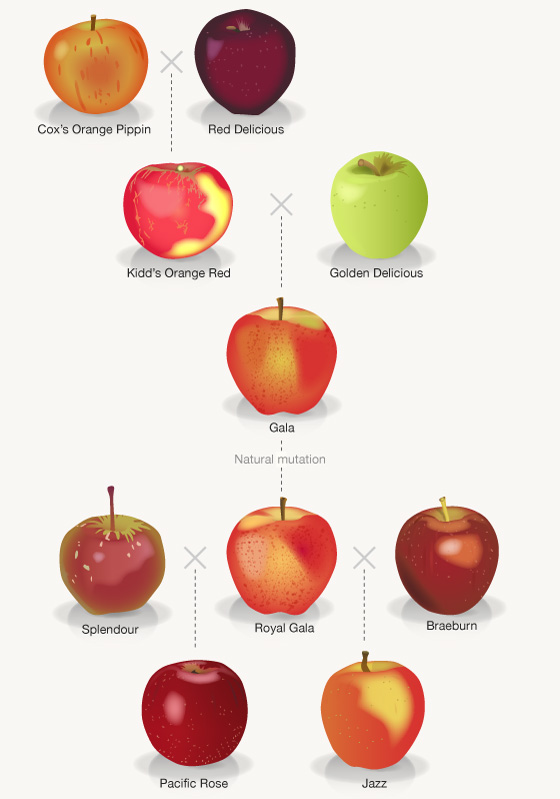
Problem is, I may be breaking some sort of law reproducing it here. The website where I found it, Te Ara, or the Encyclopedia of New Zealand, says, at the bottom of each page, that:
All text licensed under the Creative Commons Attribution-NonCommercial 3.0 New Zealand Licence unless otherwise stated. Commercial re-use may be allowed on request. All non-text content is subject to specific conditions. © Crown Copyright.
Well, I don’t really want to use the text, certainly not commercially, so that means specific conditions apply. What might they they?
This item has been provided for private study purposes (such as school projects, family and local history research) and any published reproduction (print or electronic) may infringe copyright law. It is the responsibility of the user of any material to obtain clearance from the copyright holder.
It also gives an indication of how to cite the item, which I am happy to do: Ross Galbreath. ‘Agricultural and horticultural research — Advances in plant science’, Te Ara — the Encyclopedia of New Zealand, updated 14-Nov-12 URL.
I left comments on the item on two occasions, asking for permission to use the image. No reply. I then emailed the general address provided on the About page. No reply. So, having waited a decent interval, I’m going for it. Let’s see what happens. I hope someone wanting permission to use the apple for breeding purposes finds it more straightforward than accessing the image in which it features.
Yeah. Diversity is nice, but…
I find the whole debate about Golden Rice pretty boring. Not because I don’t think the subject — GR in and of itself, and as a symbol of something bigger — is important. Rather, because I think it’s very important to have a debate, but the way this is being conducted at the moment is just not likely, it seems to me, to lead to anything more than the further entrenchment of fixed positions.
For example, if you want a good encapsulation of (one side of) the wider argument, you could do a lot worse than this, from Richard Manning in Mother Earth News:
…the industrial ag folks and the Green Revolutionaries challenge us: “Yeah. Diversity is nice, but can sustainable agriculture feed the world’s population?” And then they rig the game by defining “feed” in just the same way they define agriculture — a narrow, linear process of input, throughput, output, yield per acre, calories per bushel, calories per person.
Now that’s hip and engaging, and makes its point in accessible, pithy fashion; but look at the tone — that disdainful “yeah” — and the loaded words used — words like “rig.” A couple of days ago, even before I’d seen this article, I was sort of indirectly accused on Twitter of not caring if children go blind from Vitamin A deficiency, because I had said that the debate — if it can even be called that — had become sterile: it’s not so sterile if you have VAD, was the counter. Right. That’s the reductio ad absurdum of the sort of the tone and language of the Manning article.
So it’s very welcome to see that Michael Pollan and Pamela Ronald, poster children for the two sides of the argument, have recently engaged in what has been described as a “respectful dialogue.” Hopefully more details will emerge, and a precedent will have been set, and we can move on from the boring — there’s really no other word for it — spectacle of people talking past each other.
LATER: And here it is, all two hours of it.
Brainfood: Biological control, Mycorrhizal diversity, Trees in landscapes, Not-so-green agriculture, EU restoration, Speciation, Let them eat fruit, Grasspea diversity, Chinese pigs and goats, Cattle diversity worldwide, Hazelnut in vitro
- Development of microbial consortia as a biocontrol agent for effective management of fungal diseases in Glycine max L. Bacteria gang up to fight soya fungal pathogens. Ain’t diversity grand.
- Species richness of arbuscular mycorrhizal fungi: associations with grassland plant richness and biomass. More symbiotic fungi, more plant species and more biomass. Ain’t diversity grand.
- Trees in a deforested tropical landscape: species and trait diversity and potential ecosystem services. Even isolated exotics provide services, for all their lack of biodiversity conservation value.
- Green Light for Green Agricultural Policies? An Analysis at Regional and Global Scales. Model suggests that biodiversity targets for EU farmland lead to externalities paid for by others.
- Exploring restoration options for habitats, species and ecosystem services in the European Union. Target degraded habitats in cheap countries to meet most targets at lowest costs.
- How common is homoploid hybrid speciation? Not very. Thank heavens for the other kind.
- Explaining the ‘hungry farmer paradox’: Smallholders and fair trade cooperatives navigate seasonality and change in Nicaragua’s corn and coffee markets. Fair trade farmers still endure 3 hungry months, but having fruit trees helps.
- Drivers of plant biodiversity and ecosystem service production in home gardens across the Beijing Municipality of China. More edibles and fewer ornamentals with increasing distance from central Beijing. But probably still not enough to meet demand.
- Genetic polymorphism of fifteen microsatellite loci in Brazilian (blue-egg Caipira) chickens. Blue eggs?
- Indigenous chicken genetic resources in Kenya: their unique attributes and conservation options for improved use. And not a single blue egg in sight. Conservation through use.
- Lathyrus diversity: available resources with relevance to crop improvement – L. sativus and L. cicera as case studies. Genotyping and core collections needed.
- Genetic diversity and population structure of black Dahe pig based on DNA sequences analyses of mitochondrial and nuclear genes. Not much diversity in this Chinese pig. No word on their presence in Beijing homegardens.
- Associations between polymorphisms of the GFI1B gene and growth traits of indigenous Chinese goats. Polymorphic sites associated with growth traits. Let the molecular breeding begin. No word on whether same possible for pigs.
- Worldwide Patterns of Ancestry, Divergence, and Admixture in Domesticated Cattle. Cattle came into Europe in at least 2 waves, one from the Middle East, one from W Africa via Spain. The Asian breeds are something else again, and were involved in only the former of those waves.
- Effect of coconut water and growth regulator supplements on in vitro propagation of Corylus avellana L. One fruit helps conservation of another.
Quinoa backlash backlash recap recap
Let’s recap. First, the Quinoa Boom on the Bolivian Altiplano was A Good Thing. A backlash was, in retrospect, inevitable. Soon enough, it was A Bad Thing. Then, slowly, sense prevailed, and we were all, like, We Need More Data. Most recently, we’ve had It’s Complicated.
So it’s interesting, don’t you think, that Alternet, which sort of started the backlash in the first place, has just published a piece which includes this summary:
…American accounts of the story “either fall on the side of ‘the quinoa boom is amazing and it’s lifting people out of poverty’ or ‘the quinoa boom is terrible and is destroying people’s lives,’ and in both of those narratives the indigenous people are given no agency…”
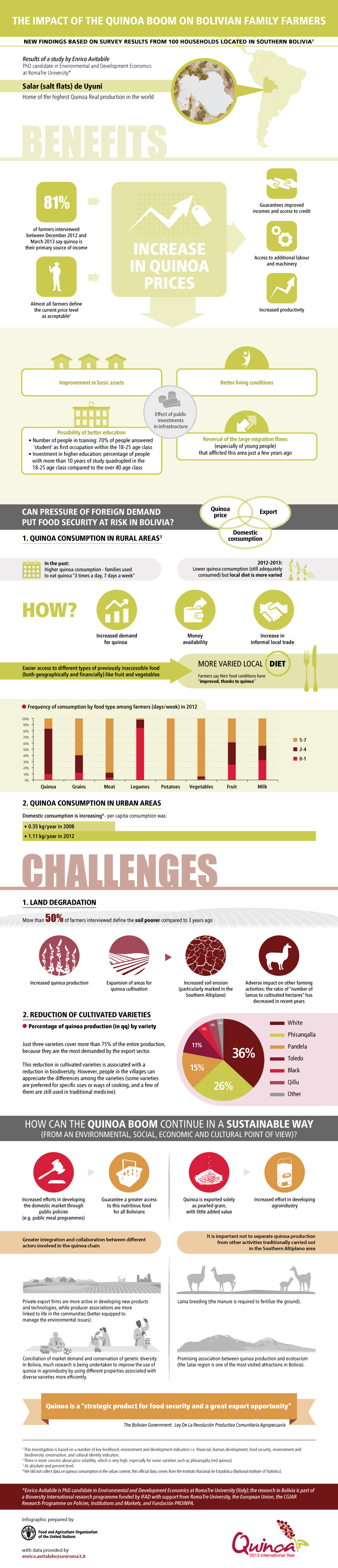 And is it just a coincidence that FAO has also just published online an infographic on The impact of the Quinoa boom on Bolivian family farmers? It not only identifies the challenges, but suggests some solutions as well. But you’ll have to click on it here on the left to see all that.
Meanwhile, though…
The most recent Farm Bill was an excellent opportunity for quinoa to gain both broader recognition and government payments. After all, temperate japonica rice, used in sushi, made the list of government supported commodities. Perhaps quinoa is next.
That would be in the US. Agency indeed.