- “Fifteen to twenty percent of the world’s food is produced through urban farming, involving an estimated 800 million people.”
- We shaped yeasts as much as they shaped us. Now to sort out their nomenclature, along with the rest of the benighted fungal kingdom.
- Cheese is just one way yeasts shaped us. What kind of cheese can you make from Ankole milk, I wonder.
- Sean Myles tells us how his lab “makes food better.”
- Tan Sonstegard of USDA tells us how ADAPTMap can make goats better. Skip to 2 mins in, if you want to avoid adorable footage of cute (human) kids. I love a nice bit of goat cheese.
- Can the private sector help combat hunger and malnutrition? Gee, I dunno, do tell me.
- Vietnamese chocolate comes of age. Someone mention the private sector?
- Gene jockeys take over world. World surrenders.
- What did the Elizabethans ever do for us? Well, they grew funky vegetables for one thing.
- Both Colas sign up to FAO guidelines that “protect the rights of poor and vulnerable people to land, livelihoods and food security.” But is it all marketing?
- The Lugar Center has a bunch of bibliographic resources for researchers.
- Biofuels? Bah, humbug.
- Jorge Dubcovsky, a professor of plant sciences at the University of California–Davis, snags another award.
- “Are you all converts to the cause of backyard potato breeding?” Do tell. And so we come full circle.
Historical crop videos online
Alerted by a tweet from Pat Heslop-Harrison, I delved into British Pathé’s new Youtube archive of 85,000 historical films. The following little gem turned up when I searched for wheat.
I shared it with my go-to guy on wheat genetic resources, and he had this to say:
Multi-branched spikes have been investigated by a number of researchers (including Cal Qualset from whom we have germplasm he developed). It’s interesting to see farmers harvesting a variety with the trait. It seems an obvious way to increase yield (make the wheat spike into a sorghum-like inflorescence) but results have not been as encouraging as the morphology suggests.
Have fun searching for your favourite crops.
My happy liver I cover with a garment fit for a queen
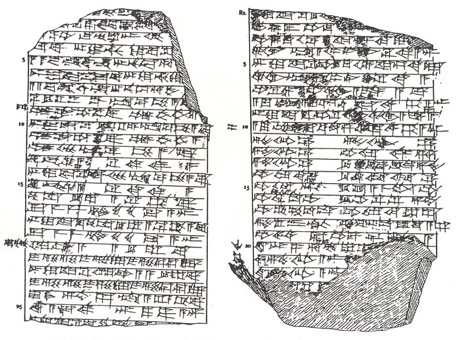 Since we’re on the subject of agricultural biodiversity and poetry, let’s also deal with that Sumerian ode to beer that featured in another article I linked to recently. It’s called the “Hymn to Ninkasi,” and it was found on a 19th century BC cuneiform tablet. Ninkasi means “lady who fills the mouth,” and was, aptly enough, the goddess of brewing. I found a longer version of the poem online, along with a recipe for the beer it describes, a “light, unhopped, unfiltered barley beer.” There’s some really detailed scholarship on Sumerian beer out there. What I don’t quite understand is why this stanza
While I circle around the abundance of beer,
While I feel wonderful, I feel wonderful,
Drinking beer, in a blissful mood,
Drinking liquor, feeling exhilarated,
With joy in the heart [and] a happy liver—
While my heart full of joy,
[And] [my] happy liver I cover with a
garment fit for a queen!…
which is rather fun, is found in some sources but not in others. Some disagreement among Sumerian poetry experts? I’d like to think so.
Incidentally, there’s a thing called the Pennsylvania Sumerian Dictionary Project which has come up with an entirely horrible but endlessly intriguing online resource. It took me like an hour, but I finally figured out what I think is the Old Akkadian cuneiform for Ninkasi.

You’re welcome.
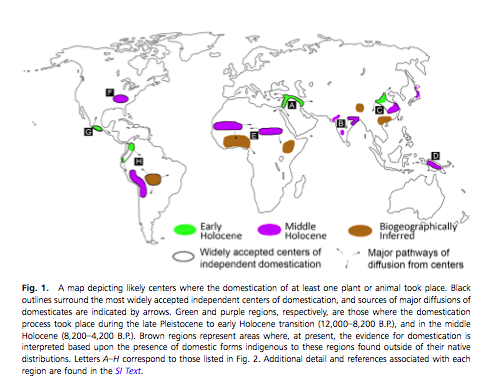
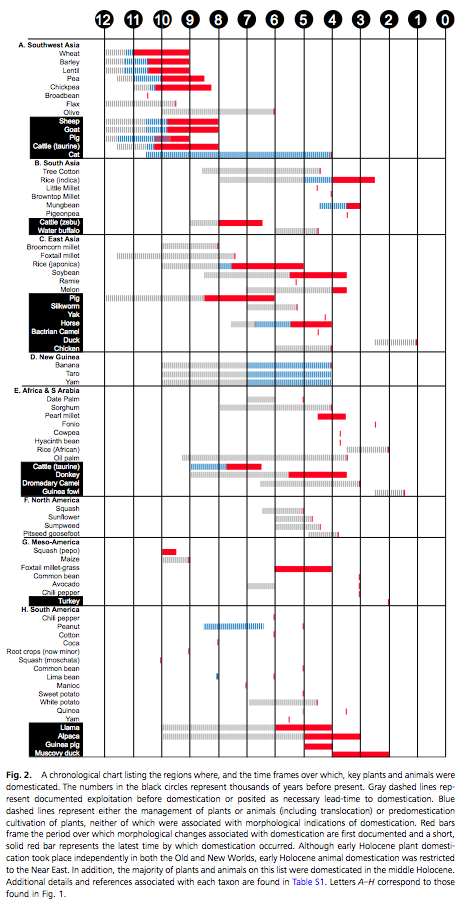
The latest thinking on domestication illustrated
I’m still ploughing through the PNAS special feature on domestication, 1 but I just thought I’d share what are in many ways the money figures. They come from the overview article, and they show the about 20 or so accepted and probable centres of domestication:
And a timeline for selected domesticates:
Nibbles: Rural income sources, Medicinal trees, Saffron, Biofuel trees, Trout genome, Maize & drugs in Mexico, Bee-keeping, Urban ag, Food security, Jackfruit, SDG2015
- Natural areas just as important for rural incomes as crops.
- Because of things like medicinal plants, among others.
- Not if the crop was saffron, though. Or multi-purpose biofuels?
- Trout gets the genome treatment. I prefer it grilled with a little butter and parsley.
- High maize prices good for one thing. Wanna guess?
- Guerrilla bee-keepers in the Rust Belt.
- Maybe they’ll be discussed in tomorrow’s tweetathon: Urban Food Security +SocialGood.
- Brussels sprouts too, maybe: it’s urban agriculture, Jim, but not as we know it.
- Another view on NatGeo’s five steps to food security. (Here’s Luigi’s.)
- The key thing NatGeo left out: jackfruit.
- Well, that, and multi-stakeholder partnerships. Of course.