- Jonathan Foley, @GlobalEcoGuy, lands well deserved award for his straight-talking on food issues.
- I wonder what he’d say about C4 rice.
- Not sure he’s ever written about fish, but he probably will.
- Sustainable harvesting of Prunus africana maybe not so sustainable after all. Well, I guess that’s science.
- Encomium to the recently-deceased “Father of Sorghum.”
- Shame he missed the round-up on improving abiotic stress tolerance in crops, linked to by AoB Blog.
- Wouldn’t it have been cool if the Father of Sorghum had met the Peanut Man?
- Global production of 10 top commodities has increased 130% since 1960, population by 89%. Draw your own conclusions about world hunger and malnutrition.
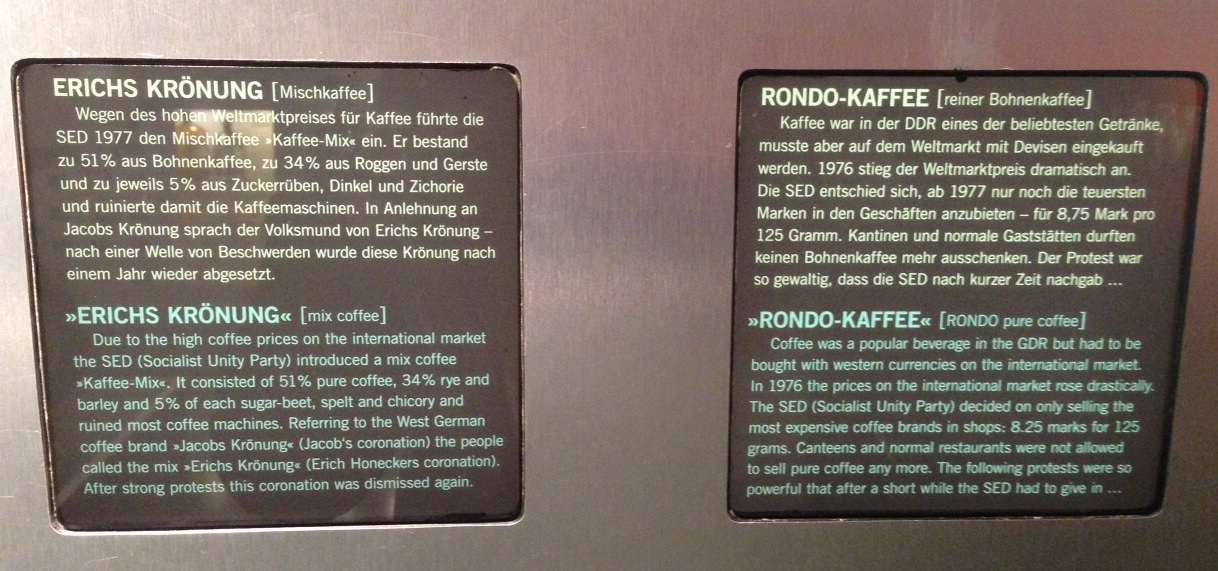
The truth about the DDR’s coffee
Many thanks to my colleague Amanda Dobson for this photo (click to embiggen) from the DDR Museum in Berlin. Sometimes one prefers a little less agricultural biodiversity in one’s food — and beverages — doesn’t one?
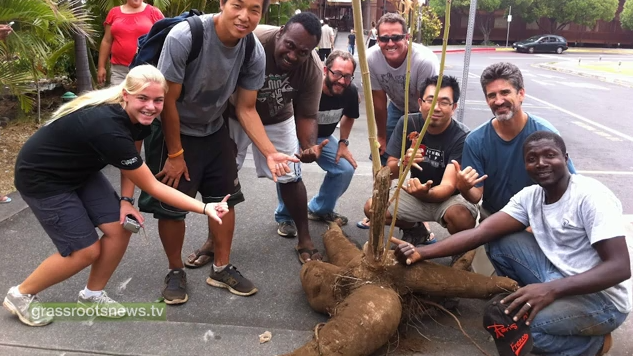
A cassava for the ages in Hawaii
Probably the biggest cassava you’ve ever seen, weighing in at about 80 kg. No word on what variety it is, alas, nor how long it was in the ground for.
Featured: Potato taxonomy
Roel Hoekstra reacts to our suggestion that CGN may want to consider changing the taxonomic determination of a potato accession in its genebank:
In general gene banks should be conservative in renaming accessions and not follow the latest publication, unless there is a clear misclassification … The suggestion on this Weblog, that CGN should rename accessions CGN18108 (from ARG) into S. venturii should probably include all okadae’s from ARG. However, taxonomy is a sensitive issue. So far, CGN was reluctant to rename okadae accessions, in particular as long as Sturgeon Bay does not rename them. Too much renaming may confuse/annoy the users of the germplasm. The discussion on this Weblog at least triggers to take a look into the available data again. Personally, I would not be surprised to once find these two species reunited again.
That ellipsis stands for a pretty lucid summary of the nomenclatural history of the two species involved, very much worth reading in full. Thoughts?
Nibbles: Plant Guardians, Peruvian Solanum, Sunflower genomics, California drought, Brazil drought, Sri Lankan tea, Minnesota wine, Seed of Hope, Sugarcane engineering, King Cotton, Rubber boom
- Do you want to be a Plant Guardian?
- Some people are already getting busy guarding Solanum in Peru.
- The sunflower family gets a molecular makeover.
- What the California drought means for food.
- And the one in Brazil for coffee.
- And tea in Sri Lanka is also in trouble, though for once drought is not to blame.
- Minnesota has a wine industry thanks to wild relatives. But I won’t hold that against them.
- In today’s Seeds of X story, X=hope and the place is Aceh.
- If sugarcane was a cold-tolerant oil-producing crop, would it still be sugarcane?
- Cotton has a lot to answer for. Or rather, the people who grew it do. Or did. Oh crap.
- Rubber too. Though not as much. I guess. Oh crap.