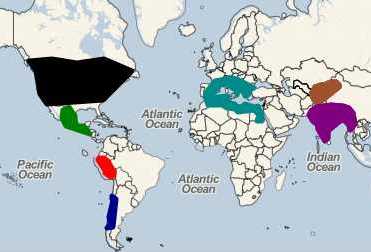
- Asian Germplasm in American Horticulture: New Thoughts on an Old Theme. The tap has sort of run dry.
- Identification of salt resistant wild relatives of mungbean (Vigna radiata (L.) Wilczek). From 22 accessions of 7 species to 2 accessions of 2 species. Now for the hard part.
- Available germplasm of the potential rubber crop belongs to a poor rubber producer, (Compositae–Crepidinae).
Cultivation of the Russian dandelion (Taraxacum koksaghyz) was no such thing, but taxonomy has the answer. - Biofortification strategies to increase grain zinc and iron concentrations in wheat. Not just about the breeding.
- Diversity Captured in the USDA-ARS National Plant Germplasm System Apple Core Collection. Apple core? Seriously.
- Genes for resistance to powdery mildew in European winter barley cultivars registered in the Czech Republic and Slovakia to 2010. There’s quite a few of them, some of them previously unknown. Oh those jammy breeders. And beer drinkers.
- Genetic diversity in local cultivars of garden pea (Pisum sativum L.) conserved ‘on farm’ and in historical collections. Little connection between historical and current material, and genetic erosion both in genebanks and on farms.
- Dairy systems in mountainous areas: Farm animal biodiversity, milk production and destination, and land use. The traditional, low-input systems are best for sustainability and biodiversity, but have low productivity, but geographic appellations for cheeses can make up for that.
- The contribution of the EU Common Agricultural Policy to protecting biodiversity and global climate in Europe. Is, ahem, limited.
- Can Big Push Interventions Take Small-Scale Farmers out of Poverty? Insights from the Sauri Millennium Village in Kenya. Greater productivity (due to seeds and fertilizers) compared to nearby villages does not translate into higher incomes. Well that’s awkward.
Nibbles: Dog fight, Deforestation maps, CWR maps, Food fight, Limpopo, Maize uses, CC adaptation breeding, Global Tree Campaign, Intensification & deforestation, American ginseng, Fish & crop yields, Fish oils, Perennially watching annual grains
- A third take on dog origins. Lock them all up in a small room and don’t let them out until they figure out a way to solve this. And more.
- Great new maps of deforestation. Same as the old maps? I’m confused.
- Ah, to be able to mash them up with crop wild relatives gap-maps! Or others, for that matter…
- Clear, balanced take on how to fix the food system. (And a great potted summary of why it is necessary to do so by the sainted Lawrence Haddad. The interviewer is not bad either.) Except maybe for the bit which sort of implies that the only way to improve crops is via GM. And for the other side…
- Bioversity comes up with a strategy for community seed banks in Limpopo and other areas of South Africa. Coincidentally, another CGIAR report on the same region, looking at wider food security issues. I wonder if the two could/should be mashed up? But really my main reason for linking to the second thing is to see how many people read the title as a plea for a return to old-fashioned cartography, as I did.
- Dual-purpose maize, shmaize. I just love that building.
- Latin American consortium looking for potatoes and wheat varieties adapted to new climatic conditions. Amazing that it is news, in a way.
- Global Tree Campaign launches new website. Sill no RSS feed though, that I can see. LATER: Here’s the feed, sorry to the GTC!
- Speaking of trees… Will agricultural intensification save tropical forests? Well, maybe. Demand elasticity comes into it, apparently. Dismal science indeed. I suppose those maps above come in useful for this kind of thing?
- In other news, the Middle Tennessee State University has a ginseng initiative.
- Teach a woman to aquaculture, improve her crop yields. No wait: Fish? We don’t need no stinking fish.
- 10 Ancient Grains to Watch. The usual suspects. This was pretty boring even when it was news.
Nibbles: Chocolate industry, Perennial grains, Digestibility gene, Potato in Africa, Maps
- Big chocolate to get bigger. What will it do to diversity?
- Gates Foundation funds perennial grains for Africa.
- Including sorghum, the perennial version of which may or may not include the latest magic bullet gene.
- Not including potato, though, which is also, however, being pushed in Africa.
- Great old maps of agricultural origins.
- And on the same subject, I can never resist etymology maps, especially of agrobiodiversity words.
Brainfood: Mixtures and productivity, Pesticides and soil biota, Andean intensification, Turkish barley, Tomato size gene, Quinoa and environment, Banana improvement, Hybrid conservation, Allozymes
- Changes in the Abundance of Grassland Species in Monocultures versus Mixtures and Their Relation to Biodiversity Effects. Monocultures are ok for productivity, but only initially.
- Agricultural soils, pesticides and microbial diversity. mRNA and high-throughput sequencing show that pesticides affect nitrification rates and soil microbe community structure. Brave new world indeed.
- Making Sense of Agrobiodiversity, Diet, and Intensification of Smallholder Family Farming in the Highland Andes of Ecuador. Want sustainable intensification? Look at the smaller enterprises.
- Genetic variation of barley germplasm from Turkey assessed by chloroplast microsatellite markers. Little genetic similarity between wild relative and landraces in same geographic area.
- A cytochrome P450 regulates a domestication trait in cultivated tomato. Single polymorphism controls fruit size.
- Blossoming Treasures of Biodiversiy. 42. Quinoa – is the United Nations’ featured crop of 2013 bad for biodiversity? It can be.
- From crossbreeding to biotechnology-facilitated improvement of banana and plantain. Quite some progress, despite few breeding programmes. Will it all go GE? Big temptation. I would have made more of the genebank collections, personally.
- Perspectives on the conservation of wild hybrids. There’s more to it than science. Tell that to the banana breeders.
- Revisiting protein heterozygosity in plants — nucleotide diversity in allozyme coding genes of conifer Pinus sylvestris. Those pre-DNA days weren’t a complete waste of time. That mean we can measure genetic erosion?
All you ever wanted to know about seed
A seed bank plans to store a barley seed lot as an active collection at 5°C. The initial viability is 99.5% and the collection has been dried to 10% moisture content. When will viability have fallen to the regeneration standard of 85%?
That comes from a little set of exercises that staff of Kew’s Millennium Seed Bank use on the training courses on seed handling and conservation that they frequently organize around the world. Time was when you had to slog through the maths to answer that question by hand. Want to try? Here’s the equation, go for it:
Nowadays, of course, there’s an app for that. Or at least a website, SID, Kew’s Seed Information Database. 1 Just click on Predict storage time, select Hordeum vulgare, enter storage temperature, equilibrium moisture content, initial viability and final viability, and click Calculate. Hopefully you got about 18 years. Easy, no?
Ok, smartypants, so now try this.
You are a forest extension officer working with communities in Burkina Faso to collect and plant Khaya senegalensis, a multipurpose tree species, with a seed oil content of 67%. Seeds are shed during the month of May at an eRH of around 50%. Average climatic conditions in the afternoon in May are 38°C and 40%RH. You use ambient drying during the afternoon to reduce eRH to 40% and then store seeds at ambient temperature (12 month average: 29°C) in large plastic drums. An initial germination test shows that viability is 99%. What will the viability be after 12 months storage under these conditions?