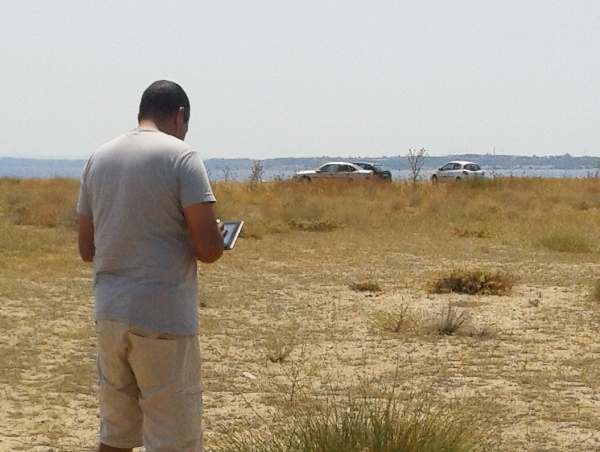
 More from the IT geeks at ICARDA. We’ve heard that they’ve been testing out, for the second field season now, and very successfully, a germplasm collecting form app on a tablet equipped with a 3G SIM from a local (European country) provider. This replaced the conventional collecting expedition complement of GPS, altimeter, camera and stack of paper collecting forms, laboriously filled in pencil. It also provided additional services, such as a taxonomic spell-checker (based on the GRIN-Taxonomy database). And it can be used as a navigation device too, comparing your location from the built-in GPS with the latitude and longitude of historical collecting sites to give you directions, via Google Maps. We look forward to a more official update from our ICARDA friends in due course. By chance, we also heard today about another plant genetic resources app, this time to record phenotypes. I’m sure there’s more out there. Let us know if you come across one that you like.
Brainfood: Leafy greens, Korean rice, Molecular breeding, Poultry conservation, Tree genomes, Pathogen genetics, Grazers and CC, Sustainable rangelands, Available land, Ecosystem services
- Analysis of urban consumers’ willingness to pay a premium for African Leafy Vegetables (ALVs) in Kenya: a case of Eldoret Town. An 80% premium! But in Eldoret. And Nairobi?
- Analysis and comparison of the γ-oryzanol content based on phylogenetic groups in Korean landraces of rice (Oryza sativa L.). Some groups are browner than others.
- What is the SMARTest way to breed plants and increase agrobiodiversity? Just another name for MAS. But some crops are SMARTer than others.
- Conservation of local Turkish and Italian chicken breeds: a case study. Turks can learn from Italians. And probably vice versa, I bet, although that’s not explored as much here.
- Open access to tree genomes: the path to a better forest. Hard to argue with. The open access bit more than the genomes bit.
- Evolution, selection and isolation: a genomic view of speciation in fungal plant pathogens. Know your enemy. Easier to figure out how new species become different than how they stay that way.
- Long-Term Climate Sensitivity of Grazer Performance: A Cross-Site Study. Hotter conditions means poorer forage quality means smaller bison. And maybe cattle. All other things being equal, like genetics, and range management. Which of course they never are.
- Ecosystem function enhanced by combining four functional types of plant species in intensively managed grassland mixtures: a 3-year continental-scale field experiment. See what I mean? And more.
- Estimating the world’s potentially available cropland using a bottom-up approach. Less than you’d think.
- Spatial interactions among ecosystem services in an urbanizing agricultural watershed. Very very limited places provide multiple services, especially crop production and water quality, which means you need to protect huge areas. But they’ll be mosaics.
Nibbles: Urban agriculture edition
- Urban Agriculture Edition. New Orleans, with a twist.
- Tokyo.
- Los Angeles.
- By design.
- Sydney.
- Detroit.
- Vintage.
- Very early.
- Not.
Quinoa and other Andean grains get their chance
The Fourth World Congress on Quinoa and the First International Symposium on Andean Grains are happening next week, 8-12 July 2013, in Quito, Ecuador. Our friends from Bioversity will be there in force. Not sure what the plans are for social networking during the proceedings, but if you’re going to be there, and would like to send us daily summaries, or thoughts on a point that grabbed your attention, or an occasional impression or observation, you’d be most welcome.
Nibbles: Sustainable aquaculture, Mekong fish project, Peruvian anchovetas, Ugandan fishing standards, Bangladesh fish celebrations, Beef vs fish, FAO on GIS
- Sustainable fish farming in Spain. With video goodness.
- A project to estimate the value of Mekong fish.
- Eating fish, rather than feeding them to pigs, to conserve them in Peru. The fish, not the pigs. And more on the same fish, but another place. I think it’s the same fish anyway.
- Codex Alimentarius standards are important even to Ugandan artisanal fisherfolk. Also with video goodness.
- It’s National Fish Week in Bangladesh.
- “So should we mourn that the cow is overtaken by the fish?”
- Fish need GIS too.