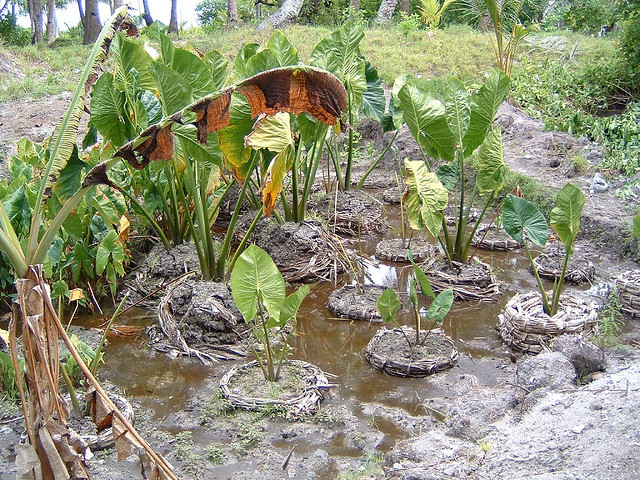
 Great to see my old friends at CePaCT, the Centre for Pacific Crops and Trees, get their data online. You remember them, don’t you? They were mentioned in a recent Featured Comment. Not quite sure how long the data’s been up, actually. Maybe quite a while, and I just missed it. Anyway, good to see it. Not least because it gives me a chance to also plug the Directory of plant genetic resources collections in the Pacific, which provides kind of metadata on CePaCT’s collections along with many others in the region. You can download the (big) PDF from the SPC Land Resources Division website, where you can also browse the accession-level data.
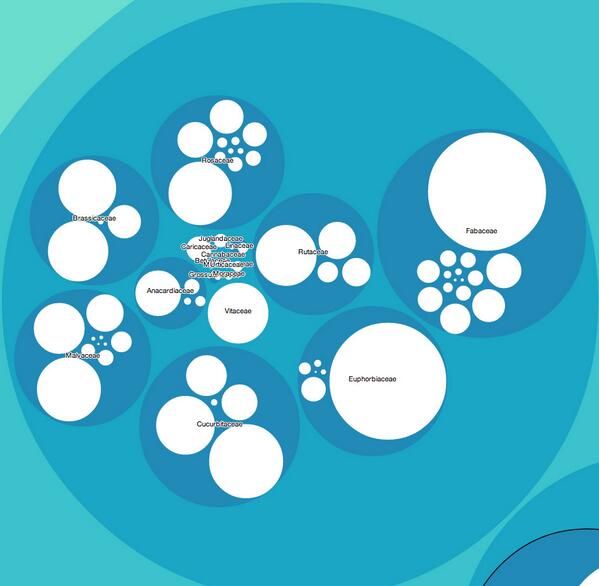
Infographic on crop production, by family no less
A tweet from Dan Chitwood of the Donald Danforth Plant Science Center really made my day today. He’s written a piece of code which shows production of different crops in 2011 (according to FAOStat) as a very cool infographic where the crops are differently sized circles arranged by botanical family. Here’s a screengrab, but go to the website, and click on a circle and see what happens. I so long to do this for genebank accession numbers…
Nibbles: Water buffalo, Beans, Rhizowen, Fisheries, Frankincence, Gender and gender, US CWR, Cropland, Forests and food security
- Today’s genome of passing interest, the water buffalo, less than two years after it was promised.
- Saluting the true amateurs, on bean and tuberous diversity.
- Unconsidered benefits of capture fisheries — except for the captured fish, I suppose.
- Eleven months early, AoBblog links to a new paper on how to best to tap frankincense.
- Not to be outdone, Modern Farmer relates how maple syrup could be industrialised as a row crop. H/t Metafilter.
- An e-learning course on Gender in Agriculture.
- Which is unlikely to please Ed Carr, author of Gender and adaptation: Time to do it differently.
- US inventories its crop wild relatives.
- Demand for cropland will increase.
- Which is bad for forests, which are good for food security, but not as much as they could be.
Nibbles: Vietnam ag, Sacred places, GWAS sarcasm, Eating insects, IDS course, Jungle fever, Poverty lecture
- Agriculture in Vietnam: rice down, coffee up. I wonder if the two may be related?
- Interactive online atlas of sacred lands.
- The Allium takes a pot shot at the gene jockeys.
- “It’s all about convincing people to take the first bite.” Oh, and the second.
- But will insects feature in this professional short course on nutrition from IDS?
- SE Asian rainforest as managed as the Amazon?
- Prof. Sen’s poverty lecture at LSE.
Brainfood: Domestication syndrome, Açaí cultivation, FIGS galore, Bean FIGS, Polish wheat, Rice groups, Chickpea QTLs, Cuban ag history, Agroforestry domestication, Conservation markets
- Plant domestication versus crop evolution: a conceptual framework for cereals and grain legumes. Only traits showing clear dimorphism between wild and cultivated taxa are really part of Domestication Syndrome. If there’s a continuum, it happened afterwards.
- Reconfiguring Agrobiodiversity in the Amazon Estuary: Market Integration, the Açaí Trade and Smallholders’ Management Practices in Amapá, Brazil. Açaí driving out other crops. Sometimes those underutilized crops should stay that way? Maybe not, as at the same time, homegardens are diversifying.
- Mining germplasm banks for photosynthetic improvement — wheat, rice, potato, legumes and maize. You need maps.
- Do faba bean (Vicia faba L.) accessions from environments with contrasting seasonal moisture availabilities differ in stomatal characteristics and related traits? Yes. Those maps again.
- Can Polish wheat (Triticum polonicum L.) be an interesting gene source for breeding wheat cultivars with increased resistance to Fusarium head blight? What do you think?
- Genetic diversity and classification of Oryza sativa with emphasis on Chinese rice germplasm. Six major groups, not five. We shall see.
- Genetic dissection of drought tolerance in chickpea (Cicer arietinum L.). It could all (or mostly) be down to one genomic region.
- Historical changes in the process of agricultural development in Cuba. I suppose one could say that, in a way, it’s back to the future.
- Developing more productive African agroforestry systems and improving food and nutritional security through tree domestication. Participation, post-production, private-public partnership.
- Market-based mechanisms for biodiversity conservation: a review of existing schemes and an outline for a global mechanism. Need to have a standard unit of measurement, and a mechanism for ensuring a long-term perspective. Can agricultural biodiversity learn from this?