Just a quick note to say that the Map of Life, which we blogged about a year back, now covers plants too. Still a bit weak in the sharing department, after a quick glance, but I’ll reserve final judgement until I’ve had more of a chance to play with it.
Brainfood: Grass evolution, Great Lakes fisheries, African cassava, Sustainable UK farms, USA biodiversity loss, PVS, Agriculture to the rescue
- Evidence for recent evolution of cold tolerance in grasses suggests current distribution is not limited by (low) temperature. Geography a better predictor of cold tolerance than phylogeny.
- May we eat biodiversity? How to solve the impasse of conservation and exploitation of biodiversity and fishery resources. We may, if we all agree.
- Genetic diversity of cassava (Manihot esculenta Crantz) landraces and cultivars from southern, eastern and central Africa. There isn’t any.
- Evidence of sustainable intensification among British farms. Amazingly, there is some, and aiming to increase profitability can get you there.
- Key areas for conserving United States’ biodiversity likely threatened by future land use change. To the tune of 5-8% area loss, and not counting climate change. Would be interesting to know what that will do to crop wild relatives.
- Dilemma in participatory selection of varieties. If it’s a one-time deal, as it often is, it ain’t gonna work.
- Green Revolution research saved an estimated 18 to 27 million hectares from being brought into agricultural production. And saved 2 million ha of forest. But less than Borlaug thought. More on “Agricultural innovation to save the environment” from PNAS.
Conserving forages for 30 years
That’s what the genebank at ILRI has been doing. Under the stewardship first of Jean Hanson and then Alexandra Jorge, both of whom you can see in the photo reproduced below from ILRI’s Flickr stream. Jean is the one on the right. Happy birthday, and keep up the good work!
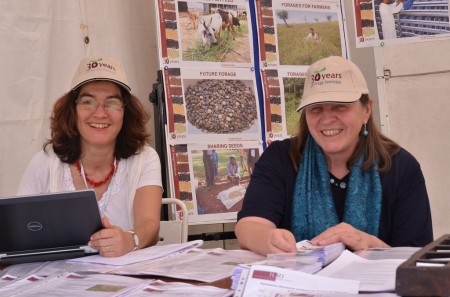
(photo credit: ILRI\Zerihun Sewunet)
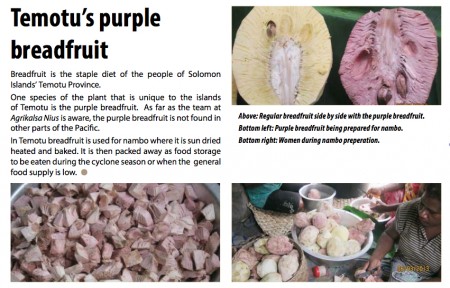
The purple breadfruit of Tamotu
I really hope the Ministry of Agriculture and Livestock of the Solomon Islands won’t mind me reproducing this snippet on a cool breadfruit variety from the province of Temotu, courtesy of the April issue of their monthly electronic newsletter, Agrikalsa Nius. 1
Brainfood: Urban German grassland, Urban Flemish gardens, Totally wild beans, Inter-specific Vigna crosses, Vietnamese cattle, Sustainable intensification, Gender, Oak seeds
- Urban land use types contribute to grassland conservation: The example of Berlin. And perhaps also to CWR conservation?
- Garden management and soil fertility in Flemish domestic gardens. Little about their diversity, though, alas.
- Drought Tolerance in Wild Plant Populations: The Case of Common Beans (Phaseolus vulgaris L.). Greater ecological amplitude than the domesticate.
- Introgression of productivity and other desirable traits from ricebean (Vigna umbellata) into black gram (Vigna mungo). It ain’t easy, but may be worth the effort.
- Assessment of genetic diversity and population structure of Vietnamese indigenous cattle populations by microsatellites. Some traditionally recognized breeds are close enough genetically to be conserved as a group.
- Ecogeographic survey and gap analysis of Lathyrus L. species. Only 6 of 36 species are adequately represented in genebanks.
- To close the yield-gap while saving biodiversity will require multiple locally relevant strategies. Location, location, location.
- Co-evolution of landscape patterns and agricultural intensification: An example of dairy farming in a traditional Dutch landscape. And here’s an example.
- Gender and Agricultural Innovation in Peasant Production of Native Potatoes in the Central Andes of Peru. And I suppose this is another, in a way.
- Ecological significance of seed desiccation sensitivity in Quercus ilex. Drying causes mortality. Could be used to predict response to climate change. In other news, oak seeds are recalcitrant.