The True-Cost Accounting in Food & Farming conference is wrapping up today. There are plenty of videos on the Sustainable Food Trust website. And of course there’s a hashtag, #TCAConf, if you want to follow live. You just missed Jules Pretty, for example. Are any of our readers there, I wonder?
Nibbles: de Schutter’s solution, CIAT’s diversification, Land Institute’s video, WRI’s infographics,
- One (admittedly fairly big) thing to do to fix the food system.
- Two-faced fique.
- 14 minutes — count them — on the Land Institute’s work on perennial cereals. Well worth it.
- 18 graphics to explain the food system. You know, the one that needs fixing.
Name the biodiversity product
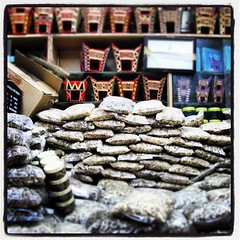
For sale in Muttrah souk, Muscat, Oman.
Nibbles: Homegardens, Ancient grains, Homeless hens, Data data data, New maize, ICRISAT ambassadors, Wine microbes, India, Soil Day
- Emma Cooper blogs her ethnobotanical MSc dissertation on British homegardeners and their cool crops.
- If she’d done her work in Sweden, she’d have written about Ragnar Pettersson and his “treasure of Ardre.”
- The downside of backyard farming: homeless hens.
- International e-Conference on Germplasm Data Interoperability: Genebank Database Hell gets an e-conference. What could possibly go wrong.
- Apparently there’s a new way to search for agricultural bibliografic (sic) data.
- CIMMYT gets its maize out there.
- ICRISAT is not one to hide its light under a bushel either.
- Aussies to survey their yeasts and bacteria to improve winemaking.
- The problems of India: “It takes a particular brand of incompetence and neglect for decades of stellar growth to have no apparent impact on India’s sky-high levels of under-nutrition.” I bet Dreze and Sen didn’t include a food bubble. Hey, but that can be exported.
- Oh and happy World Soil Day! Thanks to it, and Jim Croft, I now know Australia has a sort of soil genebank.
The Queen’s mulberries
That would be the British Queen. And yes, she has mulberry trees. A collection of them, believe it or not. On the grounds of Buckingham Palace, no less. Thanks to Sophie Leguil for pointing me to the story, which is absolutely fascinating, and which you can read in full on the Official Website of the British Monarchy.
Putting white gloves on to examine the precious book on the Queen's National Collection of Mulberries @Buck_Palace pic.twitter.com/VQPZomyRWv
— Sophie Leguil (@SLeguil) December 3, 2013
Here’s how the story starts, just to whet your appetite:
In 1608 King James I had a Mulberry Garden planted on an area of approximately 17,500 square yards to the north of the present Palace in an attempt to foster the cultivation of silk worms, which had been successful on the continent.
And here’s how it ends:
The collection was awarded provisional National Collection status in October 2002 and granted Full Status in August 2005. Most of the collection is housed at Buckingham Palace whilst a few are held at Kensington Palace and Marlborough House. The mirror collection at the Royal Gardens, Windsor is performing well with good growth all round.
…
The number of taxa planted in the various gardens is now 35, made up of 9 species (inc. subspecies) and 24 cultivars. The new accession this year has been Morus mongolica received from John Fielding. All plants in the collection are currently labelled distinctly with the Plant Heritage logo to identify the individual specimens in the collection.
But really the fun bit is in between, so do read the whole thing. So many questions arise. Do I write to the HM The Queen if I want seeds, or a cutting? Is she the one to sign the MTA? What descriptors does she use, and are the data online? Does Prince Charles insist on organic management of the trees, and on selling the produce at exorbitant prices? And why is her collections not in WIEWS?