- Summary of that 14th Session of the CGRFA we were all following last week.
- Conferences on “Changes in alpine and arctic flora under climate change” we’ll all be following in September. If you’re from Balkans, Caucasus, Central Asia, the organizers need you in particular. But hurry, before it’s too late!
- In other news, young scientists are into beer.
- India’s Directorate of Sorghum Research gets a genebank. Relationship with NBPGR unclear.
- Media portrayals of pastoralists in Kenya, China and India: The Report. The Brief. The Press Release. ILRI reaction?
- Neglected crops get the genomic treatment. And why that might be a good thing.
- CIAT wades in on quinoa.
- Call for information on Physalis peruviana cultivation in Europe.
- Biodiversity databases have errors! Shock! Horror! Probe!
- The nutritional difference between organic and conventional tomatoes deconstructed.
- Your maple sugaring questions answered. Nice idea.
- Double crop for development. I guess that’s the sustainable intensification everyone is talking so much about.
- If in doubt, clone it!
- Wait, wait, wait, we missed Earth Day?
- And also a bunch of UK plant science conferences. (I had of course linked to the storifications here originally, but they’ve gone now of course.)
Genebanks in the UK
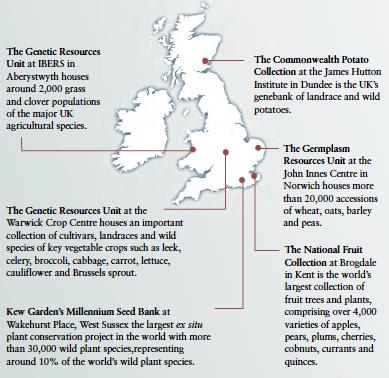 The latest issue of Plant Breeding Matters, the organ of the British Society of Plant Breeders, focuses on genebanks around the UK. In particular, the ones at the John Innes Centre and Kew, but the accompanying map hints at further treasures. We have mentioned a couple of these other genebanks before (Brogdale, Warwick), more often than not, alas, to report on their precarious state. But maybe things are changing.
Brainfood: Viruses, Allium genomic size, Acacia adaptation, Local carp, Chinese onions, Bull genetic info, Ecosystem services, Sahelian ag
- New threats to endangered Cook’s scurvy grass (Lepidium oleraceum; Brassicaceae): introduced crop viruses and the extent of their spread. Introduced crop virus threatens endemic.
- Role of adaptive and non-adaptive mechanisms forming complex patterns of genome size variation in six cytotypes of polyploid Allium oleraceum (Amaryllidaceae) on a continental scale. It’s not the environment.
- Evolution and ecology meet molecular genetics: adaptive phenotypic plasticity in two isolated Negev desert populations of Acacia raddiana at either end of a rainfall gradient. It’s the environment.
- Using biodiversity to valorise local food products: the case of fish ponds in a cultural landscape, their biodiversity, and carp production. It could work, if only people liked to eat carp and knew what biodiversity was.
- Phenotype and genetic diversity in potato onion cultivars from three provinces of northeast China. In other news, there’s something called a potato onion. Otherwise, this is actually a deeply boring paper.
- The value of genetic information to livestock buyers: a combined revealed, stated preference approach. Low to none, for now.
- Ecosystem Services. Latest issue includes a bunch of interesting reviews, and an editorial summarizing each in like a paragraph. Great service, great value. See what I did there?
- Scientific documentation of crop land changes in the Sahel: A half empty box of knowledge to support policy? There is no data, not really.
Nibbles: Vietnamese rice, Intensified rice, Photographed rice, No rice, Rice and beans, Ecosystem services
- Vietnamese rice varieties get sequenced. What will IRRI think?
- Well, they may be too busy cosying up to SRI to respond.
- A rice farmer does feature in a nice Christensen Fund slideshow.
- But no rice in these 12th century recipes.
- You know what goes well with rice? Beans, that’s what.
- And now, for something completely different: Ecosystem Service Valuation Toolkit.
Genebank standards no longer draft
The 14th Session of the FAO Commission on Genetic Resources for Food and Agriculture, taking place in Rome all week, has just adopted a new version of the Genebank Standards, two years in the making. Which we hope will be of more than merely theoretical interest to the Greek delegation.