- All nice and rested, we are resolutely back. With the peaceful gardens of Pompeii and Herculaneum.
- With the very different lifeways of the Gwich’in.
- With Cassandra Quave and her quest for medicinal plants. Not among the Gwich’in, alas.
- With Jacob van Etten and his quest for crowdsourcing. Also not among the Gwich’in, who can’t buy a break, it seems.
- With Eve Emshwiller (and others) on the joys of genomics.
- With Mary Ndila and her efforts to get to the bottom of the good cow/bad cow dichotomy. Using genomics, natch.
- With ICARDA’s exhortation to be smart and systematic.
- With CTA’s instructions on how to plant better plantains. Presumably by being smart and systematic? Kinda. Not, apparently, by varietal mixing, though.
- With ICRISAT’s pean to fonio. And now I need another holiday.
- Or a piece of chocolate.
The politics of the language of food
The always stimulating Thinking Allowed on BBC4 devoted last week’s episode to food. There were two interviews. The first was with linguist Guy Cook on his project looking at the specific words and language strategies that the food industry uses to describe its wares. There’s a paper about it too. A number of interesting observations in there, but here’s the one that stuck with me: Prof. Cook’s databases suggest that the word “frankenfoods” is now used much more often by GM enthusiasts to ridicule their opponents than by the green lobby to describe the alleged dangers of playing God.
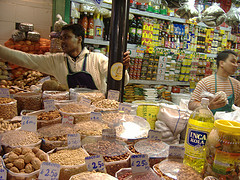
Nowt so queer as folk, and nowt like language to prove it.
Nibbles: Agroforestry, Genomics conference, Weed propagation, Potato gene, Potato Bean, Seeds, Chilli breeding, University, Prize, Arroz etc, Sinai, Maple syrup, Raw milk, Cacao
It’s Easter. A bigger than usual haul to see you safely through the lean times ahead.
- Simons says, plant a tree. And here’s how.
- FAO had an e-conference on “Impacts of genomics and other ‘omics’ for the crop, forestry, livestock, fishery and agro-industry sectors in developing countries” and all I got was this pdf.
- I personally think The Dude would prefer seeds.
- That potato day-length gene paper deconstructed. A bit.
- Owen’s
Potato beanhopniss seeds have sprouted. Can a new variety be far away? - No doubt he’ll be contributing to a list of US seed suppliers for perennial veg.
- There are perennial peppers, you know. A new weapon as the pepper breeding wars heat up?
- And enthusiasm for Kerala Agricultural University cools down.
- “Attention responsible gene stewards!” You had me at Attention. (But you lost me at responsible gene stewards.) On the other hand, if you are “diligent about developing or releasing durable varieties that will ensure long-term global wheat security” stick with it.
- Arroz, trigo, maíz y patata. The usual story: Casi todos los esfuerzos de la Revolución Verde se han enfocado hacia la mejora de los denominados cultivos principales.
- Farming in the Sinai is 5000 years older than it used to be.
- How to get genuine maple syrup.
- Raw milk is fine. No it’s not.
- Nestle and Mars commit to equality for women cocoa farmers. Mondelēz has not yet responded to Oxfam-inspired consumer pressure. Perhaps because few people know they’re Cadbury and Suchard and Toberlone and … what’s with that stupid ē anyway?
Enjoy that Creme Egg!
Nibbles: Ag research impact, Old foods, GMOs, Barcoding, Palms (well it is Easter), Medicinal plants, Passion fruits, Markets, Livestock, Chaffey, Wine and CC, Coffee culture
- “…for many for many smallholder farmers little has changed over the decades in terms of the methods and tools they use.” Geoff Tansey would seem to agree. Nobody has told ACIAR, though.
- Cherfas favourite spread bog butter among oldest food finds.
- Why it is silly to say that GMOs are always bad.
- The Star Trek tricorder-type DNA widget comes a step closer.
- Which will make it easier to do things like working out the evolution of palms. Before it’s too late. Because of all that nasty agriculture. Anyway, read about it on page 3 of Kew Scientist, along with lots of other stuff.
- Like the taxonomy of herbal medicine, for instance, which coincidentally also comes up in a newspaper article from Australia today. Maybe some of the plants involved will go into the Kimberly Ark, whatever that is.
- Passion fruit is the next big thing in Costa Rica.
- Colombian peasant organizations go to market. Including, I bet, with passion fruits.
- Even in the struggle between man and steer, the issue is uncertain.
- Is it time for Plant Cuttings again? Thank goodness.
- I think I’ll read it with some Danish wine at my elbow. Or maybe Vietnamese coffee.
Brainfood: Coconut and climate, Cereal biofortification, Ancient tuber oat grass, Grape diversity, Shade cacao, Ancient Central Asian ag, Diversity of knowledge, Edible canna
- Climate change and coconut plantations in India: Impacts and potential adaptation gains. Seems we don’t need to worry about coconut in India. Much. Overall.
- Biofortification of cereals to overcome hidden hunger. Need to understand mineral uptake and transport mechanisms better. But once we do…
- Evaluating prehistoric finds of Arrhenatherum elatius var. bulbosum in north-western and central Europe with an emphasis on the first Neolithic finds in Northern Germany. May just have had a ritual role.
- Genetic diversity and population structure assessed by SSR and SNP markers in a large germplasm collection of grape. High diversity despite duplication. Ecogeographic groupings within the cultivated material. Genetic core more genetically diverse than phenological core, though similarly phenotypically diverse. Information will revolutionize breeding. No, not really.
- Shade Tree Diversity, Cocoa Pest Damage, Yield Compensating Inputs and Farmers’ Net Returns in West Africa. Best thing is to have a diverse shade canopy, but under 50%.
- Agricultural production in the Central Asian mountains: Tuzusai, Kazakhstan (410‐150 b.c.). Yes, agriculture. Not just pastoralism.
- Diversity of Plant Knowledge as an Adaptive Asset: A Case Study with Standing Rock Elders. Differences among individuals may be just that, rather than “lack of cultural consensus” and may be adaptive as circumstances change.
- The Origin of Southeastern Asian Triploid Edible Canna (Canna discolor Lindl.) Revealed by Molecular Cytogenetical Study. C. indica var. indica and C. plurituberosa are the proud and newly-identified parents.