- ProMusa goes all social.
- Belgian flora goes online.
- Plant breeding goes to the people.
- FAO and ICARDA go together.
- Brits go all in on wheat pre-breeding.
- Modern dog breeds don’t go all the way back to the grey wolf.
Tomato expert’s field notes go online
We have blogged before about the C.M. Rick Tomato Genetic Resources Center at UC Davis and their tomato germplasm database. Now, via Dr Roger Chetelat, the director, we hear of a major addition to the data they make available.
The collecting notes of Dr Charles Rick, the world’s foremost authority on tomato genetics, who passed away in 2002 and after whom the center is named, are now online. You can see an example here, for LA1253, a Lycopersicon hirsutum f. glabratum (or Solanum habrochaites if you prefer) collected in Ecuador in 1970. The notes have been painstakingly transcribed from Dr Rick’s handwritten field notebooks, an example of which you can see below. Cannot have been easy work. And I mean both chasing after all those tomato wild relatives in the first place, and transcribing Dr Rick’s notes after so many years and with him gone.
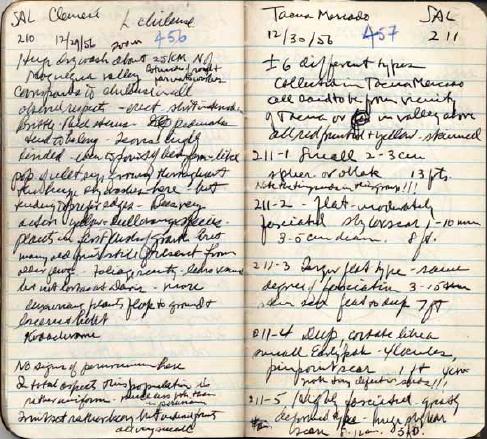
There are plans to eventually also “scan the pages that contain drawings of fruit shape, maps of collection sites, or other tidbits that can’t readily translated into text.” As an old collector, I find this stuff fascinating. Although I’m really not sure I’d like my own field observations so mercilessly exposed to the world.
Featured: Livestock data jungle
Tim Robinson updates us on livestock data at FAO:
…We had, of course, been working on the collection of the underlying livestock statistics, and the spatial modelling to produce the maps, for many years prior to them being published on the FAO website … but that is all quickly forgotten when they are re-distributed by a third party.
For your information, we have been beavering away since then, collecting more recent and detailed sub-national livestock statistics and disaggregating these using a slightly modified modelling approach, and 1 km multi-temporal, Fourier-processed MODIS imagery from the University of Oxford…
Global datasets coming soon, apparently. We’ll keep you posted.
Brainfood: Spanish emmer, Lathyrus breeding, Vitis in N Africa, European tree niche models over time
- Remnant genetic diversity detected in an ancient crop: Triticum dicoccon Schrank landraces from Asturias, Spain. Strong geographic differentiation even at small scales.
- Grass pea (Lathyrus sativus): Is there a case for further crop improvement? Yes, but then they would say that, wouldn’t they.
- Highly polymorphic nSSR markers: A useful tool to assess origin of North African cultivars and to provide additional proofs of secondary grapevine domestication events. North African cultivars do not derive from North African wild strains. Did anyone really think they did? Well, I guess it’s good to have the data.
- Building the niche through time: using 13,000 years of data to predict the effects of climate change on three tree species in Europe. You have to take into account past distributions when predicting future ones.
Nibbles: Welsh sheep, Indian cows, International centres, NUS in Asia, Purdue workshop, Onions, New Alliance, Community seedbanks, Seed Savers Exchange, Restoration, Shakespeare
- “I think you’re going to need different sheep.” In Wales, that is. (And different grasslands?)
- And new cattle in India, apparently.
- Another bunch of international agricultural research centres get together. Yeah, because the other lot are doing so well.
- I wonder if any of either lot will be going to this FAO symposium on NUS in Asia in a couple of weeks’ time. And no, I don’t know why we didn’t know about this earlier.
- On the whole, though, I think I’d rather be at the Purdue llama workshop.
- Or, at a pinch, this thing on the edible Alliaceae.
- Wait, there’s also a New Alliance to Increase Food Security and Nutrition. Not sure who’s invited to this party, but the “Rome-based agencies” seem to be the ones throwing it. (I guess this comes on the heels of the Chicago Council on Global Affairs’ annual symposium? Where’s a good summary of what happened there? Anyone? Ah, yes, Ian Scoones explains all.)
- One of those agencies wants to hear from you if you have experience of community “gene/seed banks.”
- Unclear if Seed Savers Exchange would qualify, but they have a bunch of peas out for the “community” to have a look at.
- These Indian award-winners would definitely qualify. Which is just as well as it seems the national genebank is up for sale.
- Meanwhile, botanic gardens get together to restore degraded ecosystems.
- The Bard’s plants. Well, some of them.