Our post of a couple of days ago on Ruoppolo’s grapes found its way to an actual grape expert, Anna Schneider of the Istituto di Virologia Vegetale in Italy. I’ve translated her comments below:
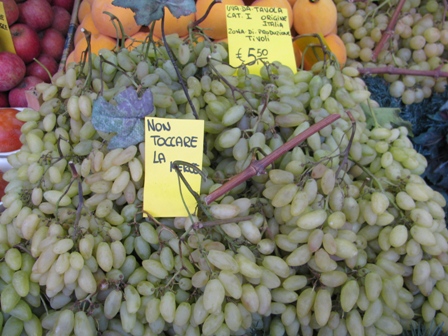
I did some research on Ruoppolo and saw that he worked in Naples, so it is indeed possible that the grapes he represented are Pizzutello white, which is actually still grown in Tivoli together with Pergolese and still arrive in the markets of Rome.
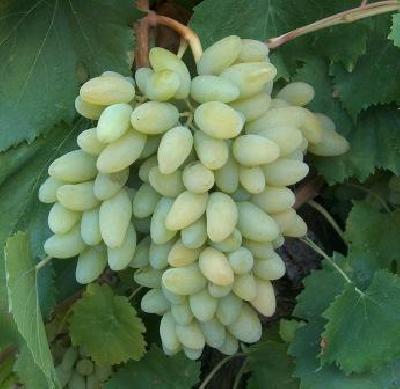
On the difference between the painting and the image of the Dedo de dama of Portugal, which is synonymous with Pizzutello, I am not worried: the color obviously depends on environmental conditions, and also the elongation of the berry may be: a) an exaggeration of the artist (who usually tended to exaggerate the more unusual characters, b) intra-varietal diversity (often mostly present in some varieties), c) growing conditions in the absence of “forcing”.
Other synonyms of the same grape variety, which was one of the most popular table varieties in the Mediterranean basin, because of the shape of the berry, to the particular form of the berry, are Cornichon blanc (France), Corazon de cabrito and Teta de vaca in Spain.
These synonyms are the “official” ones; unofficial ones number in the hundreds are hundreds (Galletta, Uva corno, Cornicchiola, Lady finger, etc…)
As a final note, I have a Pizzutello look-alike I recovered in old vineyards that seems a distinct genotype. In fact, it is possible that there is more than one variety with such a berry (and called the same ), although this Pizzutello (Cornichon, Dedo de dama, etc..) Is probably the most widely cultivated both today and in the past and among the oldest documented varieties (perhaps the dactyli grape of Pliny? though as you know such correspondences can never be definitely proven…)
To find out more I would need to do a more thorough search in the literature and among molecular profiles, but for that I would need a little more time…
Many thanks to Anna for taking the time to provide more information than I would have ever have been able to get out of the databases.
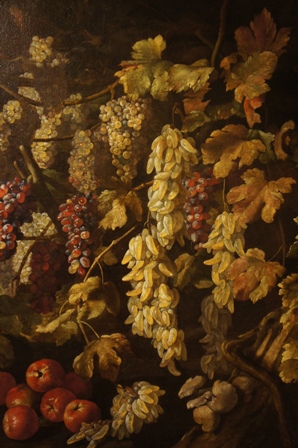 That was Michael, who was visiting the Museo de Bellas Artes in Sevilla a few weeks back, talking about Gianbattista Ruoppolo’s “Bodegón con uvas y manzanas.” Ruoppolo did quite