The very Web 2.0 savvy John Cho is at it again. He’s got more great historical pictures of Hawaii and its taro culture on his personal Facebook page. And he’s started to post about his breeding work on a separate Facebook page dedicated to Colocasia esculenta. 1 If you’re into taro in any way, you need to become John’s friend.
Nibbles: Microlivestock, Urban ag, Ag info, School meals in Peru, Agrobiodiversity indicators, Nature special supplement, Extension, Breeding organic, Forgetting fish in China, Deforestation, Russian potatoes, Fijian traditional knowledge, Megaprogrammes
- FAO slideshow on Egyptian rabbits.
- Journal of Agriculture, Food Systems, and Community Development calls for papers on urban agriculture. Will some look at the intersection with art?
- And IAALD re-launches its journal.
- “…students receiving online encouragement from the national soccer star reported going to bed at night looking forward to receiving their iron supplements the following morning.” Great, of course. But why not iron-rich foods?
- Speaking of which, there’s a new FAO publication on “Foods counting for the Nutritional Indicators Biodiversity.” No, I don’t quite understand it myself. Something to do with what foods count towards CBD biodiversity targets. Well, it’s the International Year of Biodiversity, after all.
- Indeed it is. And Nature makes the most of it. See what I did there? No agriculture though, natch.
- Extension gets a forum?
- Biotech can be useful in organic farming? Say it ain’t so!
- More evidence of shifting baselines in people’s perceptions of biodiversity. How quickly they forget.
- Will they forget what forests look like?
- The Vavilov Institute potato collection needs a thorough going over. Taxonomically, that is.
- Making salt in mangrove ponds in Fiji. Nice video. Not agrobiodiversity, but it’s my blog and I like seeing Fiji on it.
- CGIAR abandons agrobiodiversity? Say it ain’t so. Anyone?
- Speaking of megaprogrammes, there’s going to be one on agricultural adaptation to climate change, right?
- “So, how does huitlacoche taste? Does it matter?? LOOK AT IT! I guess it would be fair to say it doesn’t taste as truly horrible as it looks. The flavor is elusive and difficult to describe, but I’ll try: ‘Kinda yucky.'” Don’t believe him! And read the rest.
Nibbles: Agroforestry, Biofortification
- ICRAF DG on why leguminous trees on farms are good for sustainable food security in Malawi.
- Sorghum next for biofortification.
Ancient lentils come back to life?
Remember the story about the 4000 year old lentil? Well, the latest is that 17 seedlings are going to be planted.
Early farmers got high on chickpeas?
 A somewhat cryptic comment a few days ago on a year-old post on domestication eventually led us to an intriguing 2007 article in The Times which we unaccountably seem to have missed the first time around. The article quotes liberally from a Journal of Archaeological Science paper which puts forward something of an unorthodox take on chickpea domestication. 2
The authors, from various Israeli institutions, start by saying that chickpea is an unusual member of the “founder package” of Middle Eastern crops, which also includes diploid einkorn wheat, tetraploid emmer wheat, barley, pea, lentil and bitter vetch. That’s because its wild precursor (Cicer reticulatum), unlike those of the other first crops, has a relatively narrow distribution and an indehiscent pod (that is, the pods don’t split open when the seeds are ripe), and the crop itself is grown in the summer rather than the winter, basically to escape the fungal disease Ascochyta blight. A rare precursor and a problematic agronomy: why bother with the damn thing? There must have been something special — or at least different — driving the domestication of chickpea. That something, according to the authors, is the amino acid tryptophan.
Free tryptophan levels are an average of three times higher in seeds of cultivated chickpeas compared to their wild precursor, but with a lot of variation among cultivars. The usual sorts of processing have no effect. The levels are such that the authors are able to suggest that “consuming domesticated chickpea will elevate the levels of tryptophan available for processes other than growth and maintenance.” What processes might these be?
Tryptophan is a precursor of the neurotransmitter serotonin in the brain. More tryptophan in the diet means more tryptophan in the blood which means more serotonin in the brain, which has a whole suite of interesting effects. Apart from a feeling of satiety, these include higher ovulation rates in women, improved performance under stress, lowering of aggression and greater receptivity.
So the authors are suggesting that early farming communities consuming wild chickpeas would have been more fertile, less hungry, less depressed, more accepting of social complexity, more innovative and more self-confident. Sounds like I should be eating more chickpeas. Anyway, recognizing the effect that eating these wonder grains had on their mood — and farm animals are apparently able to recognize high tryptophan feeds — early farmers would have selected for ever higher levels, leading to the domestication of the species: “it seems that the inclusion of chickpea in the founder crop package is best understood in light of its high nutritional seed properties.”
Well, it’s a great story, and I really hope it turns out to be true, although I’m not entirely sure how one might further test the hypothesis. Shades of the tale of the domestication of coffee. But I think it might be worth revisiting that initial assumption. Is chickpea really all that different from the other members of the founder package? The distribution of its precursor is certainly limited compared to some of the cereals (the map is courtesy of GBIF).
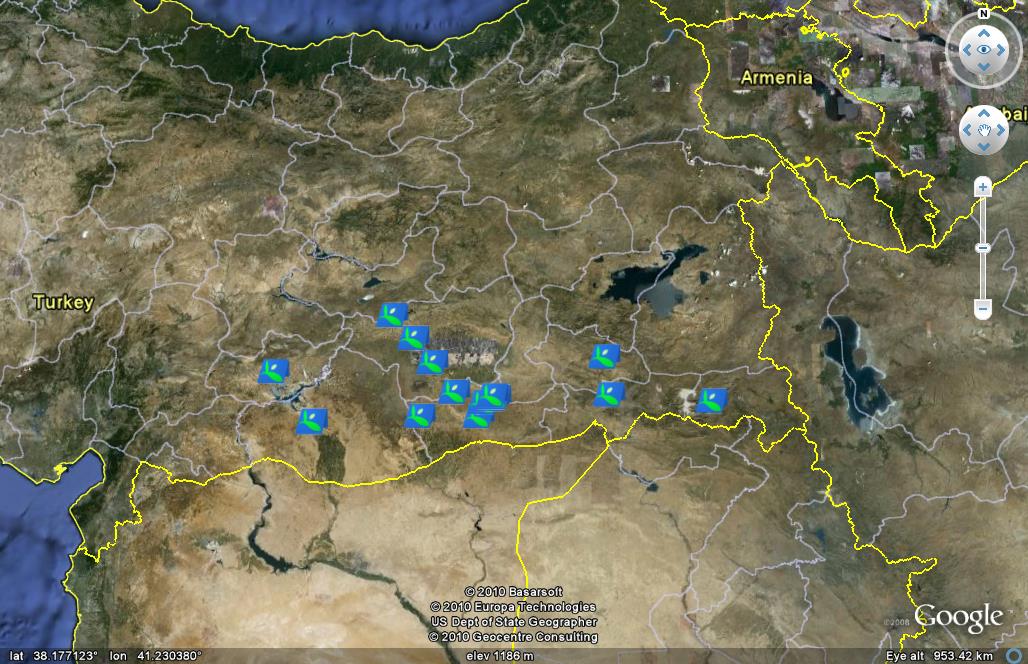
But wild lentils are not exactly common, and much more inconspicuous. And anyway we don’t really know what the distribution of C. reticulatum was like in the Neolithic. Its pollen doesn’t turn up in cores, according to one expert I asked, so it’s going to be difficult to reconstruct its ancient distribution and frequency. And why should seed indehiscence make chickpea a poor candidate for domestication? Wouldn’t it have been just the opposite? What about tryptophan levels in the other early legumes? And finally, as suggested by a former legume breeder I consulted, was Ascochyta blight a problem in the Neolithic? And is C. reticulatum susceptible to it anyway?
It does seem that perhaps the authors may have erected a bit of a straw man, which they then attacked with a very ingenious, utterly plausible, but ultimately unnecessary argument. But that’s not going to stop me eating my pasta e ceci a bit more often than before I read this paper.