International collections can’t do it by themselves

Two international centres tout their germplasm collections today. AVRDC’s newsletter, which I just got by email but can’t find on their website, gives a bit of a history lesson:

When AVRDC was founded in 1971, the Center started off with a modest collection of 570 accessions. By 1995, the genebank had grown to 43,205 accessions, comprising 63 genera and 209 species. To date, the Center has accumulated 57,230 accessions comprising 168 genera, 420 species from 154 countries of origin, a growth of 32.5% in number of accessions, 166.7% in number of genera, and 101% in number of species. AVRDC’s vegetable germplasm collections, held as an international public good for the world community, are growing in genetic diversity.

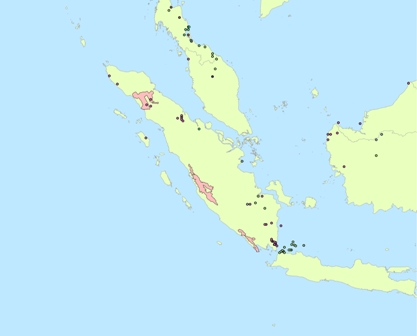
A further snippet of information shows yet again how interconnected the world is for genetic resources. Although “AVRDC is the largest holder of tomato germplasm,” it only includes “9% of the 83,680 accessions held worldwide.”

The same point is made, not quite so directly, but in a more visually striking way, in a map just out in Rice Today (click to enlarge):

And that, dear reader, is why we need a global system, and not just ever more genebanks.

Is nutrition research any use without genetics & genomics?

That’s the question Keith Grimaldi of the Eurogene project asks in the latest post on his newish blog. By “genetics” he means human genetics.

His answer?

Without genetics & nutrigenomics, epidemiological nutritional research will remain “mostly harmless”. Or to paraphrase a less amusing person maybe it’s like trying to govern the Italians — “not difficult, just a waste of time”

We’ve suggested something similar here a couple of times, albeit it much less eloquently than Dr Grimaldi. Are the people designing projects aiming to improve the nutritional status of communities, whether based on biofortification through genetic modification or diversity-based approaches, listening?

Research on Ethiopian food insecurity not very joined up?

The Drylands Coordination Group (DCG) is a network for capacity building through exchange of practical experience and appropriate knowledge on food security in the drylands of Africa.

And a huge amount of very detailed research they are doing too, in Mali, Eritrea, Sudan and Ethiopia. But one does have to wonder how much “exchange of practical experience” is really taking place. Take two reasonably recent reports from Ethiopia.

One, entitled “The Levels, Determinants and Coping Mechanisms of Food Insecure Households in Southern Ethiopia” (published Feb. 2009) makes no mention of diversity within crops at all. In fact, it even conflates crops, by measuring household economic status as the “average amount of wheat per person (all household production converted into wheat term).” Surely it makes a difference to the “levels, determinants and coping mechanisms of food insecure households” whether they are producing only one variety of wheat, several varieties of wheat, or both wheat and other cereals.

Compare that with another DCG study, entitled “Seed system impact on farmers’ income and crop biodiversity in the drylands of southern Tigray” (published Jan. 2009). This goes into great detail on the different varieties of each of the cereal crops in the study area.

Surely the two teams could have talked?