- Another nail in the coffin of Cartesian dualism in conservation? Yeah, right. Oooooh, here’s another. What next? Conservation-vs-use to bite the dust?
- Now here’s a thing. Priority setting in conservation for plants in Turkey and sheep in Ethiopia. Compare and contrast.
- “Bad-ass eco warrior” quoted on … apples.
- Invasive species can be good … when they are sunflower wild relatives.
- Pests and diseases: “New solutions could include novel resistant cultivars with multiple resistance genes, suitable epigenetic imprints and improved defence responses that are induced by attack.” I’ll get right on that. And more from Food Security.
- Rare Ethiopian honey becoming rarer.
- Also rare are micro-breweries in Africa. Alas.
- Volcano bad for British diet. And Kenyan jobs.
- So let them drink camel milk!
- Conference on Sustainable Animal Production in the Tropics. Doesn’t sound like much fun? It’s in Guadeloupe!
- And, there will probably be photographs of bulls of “stunning scrotal circumference.” Convinced yet?
- “Rios won for his work promoting a return to more traditional farming techniques focusing on seed diversity, crop rotation and the use of organic pest control and fertilizers to both increase crops and improve the communist-led island’s environment.”
- Our friend Anastasia does Seed Magazine: “Until broader efforts to reduce poverty can take hold, crops with improved nutrients could be very important in reducing death and disease caused by nutrient deficiencies.”
The recent history of sustainable agriculture in Thailand deconstructed
We are happy to publish this contribution from our reader Donald R. Strong of the Department of Evolution and Ecology, University of California, Davis.
 Thailand is a cornucopia of agricultural biodiversity. Western visitors like me are astounded by the numbers of kinds, and sheer volume, of fruits and vegetables offered from the densely packed food carts that line city streets. Piles of Asian species — longan, durian, mangosteen, lychee, longkong, salak — as well as unusual melons and herbs, are jumbled together with more familiar food plants — bananas, corn, chilis, onions, citrus, etc. Unlike in many other wet, tropical countries with impressive displays of food in central markets, Thais are generally well fed. Malnutrition and infant mortality are substantially lower than in contiguous countries, and in the region only China rivals Thailand in measures of population well being. 1 Thailand has not sacrificed wealth by feeding its people. Food exports have long been high and lucrative, and it is the world’s leading exporter of rice.
The social policies responsible for these positive agricultural outcomes have evolved, sometimes tortuously, over a long period. Thailand had became a major exporter of rice for the global market by the second half of the 19th century, but the wealth from this trade did not trickle down. 2 Thanks to the Green Revolution, by the late 20th century Thailand had become a model of development. It had progressed from subsistence agriculture, to agribusiness, and then to an industrializing economy. At the same time, low incomes dogged large fractions of the rural population, which provided the labor for agribusiness and practiced small-scale agriculture.
The evolution of social and economic conditions for small farmers following the Green Revolution, and the subsequent movement toward sustainable agriculture, is the subject of a fascinating recent study by Yuichiro Amekawa of Iowa State University. 3 Manned by surplus labor in rural regions, and trained by agricultural extension funded by the World Bank, industrial agriculture employed new varieties, inorganic fertilizers, and machinery. Great increases in yields followed. Skillful marketing of the bounty by agribusiness boosted Thailand’s capital. GNP increased to drive industrialization.
While the Green Revolution was promulgated throughout Thailand, however, only in the irrigated central part of the country did rice yields rise a great deal. In many areas that rely upon rainfed cultivation, impoverishment persisted for small farmers, and market prices did not rise to match costs of the technology. Small farmers on marginal lands faced drought, soil salinization, pest resurgence, poisoning due to ignorance of proper handling of pesticides, and many were overwhelmed by debt. In upland areas of northern and northeastern regions of the country, indigenous people were displaced by the deforestation that came with the push for cash crops other than rice. Bereft of land, these people became the pool of dependent labor. Government reforestation efforts displaced poor farmers who then moved into the remaining forest seeking places to farm. 4
The thrust of Amekawa’s work concerns the outcome of the sustainable agriculture movement in Thailand meant to counter the economic insecurity, pollution from inorganic fertilizers and pesticides, harm to the environment, and erosion of biodiversity caused by industrial agriculture brought by the Green Revolution. He addresses governance, following the approach of the 2009 Nobel Prize in economics to Eleanor Elinor Ostrom, one of the two co-awardees. She and others have focused upon what might be termed bottom-up, self-management by local communities. The examples of successful management of such “common property regimes” contradict the original assertion of Hardin’s Tragedy of the Commons that the only means of avoiding over-exploitation and the tragedy of the commons is top-down control by private ownership of the property or by government .
Amekawa learned Thai and based his study upon data that he collected over a ten year period before 2009, which was an advance upon previous purely theoretical analyses of the prospects for smallholder sustainable agriculture in Thailand. His study was in Chaiyaphum Province, in the northeastern region, locally called Isan and considered the least developed of Thailand’s four regions. It has low agricultural productivity, drought, soils that have become saline, and farmers with low incomes. They grow a range of fruits and vegetables as well as sugar cane, taro, cassava, pummelo citrus, and corn. He concentrates on the case of the “SAO: Industrial Organic Agriculture,” which was promoted by a Japanese NGO with efforts at democratic local governance in 13 villages.
They raised diverse vegetables in small gardens, with manure, organic pest management, and crop rotation — and received guaranteed high prices from subscribing Japanese households in Bangkok. The operation collapsed after a few years under a burden of oversupply driven by “increasingly opportunistic entry of producers.” Control of supply is a crucial element of common property theory and practice, and its absence from SAO operation contributed to the tragedy of the collapse of the SAO operation.
This was not an orthodox tragedy of the commons, however. Overexploitation in this case was of the limited market rather than a natural resource. Subsequent rescue schemes by the government and private parties were not successful.
The failure of SAO not withstanding, Amekawa concludes that sustainable agriculture as it exists in the complicated government polices and procedures — which do contain some elements of local, shared governance — are indeed valuable to small-scale farmers. However, consistent with the SAO story, the domestic markets for many Thai crops, especially those for fresh fruits and vegetables, are saturated. He finds no wisdom in “encouraging less competitive groups to newly enter the markets…” Amekawa is making an important statement about the complex relationship between agricultural biodiversity, sustainability, and economic sociology.
An early look at an atlas of agrobiodiversity
On reading about the Atlas of Global Conservation here a few days ago, Nora Castaneda of Bioversity International’s Regional Office for the Americas sent me some of her own forays in that area, which are focused on plant species of agricultural interest. They’re still works in progress, and unpublished, 5 but definitely worth having a quick look at. The data comes from germplasm databases (SINGER, GRIN, EURISCO) and the databases put together for the GapAnalysis project, about which we have already blogged about here.
Here’s what the distribution of numbers of accessions of varieties of the major food crops in genebanks looks like. Dark brown means lots of different accessions (not varieties, mind!).
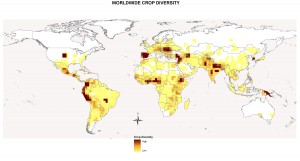
One has to wonder what’s going on in Spain. As I say, it’s a work in progress. A certain amount of data cleaning may still be necessary, for example to identify duplicates and take them out of the equation. And when Genebank Database Hell allows it should even be possible to take into account morphological and genetic diversity.
Anyway, here’s the distribution of richness of wild relative and landrace accessions of a number of major crops. Green means lots of species and landraces.
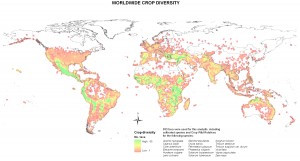
When finished, I think these maps will make a great complement to the Nature Conservancy’s Atlas. But would the biodiversity community be interested?
Nibbles: ILRI, Diversitas, Trees, Water use, Soil, Kenya, Microlivestock, Truffles, Climate data, Forests, Diseases, Plant breeding survey, Beer, and more beer, Pollinators
- ILRI annual programme meeting thing gets Twitter treatment. Web 2.0 seizes up.
- Via EcoagriculturePartners newsletter, news that agroBiodiversity has a new website. Web 1.0 surrenders.
- And the prize for the weirdest name for a tree-planting initiative goes to…
- The water footprint of pasta is greater than that of pizza. Still no cure for cancer.
- Microbes good for soil. I see that, and I raise you termites. Take that, Dirt Diva.
- Fish farming in dryland Kenya. Must get out to see one of these next time I’m there, maybe set one up on mother-in-law’s farm. And get her one of these funky backpacks while I’m at it. Wouldn’t want her to laze about.
- Farmer Brown (sic) from Ghana talks about his grasscutters.
- Ever wonder how one cultivates truffles? Wonder no more.
- FAO librarian answers agroclimatological query. Lots of databases for you to explore is the result.
- And also from FAO, the latest on the state of the world’s forests. More databases no doubt involved.
- Damn, you mean diversity can be good for disease?
- Study says that to “be effective plant breeders, … should also be equipped with strong critical thinking and time management skills, and a well-founded work ethic.” Still no cure for cancer.
- Climate change to affect beer? Now it’s personal!
- Wonder how Ugandans feel about that? Guide to Ugandan Beer, Part 1.
- Pollinators do the Harlem Flutter.
UK public asked to forget election, map cherries instead
In another example of “citizen science” the Natural History Museum in the UK is enlisting the help of the public in a survey of cherry trees.
The results will produce a map of cherry tree locations and their flowering and fruiting timings. It will give scientists a better insight into the cherry tree population and help them find out how climate change may be affecting the flowering and fruiting times.
You can read all about it on the NHM’s website, and follow progress on a handy map.
As I’ve probably said here before, I think this sort of approach could work really well with heirloom varieties. But I imagine not as many people will be interested in oats as in cherries.