- Size isn’t everything, genome edition.
- Nutrient efficiency of agriculture, phosphorus edition.
- Win-wins, fisheries edition.
Towards the establishment of genetic reserves for crop wild relatives and landraces in Europe
The ECPGR In situ and On-farm Conservation Network Coordinating Group and others are organizing a symposium entitled “Towards the establishment of genetic reserves for crop wild relatives and landraces in Europe” at the University of Madeira, Funchal (Portugal), from 13-16 September 2010.
Conservation biologists, protected area managers and experts from the agrobiodiversity sector engaged in the management and use of plant genetic resources for food and agriculture are welcome to attend the symposium.
Interested? You can find out more on the website of the Centre for Macaronesian Studies of the University of Madeira, one of the co-organizers.
Nibbles: Asses, Mapping pathogens, Oysters, Tea, Turkish biodiversity hotspot, Dolmades and sage, Yams festival, Pollen video, Agriculture and mitigation, Rarity, School feeding, Sheep
- Jeremy probes into wild asses at Vaviblog.
- Mapping the evolution of pathogens. And in kinda related news…
- The European oyster needs diversity. Well, natch.
- The tree forests of Yunnan, and, concidentally, the story of how the secret of their product got out.
- The Kaçkar Mountains at Yusufeli, northeast Turkey are in trouble. Any crop wild relatives there, among the bears and other charismatic megafauna
- Speaking of Turkey, here’s how to make one of its delicacies. But hey, if you don’t have vine leaves, you can use this.
- Having fun with yams.
- Drori does pollen.
- FAO’s Mitigation of Climate Change in Agriculture (MICCA) Project. Any agrobiodiversity-related stuff? Need to explore…
- “…conserving species may only require specific activities, such as collect and distributing seeds.”
- African school feeding programme uses “local” products. What would Paarlberg say? You can find out here, if you have 90 minutes to spare.
- British boffins breed self-shearing sheep. No, really.
International collections can’t do it by themselves
Two international centres tout their germplasm collections today. AVRDC’s newsletter, which I just got by email but can’t find on their website, gives a bit of a history lesson:
When AVRDC was founded in 1971, the Center started off with a modest collection of 570 accessions. By 1995, the genebank had grown to 43,205 accessions, comprising 63 genera and 209 species. To date, the Center has accumulated 57,230 accessions comprising 168 genera, 420 species from 154 countries of origin, a growth of 32.5% in number of accessions, 166.7% in number of genera, and 101% in number of species. AVRDC’s vegetable germplasm collections, held as an international public good for the world community, are growing in genetic diversity.
A further snippet of information shows yet again how interconnected the world is for genetic resources. Although “AVRDC is the largest holder of tomato germplasm,” it only includes “9% of the 83,680 accessions held worldwide.”
The same point is made, not quite so directly, but in a more visually striking way, in a map just out in Rice Today (click to enlarge):
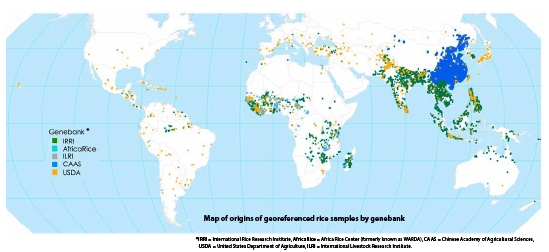
And that, dear reader, is why we need a global system, and not just ever more genebanks.
Is nutrition research any use without genetics & genomics?
That’s the question Keith Grimaldi of the Eurogene project asks in the latest post on his newish blog. By “genetics” he means human genetics.
His answer?
Without genetics & nutrigenomics, epidemiological nutritional research will remain “mostly harmless”. Or to paraphrase a less amusing person maybe it’s like trying to govern the Italians — “not difficult, just a waste of time”
We’ve suggested something similar here a couple of times, albeit it much less eloquently than Dr Grimaldi. Are the people designing projects aiming to improve the nutritional status of communities, whether based on biofortification through genetic modification or diversity-based approaches, listening?