An early look at an atlas of agrobiodiversity

On reading about the Atlas of Global Conservation here a few days ago, Nora Castaneda of Bioversity International’s Regional Office for the Americas sent me some of her own forays in that area, which are focused on plant species of agricultural interest. They’re still works in progress, and unpublished, 1 but definitely worth having a quick look at. The data comes from germplasm databases (SINGER, GRIN, EURISCO) and the databases put together for the GapAnalysis project, about which we have already blogged about here.

Here’s what the distribution of numbers of accessions of varieties of the major food crops in genebanks looks like. Dark brown means lots of different accessions (not varieties, mind!).
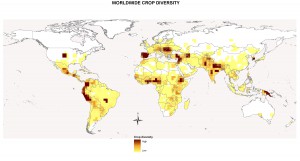
One has to wonder what’s going on in Spain. As I say, it’s a work in progress. A certain amount of data cleaning may still be necessary, for example to identify duplicates and take them out of the equation. And when Genebank Database Hell allows it should even be possible to take into account morphological and genetic diversity.

Anyway, here’s the distribution of richness of wild relative and landrace accessions of a number of major crops. Green means lots of species and landraces.
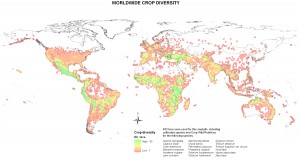
When finished, I think these maps will make a great complement to the Nature Conservancy’s Atlas. But would the biodiversity community be interested?

Nibbles: ILRI, Diversitas, Trees, Water use, Soil, Kenya, Microlivestock, Truffles, Climate data, Forests, Diseases, Plant breeding survey, Beer, and more beer, Pollinators

UK public asked to forget election, map cherries instead

In another example of “citizen science” the Natural History Museum in the UK is enlisting the help of the public in a survey of cherry trees.

The results will produce a map of cherry tree locations and their flowering and fruiting timings. It will give scientists a better insight into the cherry tree population and help them find out how climate change may be affecting the flowering and fruiting times.

You can read all about it on the NHM’s website, and follow progress on a handy map.

As I’ve probably said here before, I think this sort of approach could work really well with heirloom varieties. But I imagine not as many people will be interested in oats as in cherries.

Fairtrade quinoa vodka hits the stores

Oliver Morton alerts me on Twitter to the existence of a fairtrade quinoa vodka. The “first fairtrade certified vodka in the world,” no less. The quinoa comes from Bolivia, but the vodka is made in France as a joint venture.

The quinoa used by FAIR Vodka is cultivated by over 1,200 small producers in the Bolivian Altiplano and gathered within the Anapqui cooperative, the main association of farming producers in the country. With a strong focus on sustainability, FAIR is keen to build long-term relationships with their partnered cooperatives along with their communities in order to ensure their continued development.

A quick look around the intertubes did not reveal much in the way of other alcoholic beverages made from quinoa, apart from a reference to its use in making a type of chicha in Ecuador. Anyone know more?