Madeline nails the weird Chinese vegetable: celtuce, or stem lettuce, or wosun, rather than osun (Chinese: 莴笋; pinyin: wōsŭn).
Forays in fermentation

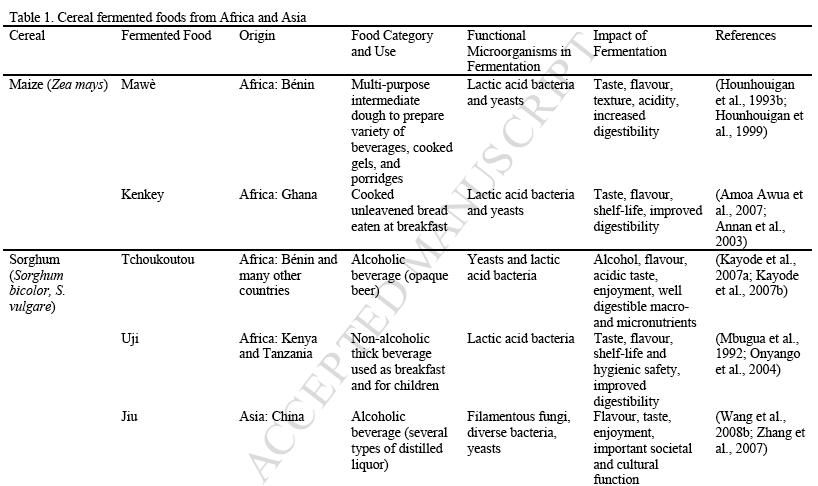
There’s a couple of interesting articles about cereal fermentation in the latest Food Microbiology. Both basically say that fermentation is a useful way of getting more nutrition out of your staples. Rob Nout 1 describes how various traditional fermented dishes are made in Africa and Asia, ranging from kenkey in Ghana to idli in Sri Lanka. The former is made from maize, the latter from rice. Here’s the part of the paper’s Table 1 which lists fermented foods made from maize and sorghum (pearl millet, finger millet and rice are also considered):
It can get complicated. Here’s how they make jnard in India (I’ve removed the references to ease the flow), for example:
Jnard is an opaque beer made from finger millet (Eleusine coracana). Although – judging by its description – it would seem similar to Tchoukoutou, its mode of processing is fundamentally different. Whereas Tchoukoutou is brewed from sorghum malt, Jnard is saccharified by the action of an indigenous amylolytic starter (Murcha) on previously soaked and cooked fingermillet paste. Murcha is a rice-based dried tablet containing a mixed microflora of filamentous fungi, yeasts and lactic acid bacteria, and differs from koji which is a concentrate of fungal conidia of e.g. Aspergillus oryzae, used in the preparation of soya sauce and similar products. The process of preparing Jnard includes an overnight soak of finger millet seeds to soften them, grinding to obtain a crushed mass which is cooked and cooled to about 30ºC. Then, pulverized Murcha is sprinkled in the cooked mass and during a 1-3 day incubation, saccharification, lactic fermentation and alcoholic fermentation take place simultaneously. Functional microorganisms of Murcha and similar Asian amylolytic starters are filamentous fungi (Amylomyces rouxii, Rhizopus oryzae, etc.) which produce a range of enzymes including glucoamylase that degrades starch directly into glucose; yeasts (Endomycopsis fibuligera, Saccharomyces cerevisiae, etc.) which ferment part of the glucose produced; and lactic acid bacteria (Enterococcus faecalis, Pediococcus pentosaceus and others) growing together with the yeasts. LAB are able to co-exist with yeasts in a protocooperative manner.
Nibbles: Camel, Maya forestry, Ancient barley, Cattle diversity, Poisons, Agroforestry Congress, Lactase persistence
- Wild camel genetically distinct from the domesticated kind. Well I never.
- Maya tapped into their “sacred groves” to build temples, which did not end well.
- Boffins extract DNA from ancient barley in Upper Egypt, find it was 2-rowed, but derived from a 6-rowed ancestor. No word on whether it was used to make beer, but my guess is yes.
- Large Y chromosome microsatellite study of Eurasian cattle does “not support the recent hypothesis on the origin of Y1 from the local European hybridization of cattle with male aurochsen.” This could run and run.
- I like this idea: a garden of poisons.
- Agroforestry’s coming-of-age party coming up. You going? Let us know.
- Multiple explanations for lactase persistence.
Mystery Chinese vegetable filmed in Vancouver
Anybody know what this weird bit of Chinese agrobiodiversity might be? Google knows nothing about it, at least under the spelling provided: “orsun.”
Drink a beer, save a forest
A piece in Timber Industry Magazine picked up by the ever-excellent NWFP Digest alerts us to the first beer to carry the PEFC (Programme for the Endorsement of Forest Certification) seal of approval.
Brewer Gino Perisutti’s Blonde PEFC Mountain Pale Lager contains spruce bark, mountain pine buds and Scots pine needles from PEFC-certified forests.
I’m trying to obtain a sample for review.