The BBC World Service has a new radio documentary out soon called “Farm Swap.” The conceit is you take a farmer and you plonk him or her into a completely different farming situation. An Ecuadorian organic farmer goes to Hawaii and an English potato farmer goes to Eastern Europe, judging from the brief on-air adverts, but there are no details at all on the website yet. I’m not sure if this is a one-off or a series, but I hope the latter, as it sounds like fun. Especially if subsistence farmers are included, say maize farmers in Kenya and Mexico exchanging experiences, or coconut farmers in India and Ghana. Not enough of that goes on, I think. It would also be nice to see what a particular British allotment gardener would do in another milieu.
Featured: Rome vs Carthage
Dirk Enneking takes Luigi to task:
What is wrong with repatriating germplasm? Isn’t your argument questioning the role of national genebanks and genetic sovereignty? Is Rome reviving its old rivalry with Carthage?
Let the games begin!
Nibbles: Communication, Chicken mutations, Endophytes, Earthworms
- DFID-supported collection of stories showing how information about new ways of doing things is communicated to rural people in developing countries includes some agrobiodiversity stuff.
- The genetic nature of the Pea-comb phenotype in chickens.
- Entomopathogenic fungus can become an endophyte in sorghum and confer protection from stem borer. Ain’t agrobiodiversity grand?
- Different earthworm species have different effects on the competition between four annual plants and their relative fecundity. Ain’t agrobiodiversity grand?
Reindeer game up
The species Rangifer tarandus is divided into seven subspecies, but all are in trouble, according to a survey of their status published in a recent paper in Global Change Biology. We’re talking about the animals that are usually called reindeer in Europe and caribou in North America. All across their circum-polar range their populations are undergoing an unprecedented synchronous decline (red denotes herds in decline in the map below, which I hacked from the BBC article quoted below, green indicates those on the increase and dark grey means no data is available).
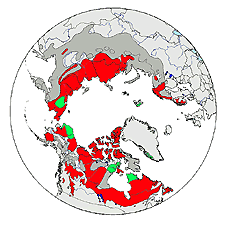
One subspecies — R. t. tarandus — comprises the semi-domestic and wild reindeer that live across northern Scandinavia and Russia and are so important to the Sami people and others. Here’s one of the authors quoted by the BBC on the causes of the decline:
“If global climate change and industrial development continue at the current pace, caribou and reindeer populations will continue to decline in abundance,” says Vors.
“Currently, climate change is most important for Arctic caribou and reindeer, while anthropogenic landscape change is most important for non-migratory woodland caribou.”
Interestingly, reindeer were recently re-introduced to Britain after a gap of 800 years. I guess their long-term future there must be in question.
Bactrian camel a little less on the edge
Today’s BBC story about the unexpected birth of a Bactrian camel calf at Knowsley Safari Park in the UK reminded me how little I know about camels — although my performance on the camel question on the recent domestication quiz should have warned me. In particular, I didn’t know that there are wild Bactrian camels (Camelus bactrianus) in NW China and Mongolia, though admittedly they are down to about a thousand and endangered. It’s unclear from the Knowsley website whether the Bactrian camel birth is part of a captive breeding and re-introduction programme, but there are such programmes there for other species:
Our Pere David’s deer herd is one of the largest in the UK. These deer were classified as extinct in the wild until the mid 1980’s when a group of 39 deer went back to China as part of a project organised by the Zoological Society of London. Four of our deer formed part of this group returned to the 1,000 hectare Dafeng reserve. Now classified as critically endangered, they are protected from hunting on the reserve and the captive breeding herds such as ours at Knowsley are still very important to ensure the future of these deer.