- Feeding the world with breadfruit.
- Feeding the world with ngali nut. Well, the Solomons.
- Feeding the world with sticky rice. Well, Laos.
- Threatened forest hotspots mapped, and discussed. Why is it we haven’t done this for agrobiodiversity?
- Man takes best friend to grave, old and very old.
Nibbles: Dog, Beer, Human Planet, Entomophagy, Food Atlas, Pepper, Barley
- When dog was on the menu.
- Going far, and far back, for beer. And indeed yeast. Always worth the effort.
- BBC launches Human Planet, focusing on “man’s remarkable relationship with the natural world.” Which apparently doesn’t include agriculture.
- Mexicans eat many moth species, and not just the larvae.
- Amazing interactive food atlas for the US. wish I had a use for it, but someone surely does.
- Breeding a “better” Jalapeño pepper — to hold more cheese, natcho.
- Food as politics; the tsampa-eaters of the TAR. h/t GOOD.
Of cattle and people. And barley
Dienekes, a blogger who specializes in molecular anthropology, has a quick note today on a paper on the molecular genetics of cattle in Europe. The main story is one of distinction between North and South.
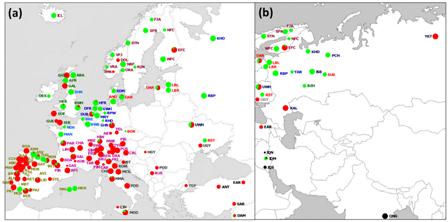
Apparently, the expansion of the dairy breeds have created, or largely maintained, a sharp genetic contrast of northern and southern Europe, which divides both France and Germany. It may be hypothesised that the northern landscapes, with large flat meadows, are suitable for large-scale farming with specialised dairy cattle (Niederungsvieh, lowland cattle), whilst the mixed-purpose or beef cattle (Höhenvieh, highland cattle) are better suited to the smaller farms and hilly regions of the south. However, it is also remarkable that in both France and Germany the bovine genetic boundary coincides with historic linguistic and cultural boundaries. In France, the Frankish invasion in the north created the difference between the northern langue d’oïl and the southern langue d’oc. The German language is still divided into the southern Hochdeutsch and northern Niederdeutsch dialects, which also correlates with the distribution of the Catholic and Protestant religions. On a larger scale, it is tempting to speculate that the difference between two types of European cattle reflects, and has even reinforced, the traditional and still visible contrast of Roman and Germanic Europe.
It doesn’t seem that the strong latitudinal genetic differentiation in cattle is matched by one in human populations. Here the pattern is much more gradual and clinal. 1 However, there may be a similar “sharp genetic contrast of northern and southern Europe” (or at least between the Mediterranean and the rest of Europe) for barley. 2
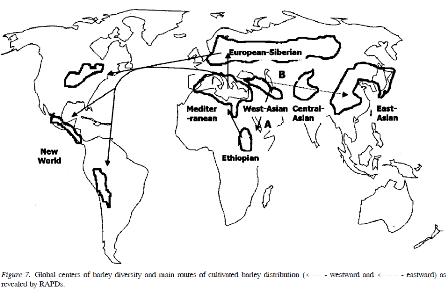
I’d dearly love to have the time to find out whether other livestock and crops show a similar pattern.
Nibbles: Neanderthal, CWR, Bioinformatics, Svalbard, Old Armenian wine, Maple syrup, Plants databases, Bananas in trouble
- Neanderthals cooked and ate plants, but did not use toothbrushes.
- Andy Jarvis talks up a crop wild relatives storm.
- Towards an information infrastructure for the global genebank system. Maybe.
- Aussies send seeds to wrong Global Seed Vault.
- Oldest winery found in Armenia. Search still ongoing for oldest wino. Maybe in Lebanon?
- Oh, to be at the Bigleaf Maple Syrup Festival!
- The most important thing to happen in botany in, what, a couple of weeks? Ah, but the backlash is here.
- Colbert finally works out why his high school teacher put condoms on bananas. Here’s his informant.
Nibbles: Old fruit, Same fruit, Fruit juice, Dog breeding, Plant Cuttings, Seed storage, Romanian cattle breeds
- REALLY old fruit found in Chinese cellar.
- Marufo the same as Brujidera? Say it ain’t so!
- Rachel Laudan deconstructs a French depiction of cider-making. Well, someone had to.
- Genetic modification dates back to ancient Mexico.
- Rejoice, Plant Cuttings is out!
- Seeds of alpine plants don’t live as long as those of lower altitudes. So how many crop wild relatives are high-altitude species I wonder?
- Get your teeth into the work of the Transylvanian Rare Breeds Association.