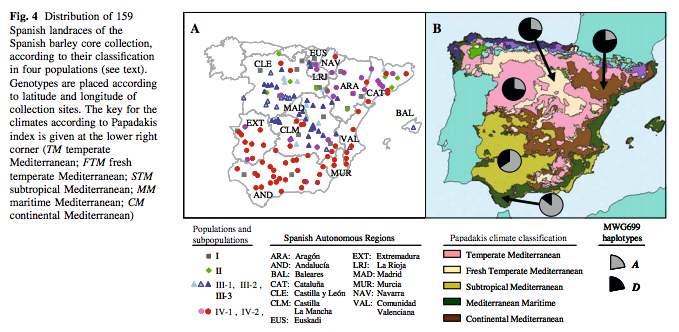
The researchers were also able to group Spaniards into five genetic clusters. On a map, these groups form five strips running north to south. Those strips line up neatly with history.
I wonder if you’d get a similar pattern looking at crops, say wheat. There’s lots of material in genebanks to play around with.
LATER: Thanks to David Marshall for pointing out that work has been done on barley.
It just needs someone to compare the patterns now. And repeat for other crops.
A paper just out in Quaternary Science Reviews provides an overview of the first 3000 years of the spread of cultivated cereals around Eurasia, based on archaeobotanical evidence. The paper has some nice maps, but the press release has a really cool animated gif, which I had no hesitation in stealing.
Before 5000 BCE: farming communities used foothill, alluvial and catchment locations in different parts of Eurasia.
Between 5000-2500 BCE: crops move around, but remain ecologically constrained, with the Tibetan Plateau and the Asian monsoons separating east from west, and north from south.
Between 2500-1500 BCE: crops are taken to new thermal and hydrologic contexts, bringing previously isolated agricultural systems together.
The title of that press release says it all really: “A small number of crops are dominating globally. And that’s bad news for sustainable agriculture.” Compare and contrast with the findings of Colin Khoury and friends from a couple of years back on the increasing homogeneity of global diets. Basically looking at the same data in a somewhat different way: pretty much the same result.