- New guy in charge Peter Wenzl gives us his vision for the CIAT genebank.
- Agriculture and Irrigation Minister of Peru gives us his vision for the Peruvian genebank.
- CIMMYT’s annual report gives us a vision of conserving maize in Guatemala.
- Farmer Somashekhara gives us his vision for finger millet farming in India. And two makes a trend…
- Retired agriculture expert Malcolm Hazelman gives us his vision for Samoan gardens.
- A Tagorean vision of radical relocalization involving perennial edimentals.
- Lots of people give us their vision for saving the wild apple.
- IFPRI gives us their vision for the future of food in a changing world. With infographic goodness.
- Natalie Mueller et al. give us their vision for reviving the forgotten crops of the Eastern Agricultural Complex.
- A vision of a planet protected in situ, in multiple ways. Yes, even pigeons. And yes, even cities, though agrobiodiversity neglected as usual.
- A vision of permanent identifiers everywhere.
- DNA gives us a vision of domestication explained. Yes, even sugarcane.
Brainfood: Wild foods, Maize in Guatemala, Wild lentils, Sorghum gaps, Ethiopian erosion, Chikanda barcoding, Brazil nut systems, Wild carrots, Ancient wild potato use, Wild wheat grains
- The role of wild fruits and vegetables in delivering a balanced and healthy diet. Not great, until they’re domesticated.
- Maize Diversity, Market Access, and Poverty Reduction in the Western Highlands of Guatemala. Forget maize.
- Evaluation of Wild Lentil Species as Genetic Resources to Improve Drought Tolerance in Cultivated Lentil. Environment explained drought response in wild lentils better than molecular classification.
- Geographical distribution, diversity and gap analysis of East African sorghum collection conserved at the ICRISAT genebank. Both Sudans.
- Explaining the Ethiopian farmers’ perceptions on potential loss of traditional crop varieties: A principal components regression analysis. Poor farmers know more, and care more, about loss of traditional landraces.
- High-throughput sequencing of African chikanda cake highlights conservation challenges in orchids. Those are very biodiverse cakes, but not in a good way.
- Revisiting the ‘cornerstone of Amazonian conservation’: a socioecological assessment of Brazil nut exploitation. It’s actually in pretty good shape, but that doesn’t mean it can’t be improved.
- Phylogenetic Prediction of Alternaria Leaf Blight Resistance in Wild and Cultivated Species of Carrots. Look for taller material in clade A.
- Starch granule evidence for the earliest potato use in North America. S. jamesii may have been used for 10,000 years in Utah.
- Genome-Wide Association Study of Grain Architecture in Wild Wheat Aegilops tauschii. Two genetic lineages, with big differences in grain width and weight.
The shocking news about breeding for flavour
Luigi linked, with scarcely a comment, to a plant breeding paper by Kevin Folta, scourge of biotech deniers everywhere.
Stripped down, what Folta and his co-author, Harry J Klee, propose is that plant breeders “can now turn to the consumer for guidance in defining critical desires,” by which they mean previously unconsidered trifles like flavour and aroma.
I was going to let it lie – nil nisi bonum and all that – but I just can’t.
The burr under my saddle is not the cutesy metaphor of the Model T Ford, nor the pedantic insistence that tomato is a fruit while strawberry is a vegetable. It is this:
The idea of putting the consumer first is shockingly novel …
To which I can only reply, “Srsly?”.
What about the shockingly novel idea of participatory variety selection, in which participants are encouraging to evaluate sensory traits and even practical matters like preparation and cooking time? What about the Culinary Breeding Network and many other breeders who are already working closely with chefs and other consumers?
Another shocking aspect to the paper is how fundamentally reductionist it is, although that also explains why they think it so novel to consult people who eat fruit and veg, as opposed to intensive farmers and their customers, the usual consumers for reductionist plant breeders. The focus is on relating what consumers say they like to specific levels of specific compounds, and those compounds to specific genes, the better to manipulate them.
There are, I admit, some juicy insights as a result of this approach. It is indeed interesting that in the strawberry vegetable, a few specific genes underly specific different flavours, while in the tomato berry many related genes and metabolic pathways influence flavour, and are under the control of a few regulatory genes. One heirloom tomato is consistently reported as sweeter than a modern variety, even though it contains 10% less sugar. Why? Because it contains “significantly higher levels of certain volatiles … creating the illusion of sweetness in the absence of sugar”. In strawberries, “furaneol and its methyl ether 2,5-dimethyl–4-methoxy–3(2H)-furanone … produces [sic] a rich, buttery, caramel-like aroma” while γ-decalactone – produced by the gene FAD1 – “confers a strong peach essence”.
Folta and Klee conclude by noting that:
Coupling the targets defined by consumer tests to today’s powerful metabolomic and genomic technologies, plus the potential for genome editing, suggests that creating the next wave of highly flavored fruits and vegetables can be streamlined compared with yesterday’s processes of traditional breeding.
It suggests other things, too, but I’ve said plenty.
Syndicated from The Mothership.
Brainfood: Taste breeding, Cat domestication, ITPGRFA in USA, CWR extravaganza, Ecology & ag, Brassica identification, Biodiversity monitoring, Languages, Species recovery, Benin pigeonpea
- Sensory sacrifices when we mass-produce mass produce. You need consumer-assisted selection.
- The palaeogenetics of cat dispersal in the ancient world. Two Middle-Eastern sub-populations of one sub-species contributed to domestication, at different times, and the result spread first with agriculture and then aboard ships. But we haven’t changed them in the same way we’ve changed dogs etc. You don’t say.
- U.S. ratification of Plant Treaty: benefit sharing ambiguity for plant genomics researchers does not change. But what about genomics data?
- Wading Into the Gene Pool: Progress and Constraints Using Wild Species. Introduction to the Special Section on CWR.
- Plant ecological solutions to global food security. Introduction to the Special Feature on Ecological Solutions to Global Food Security. The intersection with the above is probably here.
- A multiplex PCR for rapid identification of Brassica species in the triangle of U. Now there’s no excuse.
- Connecting Earth observation to high-throughput biodiversity data. I don’t see any reason why the same thinking couldn’t be applied to crop diversity.
- Linguistic diversity of natural UNESCO world heritage sites: bridging the gap between nature and culture. 80% of Natural WHSs intersect at least one indigenous language.
- Overcoming barriers to active interventions for genetic diversity. Embrace the hybrid by focusing on process, not form.
- Utilization and farmers’ knowledge on pigeonpea diversity in Benin, West Africa. For some reason, farmers don’t like coloured seeds.
Maize for Haiti; but from Haiti?
Good news for hard-pressed Haitian farmers.
The International Maize and Wheat Improvement Center (CIMMYT) has grown 150 tons of renewed, improved maize seed that will be sent to Haitian farmers to help jump-start the country’s seed sector, improve local food security and decrease malnutrition. This will be the largest seed shipment to any country in CIMMYT’s history.
But are there any maize landraces left in Haiti that this much-needed effort will displace? If so, it will be important to collect them. Genesys lists 78 landraces from the country, most at the genebank of CIMMYT itself, collected thus:
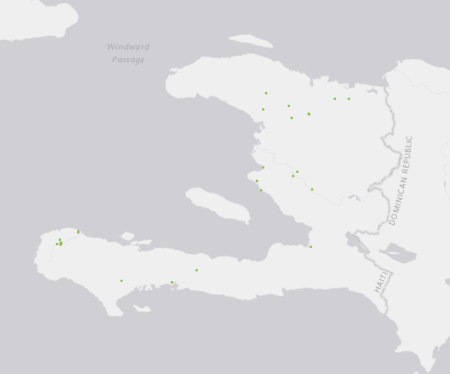
Maybe enough. Maybe not…