- Identification of zucchini varieties in commercial food products by DNA typing. You can trace zucchini varieties in food products despite various kinds of processing.
- Anaerobic microorganisms in astrobiological analogue environments: from field site to culture collection. Practicing to collect genetic resources on Mars.
- Genetic diversity and population structure in the narrow endemic Chinese walnut Juglans hopeiensis Hu: implications for conservation. It’s in trouble.
- Do traditional sheep breeders perform conscious selection? An example from a participatory breeding program of Morada Nova sheep. Breeders of purebreds use different criteria to those of crossbreds.
- Characterization of common bean wild populations for their in situ conservation in Northwestern Argentina. Some populations should be conserved because they’re pure wild, the rest because they’re not pure wild.
- Quality Management System for Research Biobanks: a Tool to Incentivize Public-Private Partnerships. ISO developing a QMS specifically for biobanks. Full text in Google Books.
- Cryopreservation of fruit germplasm. Elements of a strategy for Germany.
- Implications of Seed Policies for On-Farm Agro-Biodiversity in Ethiopia and Uganda. 117 provisions in 21 national seed policies in coded for implications for availability and accessibility of improved, quality-controlled and genetically diverse local seed in both the formal and informal seed systems. Ok, now what?
- Measuring the financial sustainability of vine landraces for better conservation programmes of Mediterranean agro-biodiversity. Landraces are not worth it, because of low yields.
- Traditional People, Collectors of Diversity. ‘Nuff said.
- Changes in human skull morphology across the agricultural transition are consistent with softer diets in preindustrial farming groups. Cheese changed your skull shape.
Calvin Lamborn, plant breeder
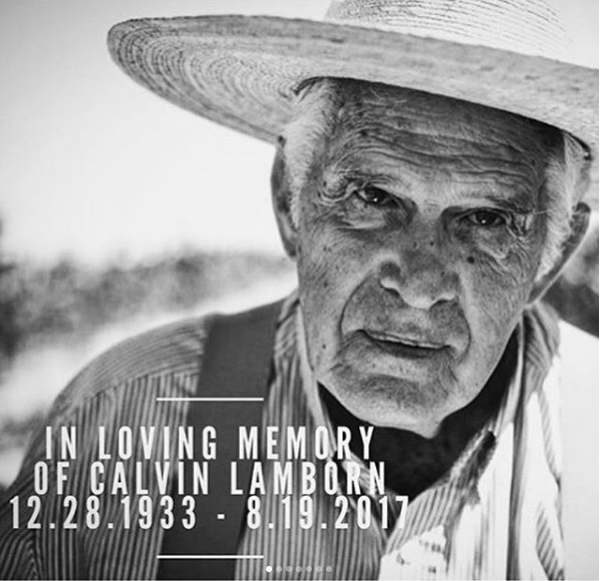
It isn’t that people don’t want to know who bred their favourite fruit and vegetable varieties, it’s just that the story of those breeders is so seldom put before us. A tribute post from @culinarybreedingnetwork alerted me to the death of Calvin Lamborn. And who is he? Only the man who gave the world Sugar Snap peas, and many other wonderful peas.
Jim Myers, no slouch as a plant breeder himself, had this to say:
Calvin is the reason why we have snap peas as a part of our everyday cuisine in the U.S and in much of the world. Most people think that snap peas have always been part of our food culture, but before Calvin’s work, snap peas were only a very minor curiosity in the garden. When he went to work at Gallatin Valley Seed Company in Twin Falls Idaho as a young plant breeder, he was given the problem of “straightening out” edible podded snow peas. He wondered what would happen if he crossed a spontaneously occurring trait for thick pod walls in the old shelling pea ‘Dark Skin Perfection’ with ‘Mammoth Melting Sugar’ snow pea. The result was completely unexpected; it did straighten the pods, but it was a completely different crop. The first variety from those breeding efforts was ‘Sugar Snap’ pea and he is responsible for releasing most of the snap pea varieties that we enjoy today. Equally critical, snap peas would remain a minor curiosity today if not for his continuous and tireless promotion of the crop. What I have learned from Calvin is that if you are trying to introduce a new crop, it is not enough to just breed improved versions. One must get it in front of the world to let others understand the novelty and benefits that the crop can bring.
Edible Manhattan has featured Calvin Lamborn, as has Civil Eats — and if you’re really keen, there’s a three-part webinar on YouTube in which Jim Myers talks about “Putting the snap back in snap peas.”
I hope Culinary Breeding Network doesn’t mind me using their image.
Nibbles: Jumping genes, Lebanese winemaking, Ag data, Ag & soil C, Citrus routes, Breeding peas, Heritage cattle
- Pinning down transposable elements across the whole maize genome.
- Wine and weed in Lebanon. Not as mellow as it sounds.
- Yields and Land Use in Agriculture: The Website.
- The effect of all those yields times 12,000 years on C sequestration is about as much as that of deforestation.
- Ancient Roman 1% responsible for introducing the citron and lemon to the Mediterranean.
- Flowering duration and pod numbers are they keys to heat tolerance in peas.
- 94% of US dairy cows are Holsteins. How boring is that?
Brainfood: Temperate maize, Pre-Neolithic Revolution, Social media, European maize
- Genomic estimation of complex traits reveals ancient maize adaptation to temperate North America. “The diversity needed for high altitudes was there, but getting it in the right combination took 2,000 years,” says ancient maize DNA.
- The deep human prehistory of global tropical forests and its relevance for modern conservation. There were “garden cities” in the tropical forests of equatorial Africa, South Asia, and Southeast Asia starting 45,000 years ago.
- An Introduction to Social Media for Scientists. Choose wisely.
- Is there an optimum level of diversity in utilization of genetic resources? It depends.
Brainfood: Sustainability index, Beet wild relative, Participatory goats, Sarma, Wild wheat & drought, Ahipa conservation, Saving genebanks, Chinese cattle, Bolivia & CC, Seed systems, Cereal residues
- Sustainability assessment of agricultural systems: The validity of expert opinion and robustness of a multi-criteria analysis. Experts know their stuff.
- Genetic diversity of Patellifolia patellaris from the Iberian Peninsula, a crop wild relative of cultivated beets. 271 individuals, 10 sites, maybe 3 genetic groupings?
- Production system and participatory identification of breeding objective traits for indigenous goat breeds of Uganda. Resistance to biotic and abiotic stresses are the priority.
- Plant diversity for sarma in Turkey: nature, garden and traditional cuisine in the modernity. 73, including 3 endemics.
- Identification of ecogeographical gaps in the Spanish Aegilops collections with potential tolerance to drought and salinity. Evaluation avant la lettre.
- Trends and drivers of on-farm conservation of the root legume ahipa (Pachyrhizus ahipa) in Bolivia over the period 1994/96–2012. Price is too low.
- The Vulnerability of Plant Genetic Resources Conserved Ex Situ. The problem: “…genebanks around the world are generally under stress, largely from inadequate public investment, weakened political support, and insufficient stakeholder engagement.” The solution: privatization, commodification, consolidation, prioritization, communication.
- Species composition and environmental adaptation of indigenous Chinese cattle. Taurine-indicine cline N-S, with traces of banteng, gayal and yak.
- Climate change and crop diversity: farmers’ perceptions and adaptation on the Bolivian Altiplano. Maintaining multiple varieties still done, despite not seen as climate adaptation.
- A Risk Assessment Framework for Seed Degeneration: Informing an Integrated Seed Health Strategy for Vegetatively Propagated Crops. Actually not seed, but rather what to do about pathogen build-up in vegetative planting material. Turns out farmers can be quite good at producing clean material if they can choose healthy plants.
- New criteria for the molecular identification of cereal grains associated with archaeological artefacts. Alkylresorcinols, basically.