- Maize domestication video from CONABIO.
- Why has a seaweed never been domesticated?
- Any seaweeds mentioned in the Bible?
- Series of talks on ancient Amazonia.
- Africa needs pulses.
- Myanmar needs salinity tolerant rice.
- 30% of Ghanaian cassavas are improved varieties, but you wouldn’t know it from their names.
- Wait, what, we missed World Chocolate Day?
- Tobacco for airplanes, no warning label required.
- Latest list of conservation interventions that work tackles forests.
- Brazil lists nutritious native species.
One for the birds
There’s a great set of photographs on the Facebook page of Leo Sebastian, Regional Program Leader, Southeast Asia at CGIAR Research Program on Climate Change, Agriculture and Food Security, based in Los Baños, Philippines. It’s entitled Birds in Rice Selection, and the idea behind it is pretty simple:
How about using birds to select for new rice varieties? Observing the birds in the field, they prefer certain varieties to feed on. Such observation can give us a clue of certain grain quality characteristics.
Here’s an example.
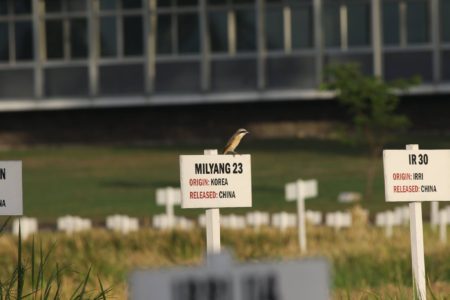
Milyang 23 is apparently a popular Korean rice variety. I wonder how they record the results in the database.
Brainfood: African land use, Sorghum double, NUS trifecta, Grape hybrids, Sunflower genome, Fungi, Tree dispersal
- Africa’s Land System Trajectories 1980–2005. Biomass harvest increase has mainly come from expansion, save in the north and south.
- Status, genetic diversity and gaps in sorghum germplasm from South Asia conserved at ICRISAT genebank. Still a lot of work to do.
- Indirect estimates reveal the potential of transgene flow in the crop–wild–weed Sorghum bicolor complex in its centre of origin, Ethiopia. Could be relevant if transgenic sorghum were ever to be developed, and deployed in Ethiopia.
- Are Neglected Plants the Food for the Future? The latest hope is the SDGs.
- Potential of Kersting’s groundnut [Macrotyloma geocarpum (Harms) Maréchal & Baudet] and prospects for its promotion. Not enough mutations, apparently. Hope that won’t be an issue for the SDGs.
- Back to the Future – Tapping into Ancient Grains for Food Diversity. They need to pay their way. Enough mutations, though, I guess.
- Genomic ancestry estimation quantifies use of wild species in grape breeding. 11-76% cultivated ancestry across 60-odd hybrids, one third 50%. More back-crosses to cultivated needed.
- Genome scans reveal candidate domestication and improvement genes in cultivated sunflower, as well as post-domestication introgression with wild relatives. Wild introgressions cover 10% of cultivated genome, and there is some in every modern cultivar tested.
- MycoDB, a global database of plant response to mycorrhizal fungi. Monumental.
- Contrasting effects of defaunation on aboveground carbon storage across the global tropics. Loss of dispersal animals bad for C sequestration, but only in African, American and South Asian forests.
Brainfood: Med diet, Rice relatives, Local breeds, NGS, Extremophiles, Farmers’ rights, Wild foods
- Prototypical versus contemporary Mediterranean Diet. They’re basically the same.
- Development of Oryza sativa L. by Oryza punctata Kotschy ex Steud. monosomic addition lines with high value traits by interspecific hybridization. A very distant relative finally succumbs.
- Local breeds – rural heritage or new market opportunities? Colliding views on the conservation and sustainable use of landraces. Apparently, both is not an answer. At least in Finland.
- Exploring Genetic Diversity in Plants Using High-Throughput Sequencing Techniques. No excuse now.
- Extremophyte adaptations to salt and water deficit stress. Any crop wild relatives, though?
- Seed wars and farmers’ rights: comparative perspectives from Brazil and India. Stewardship vs ownership.
- Quantifying the economic contribution of wild food harvests to rural livelihoods: A global-comparative analysis. Three quarters of rural families use wild foods, but their contribution to income averages only 4%. Must be the nutrition, I guess.
World Food Prize for letting food be thy medicine
Congratulations to Drs Maria Andrade, Robert Mwanga, Jan Low and Howarth Bouis on being awarded the 2016 World Food Prize for their work on biofortification in general and the orange-fleshed sweet potato in particular:
“Let Food Be Thy Medicine,” a quote attributed to Hippocrates approximately 2,400 years ago, best captures the ground-breaking achievement for which the four distinguished 30th Anniversary World Food Prize Laureates are being honored in 2016 – the development and implementation of biofortification, breeding critical vitamins and micronutrients into staple crops, thereby dramatically reducing “hidden hunger” for millions.
And let’s remember how much more difficult their work would have been if not for genebank collections that could be screened for flesh colour, along with the myriad other traits that make for a successful variety release.