- It’s not the science, stupid.
- More kelp, sir?
- New genome promises
world dominationnon-allergenic peanut. - The diet of Roman soldiers in Glasgow could have been worse. But did they have take-out?
- There is no more Nature, capital N.
Brainfood: Yam protection, Gleditsia distribution, Seed systems, Conservation narratives, Roselle diversity, Hassawi extinction, Apple GWAS, Dog domestication
- Disease risk perception and diversity of management strategies by farmers: The case of anthracnose caused by Colletotrichum gloeosporioides on water yams (Dioscorea alata) in Guadeloupe. Farmers gauge the disease pretty much the way scientists do, and use a diversity of mitigation measures, including diversity.
- Ghosts of Cultivation Past – Native American Dispersal Legacy Persists in Tree Distribution. “In the southern Appalachian region, honey locust distributions are more a reflection of Native American cultural practices.”
- Good year, bad year: changing strategies, changing networks? A two-year study on seed acquisition in northern Cameroon. In bad years, women call on extended networks.
- Conservation narratives in Peru: envisioning biodiversity in sustainable development. In terms of the relationship between conservation and development, there are biodiversity protectionists, traditionalists, localists, pragmatists, and capitalists.
- Diversity analysis based on agro-morphological traits and microsatellite based markers in global germplasm collections of roselle (Hibiscus sabdariffa L.). Nicely complementary datasets show that fibre type more diverse than calyx type.
- Extinction probabilities of Hassawi cattle from Saudi Arabia using Population Viability Analysis. Fancy maths gives it 20 years.
- Genome to Phenome Mapping in Apple Using Historical Data. Going back to old phenotype data in GRIN allowed identification of SNPs for color, fruit firmness, and harvest time.
- Genomic and archaeological evidence suggest a dual origin of domestic dogs. Independent domestications from different wolf populations in East Asia and in Western Europe, with the latter partially displacing the former.
Happy birthday, Nazareno Strampelli
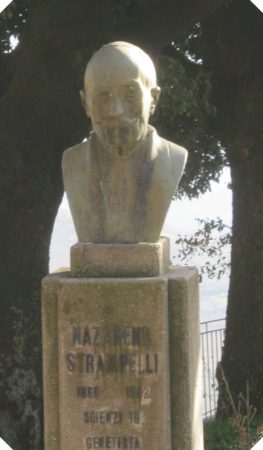 Please everyone run on over to Jeremy’s Eat This Podcast and listen to his masterly appreciation of the life and career of legendary Italian wheat breeder Nazareno Strampelli, The True Father of the First Green Revolution, on the 150th anniversary of his birthday.
Nazareno Strampelli, an Italian plant breeder, exactly foreshadowed Borlaug’s work by about four decades. His wheats doubled production in Italy and beyond and were crucial to the second green revolution ushered in by Borlaug. He was born on 29 May 1866, 150 years ago as I write this. He deserves to be better known (as do all plant breeders, actually).
Brainfood: Rice & drought, Diet & biodiversity, Iranian fermentation
- Genetic and root phenotype diversity in Sri Lankan rice landraces may be related to drought resistance. Fancy genotyping and phenotyping picks out landrace whose name in Sinhalese means “drought rice.”
- The relationship between agricultural biodiversity, dietary diversity, household food security, and stunting of children in rural Kenya. Increasing dietary diversity could increase household food security.
- Biodiversity and origin of the microbial populations isolated from Masske, a traditional Iranian dairy product made from fermented Ewe’s milk. Streptococcus thermophilus doesn’t sound like a safe thing to be drinking, but I still want to try it.
- Well, what can I tell ya, that’s all that caught my eye last week. Send me your favourite paper that I missed, and I’ll summarize it in a sentence by next Monday.
Brainfood: Italian chickens, Maca genome, Ordonomics, AnGR, Stuffed potato, Biological control, Wild pea, Rice landraces
- Genetic variability of two Italian indigenous chicken breeds inferred from microsatellite marker analysis. Two Piedmontese breeds are closer to British breeds than other Italian or continental chickens. And poorly managed to boot.
- Genome of plant maca (Lepidium meyenii) illuminates genomic basis for high altitude adaptation in the central Andes. It’s the whole genome duplications, stupid.
- Rationalizing the GMO Debate: The Ordonomic Approach to Addressing Agricultural Myths. Yeah that’ll work.
- Factors and determinants of animal genetic resources management activities across the world. Capacity, says fancy maths.
- Accumulation of Genetic Diversity in the US Potato Genebank. The collection may need to double.
- Structure, function and management of semi-natural habitats for conservation biological control: A review of European studies. There is plenty of information on natural enemies in natural habitats (though not in woodlands, surprisingly), but not much on whether they make it to adjacent fields and actually have an effect on pests.
- Prospects of the use of wild relatives for pea breeding. More work needed. Starting with translating this thing from the Russian.
- Genetic Diversity Analysis Reveals Importance of Green Revolution Gene (Sd1 Locus) for Drought Tolerance in Rice. Back to the landraces.