- In praise of common names. Meh. You won’t see a Latin name in this whole Nibbles. See how you like it.
- Building a tomato. In Spanish.
- Tracking a tomato.
- The dark side of tomatoes.
- Amaranth to rescue Mexicans from obesity.
- Seeds of contention.
- Finding the lost Least Lettuce.
- Indigo goes back to the future.
- What if the monsoon fails? MS Swaminathan has some answers.
- Nice chocolate infographic from FAO.
- A diverse microbial community in and around roots helps plants thrive. The Science article is behind a paywall, but there’s a helpful infographic on Twitter.
- The US has a National Seed Strategy for Rehabilitation and Restoration. Vision? The right seed in the right place at the right time. Wish I’d thought of that.
- When otherwise useful trees attack. Ah, the irony of this coming right after the previous one.
- UK’s Global Food Security programme says extreme weather events are increasing and we must adapt agriculture. Good to know.
- And today’s Five Plants That Will Save the World are…
- Maybe add pawpaw to that?
- Japanese rice farmers: change gonna come.
- Nice coffee museum in Brazil.
- Early agriculture in the Caribbean: Cuba and Trinidad.
- The babaçu breakers of Maranhão are under threat. What’s babaçu? Yeah, well, look it up.
- “Seed banking began about 30 years ago as an improvement to individual farmers storing and using their own seeds.” Riiiiight.
- That Vilsak is a card.
Evaluating evaluation networks
Mike Jackson, who ran the IRRI genebank 20 years ago, has some provocative things to say on his blog about the International Network for Genetic Evaluation of Rice (INGER), which has just turned 40. Here is Mike’s main point:
In my opinion, INGER could—and should—have been more. According to the riceTODAY article, INGER is today, 40 years after it was founded, at ‘the crossroads’. But it was already at a crossroads almost 25 years ago when it became clear that UNDP support would end. Opportunities were not seized then, I contend, to bring about radical and efficient changes to the management and operations of this important rice germplasm network, but without losing any of the benefits of the previous 20 years. I also believed it should be possible to add even more scientific value.
If I understand Mike correctly, he thinks INGER has gone for quantity (of trials) rather than quality of late, and missed out on some clear opportunities to be even more successful than it has been. Counterfactual history is always tricky, but I wonder whether this is a testable proposition. Maybe there’s a natural experiment out there? For example, are there countries that have not taken much advantage of INGER in the past couple of decades. How have their rice improvement efforts fared in comparison to countries which have?
Coincidentally, there was a short article in the Times of India recently trumpeting the release of rice varieties of low glycemic index. Can INGER take some of the credit for that, I wonder? Well, let’s have a look.
One of the varieties in question is Sampada. The Indian Directorate of Rice Development’s catalogue of released varieties (1996-2012) has the following entry for this variety:
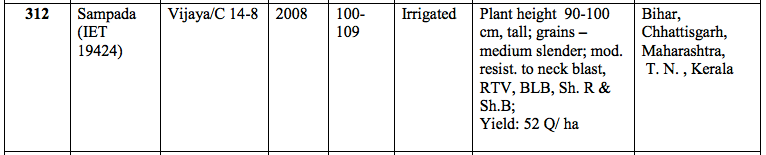
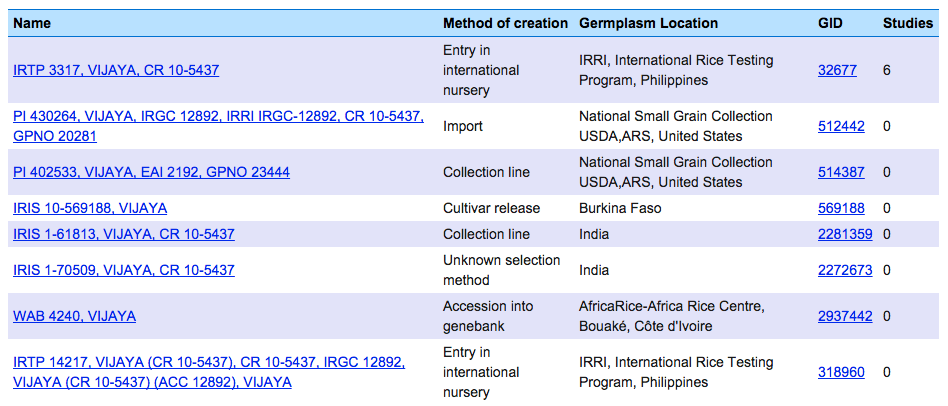
The immediate parents are therefore Vijaya and C 14-8. You can look these up in the International Rice Information System. Vijaya has featured in INGER’s nurseries:
And C 14-8 is safely in the IRRI genebank:

We saw it for wheat and maize, and now for rice. Partnership with the relevant CGIAR centre has been extremely important in the success of the Indian national breeding programmes for these crops.
Now, are there countries for which these partnership have not been so strong? And how successful have their breeding programmes been?
Brainfood: Brassica rethink, Camel colours, Parsing the ITPGRFA, Static buffalo, Traits not taxa, Expert tyranny, Chinese pollinators, Heritage landscapes, Mining text, Diversity & nutrition
- Domestication of Brassica oleracea L. It happened in the balmy Mediterranean, not along those blustery Atlantic cliffs.
- Validating local knowledge on camels: Colour phenotypes and genetic variation of dromedaries in the Nigeria-Niger corridor. The locally recognized colour-based breeds are not supported by the genetics.
- The Battle over Plant Genetic Resources: Interpreting the International Treaty for Plant Genetic Resources. The Treaty phrase “genetic parts and components, in the form received” can be interpreted in ways that do not clash with TRIPS. The author also suggests that the Benefit Sharing Fund should be used to pay lawyers, but I’m not sure if that’s tongue-in-cheek.
- The response of the distributions of Asian buffalo breeds in China to climate change over the past 50 years. Fancy maths says it’s minimal.
- Functional traits in agriculture: agrobiodiversity and ecosystem services. It’s not the taxa. Or it shouldn’t be.
- Expert opinion on extinction risk and climate change adaptation for biodiversity. In situ most preferable, ex situ most feasible.
- Conserving pollinator diversity and improving pollination services in agricultural landscapes.The view from China is much like the view from everywhere else.
- Heritage Values and Agricultural Landscapes: Towards a New Synthesis. Back to the future: heritage can mean resilience.
- Using legacy botanical literature as a source of phytogeographical data. Text parsed to yield maps. Brave new world.
- Production diversity and dietary diversity in smallholder farm households. Want better nutrition? Access to markets better than promoting production diversity.
Nibbles: CIAT job, Rice revolution, Pomegranate genebank, Spiderplant, Floating heritage, Lager origin, Amaro history, Golden Rice et al.
- CIAT genebank looking for a leader.
- IRRI soon-to-be-former (Thanks, Mike) DG looking for a new Green Revolution.
- Looking for pomegranates? Look no further.
- Cleome looking for markets. With genomics.
- Looking to the floating gardens of Bangladesh for answers.
- Looking for the origin of lager yeasts. And finding two of them.
- Looking to understand amaro.
- A good look at biofortification.
Nibbles: Kinky crops, Hot pepper, Cary Fowler, Gin history, Open data, Quaker food, QPM in Ethiopia, Botany app, Old seeds, New tomato
- Why aren’t there more crops among the orchids?
- This pepper is not so much a crop as a weapon of mass destruction.
- Now here’s a crop. New tomato has taste, storability, looks. But I think it’s dating.
- Maize with cool amino acids reaches Ethiopia. Must have walked there.
- Really old squash seeds.
- Cary Fowler on the Weather Channel. You heard me.
- Quakers have an opinion on the right to food and climate change. Well, why shouldn’t they? They also have a UN office, but that’s another story. No word on whether they made the Weather Channel.
- Ok, so apparently the answer is data. Says a data company. And open data at that. Quakers nonplussed.
- Botanizing in N or S America? There’s an app for that.
- The rise and rise of gin. And I certainly need one.