- It’s the edible memories, stupid!
- Even when the memories are poisonous.
- Johnny Appleseed knew a thing or two about edible memories.
- Onions are more than memories to Indian politicians.
- Colorful potatoes are not only edible, they could be medicinal memories.
- Bamboo and rattan want to be more than just memories.
- Scuba rice is much more than a memory.
Nibbles: Genebank videos, Genebank QMS, Leakey vid, Oz Oryza, Plant ID app, CGIAR saga, PNG food crisis, Impressive melons, Quinoa, Asian sheep diversity, Kenyan CSA
- Nice video on the Millennium Seed Bank at Kew. Compare and contrast with Ft Collins. Or CIAT’s genebank for that matter.
- Quality video on quality management systems in genebanks. No doubt followed to the letter by the three above.
- Video of webinar by Roger Leakey explaining how trees will save us: “The Global Food Crisis: Can we Heal a Divided and Ailing World?”
- Collecting wild rice in Australia. No video, alas, but nice pics.
- App to identify plants for leaves. If ever a video was needed…
- The latest on the CGIAR re-re-structuring. Hollywood interested, I’m told.
- Meanwhile, El Niño beginning to affect PNG.
- Which doesn’t stop a watermelon going for thousands in Japan.
- Hope El Niño doesn’t affect Colombia’s plans to stuff it to poor Bolivian quinoa farmers.
- Enough plants already. Asian sheep more diverse than previously thought, thanks to both migration from Fertile Crescent and indigenous development and back-dispersal.
- Not to mention “Surprising ways Kenyans are embracing climate-smart agriculture“.
Brainfood: Citrus colours, Soil biodiversity portal, Bean genome, Food diversity & security, French landscape diversity, US pigs, Alien crops, Thai food retail
- Exploring the diversity in Citrus fruit colouration to decipher the relationship between plastid ultrastructure and carotenoid composition. New, weird plastids mean new, weird colours.
- Towards a global platform for linking soil biodiversity data. A DivSeek for soils?
- A reference genome for common bean and genome-wide analysis of dual domestications. Not sure how we missed this. Two domestications confirmed, with distinct genomic signatures.
- Variability of On-Farm Food Plant Diversity and Its Contribution to Food Security: A Case Study of Smallholder Farming Households in Western Kenya. No relationship between farm diversity and food security. Say what?
- What is the plant biodiversity in a cultural landscape? A comparative, multi-scale and interdisciplinary study in olive groves and vineyards (Mediterranean France). Low intensity management with an eye to heritage is good for diversity. But, given the above, so what?
- Relationships among and variation within rare breeds of swine. American pig breeds are real. Mostly.
- Alien Crop Resources and Underutilized Species for Food and Nutritional Security of India. Bring them on!
- Traditional, modern or mixed? Perspectives on social, economic, and health impacts of evolving food retail in Thailand. It would be a pity of fresh markets were to disappear.
Documenting improved variety adoption
In my defence, I have visited the ASTI website before. Just not in a while, unfortunately. And I therefore missed a lot of developments. So thank you, Jeremy, for sending me there again earlier today. But let’s step back a bit. What is ASTI, anyway?
Agricultural Science and Technology Indicators (ASTI) provides trusted open-source data on agricultural research systems across the developing world. Led by the International Food Policy Research Institute (IFPRI), ASTI works with a large network of national collaborators to collect, compile, and disseminate information on financial, human, and institutional resources at both country and regional levels across government, higher education, nonprofit, and (where possible) private for-profit agricultural research agencies.
Very laudable. There’s a lot of useful stuff on the website, organized by country and region, but also covering the CGIAR centres. And the last is what I would like to focus on for a minute here. ASTI is hosting two projects tracking the adoption of improved varieties in South Asia and Africa. The raw data is downloadable, but there are useful summary graphics, though I would have liked them to be more easily sharable (the following examples are screenshots).
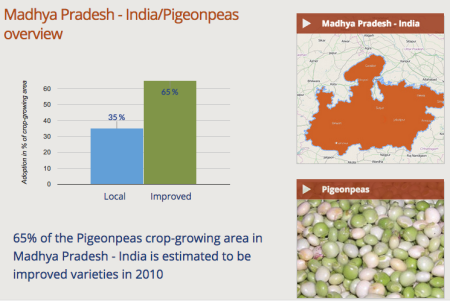
So, if we take as an example pigeonpeas in Madhya Pradesh, we get this overview:
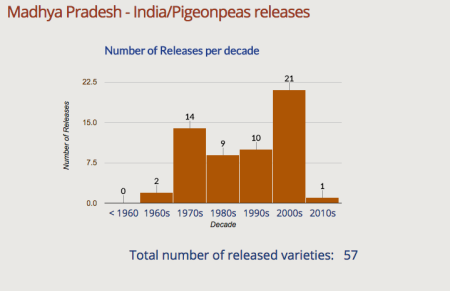
And a time line of releases:
And, perhaps most interestingly, the level of adoption of the main varieties:
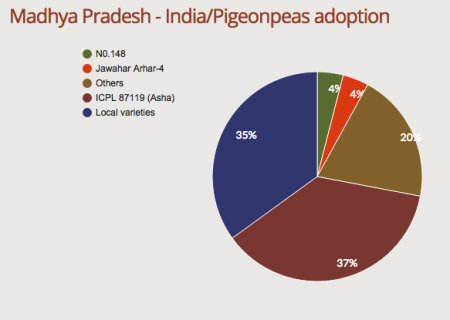
And if you’re interested in that 37% share, and I know you are, you can find out all about the variety in question, ICPL 87119 (otherwise known as Asha) from ICRISAT.
Nibbles: Plant names, Tomato trifecta, Amaranth, Corn wars, Wild lettuce, Dying, Indian ag, Chocographic, Root symbionts, Rehabilitation, Mesquite, Extreme weather, Saviour plants, Pawpaw, Japanese rice, Coffee museum, Caribbean early ag, Amazonian livelihoods, Vislak on corn
- In praise of common names. Meh. You won’t see a Latin name in this whole Nibbles. See how you like it.
- Building a tomato. In Spanish.
- Tracking a tomato.
- The dark side of tomatoes.
- Amaranth to rescue Mexicans from obesity.
- Seeds of contention.
- Finding the lost Least Lettuce.
- Indigo goes back to the future.
- What if the monsoon fails? MS Swaminathan has some answers.
- Nice chocolate infographic from FAO.
- A diverse microbial community in and around roots helps plants thrive. The Science article is behind a paywall, but there’s a helpful infographic on Twitter.
- The US has a National Seed Strategy for Rehabilitation and Restoration. Vision? The right seed in the right place at the right time. Wish I’d thought of that.
- When otherwise useful trees attack. Ah, the irony of this coming right after the previous one.
- UK’s Global Food Security programme says extreme weather events are increasing and we must adapt agriculture. Good to know.
- And today’s Five Plants That Will Save the World are…
- Maybe add pawpaw to that?
- Japanese rice farmers: change gonna come.
- Nice coffee museum in Brazil.
- Early agriculture in the Caribbean: Cuba and Trinidad.
- The babaçu breakers of Maranhão are under threat. What’s babaçu? Yeah, well, look it up.
- “Seed banking began about 30 years ago as an improvement to individual farmers storing and using their own seeds.” Riiiiight.
- That Vilsak is a card.