- Pssst, you breeder there? Need a data management system? IPB have got one for you going cheap…
- Maybe you want to test that out on some CIMMYT wheat and maize lines? CIMMYT can help you out with a new database.
- Bottle gourd: Out of Africa after all, by sea.
- World Congress on Agroforestry social media mashup for Day 1.
- The latest on the new EU legislation on the marketing of seeds.
- New Piper species found in Ecuador, and it’s a doozy.
Nibbles: Variety adoption data, Georgian biodiversity, Species migration, Agroforestry shindig, Perennial breeding, Pacific history, Livestock emissions, Dandelion rubber
- New database on the adoption of modern varieties. No doubt will eventually include the ones coming out of this shiny new rice regional hub in Burundi.
- Useful summary of what’s happening in agricultural biodiversity in Georgia. No mention of ITPGRFA ratification, alas. You can find previous editions of the newsletter of the CGIAR Regional Program for Sustainable Agricultural Development in Central Asia and the Caucasus here.
- CSIRO come up with map of where and how fast species will move due to climate change.
- And Google Earth now has the underlying climate data you need to do that kind of analysis.
- World Congress on Agroforestry off the ground. You can follow on Twitter, #WCA2014. Also, you can read the blog. Do you remember when this type of thing didn’t even have an RSS feed?
- Did we miss this thing of perennial grain breeding at the Land Institute when it came out a year ago?
- Nice long podcast and Q&A from the Bishop Museum on the footprint Hawaiians left on their islands before contact. Great stuff on GIS analysis of suitability of ancient landscapes for taro and sweet potato. And, coincidentally, an equally long video clip on Pacific island landscapes more generally, and how they shaped the culture (and agriculture) of the Polynesians.
- ILRI DG chides The Economist on article suggesting that the only way to decrease livestock emissions is to go industrial: “There simply is no moral equivalent between those making poor food choices and those with no food choices at all.”
- New EU project on Russian dandelion does not seem to include boffins who recently turned off the rapid polymerization gene. And will they use the right species? And do some ex situ conservation? I’m not holding my breath on that last one.
Brainfood: Genomics trifecta, Ex/in situ, Oat disease resistance, Drying beads, Biodiversity assessment, Maize models, Trees & nutrition, NTFP, Fortification
- Maintaining Food Value of Wild Rice (Zizania palustris L.) Using Comparative Genomics. Cultivated cultivated rice assists in the breeding of cultivated wild rice. If you see what I mean.
- Mining the Genus Solanum for Increasing Disease Resistance. The key is distinguishing the alleles from the paralogs.
- Genetic Dissection of Aluminium Tolerance in the Triticeae. And the trifecta from the Genomics of Plant Genetic Resources book. Rye has most, barley least, and we know how they do it.
- Dual Threats of Imperiled Native Agroecosystems and Climate Change to World Food Security: Genomic Perspectives. Genebanks are necessary but not sufficient.
- Identification of new sources of resistance to powdery mildew in oat. In the wild species, natch.
- Optimum ratios of zeolite seed Drying Beads® to dry rice seeds for genebank storage. 1:1 by weight.
- The Biodiversity Forecasting Toolkit: Answering the ‘how much’, ‘what’, and ‘where’ of planning for biodiversity persistence. Yeah, but will it work with agricultural biodiversity?
- How do various maize crop models vary in their responses to climate change factors? Enough to make using an ensemble best, not enough to doubt that temperature will be the main factor affecting yields by the end of the century.
- Dietary quality and tree cover in Africa. More trees, more dietary diversity, more fruit & veg consumption, though up to a point.
- The importance of local forest benefits: Economic valuation of Non-Timber Forest Products in the Eastern Arc Mountains in Tanzania. $42 million a year, spread over 2000 households.
- Fortification: new findings and implications. It’s worked in the US for some nutrients, but not for others, and in some case we don’t understand how and why. We know in other cases it is unlikely to work. Nutritionists have to work together with plant breeders. And, we would add, the agricultural sector in general.
The apple of Poland’s eye
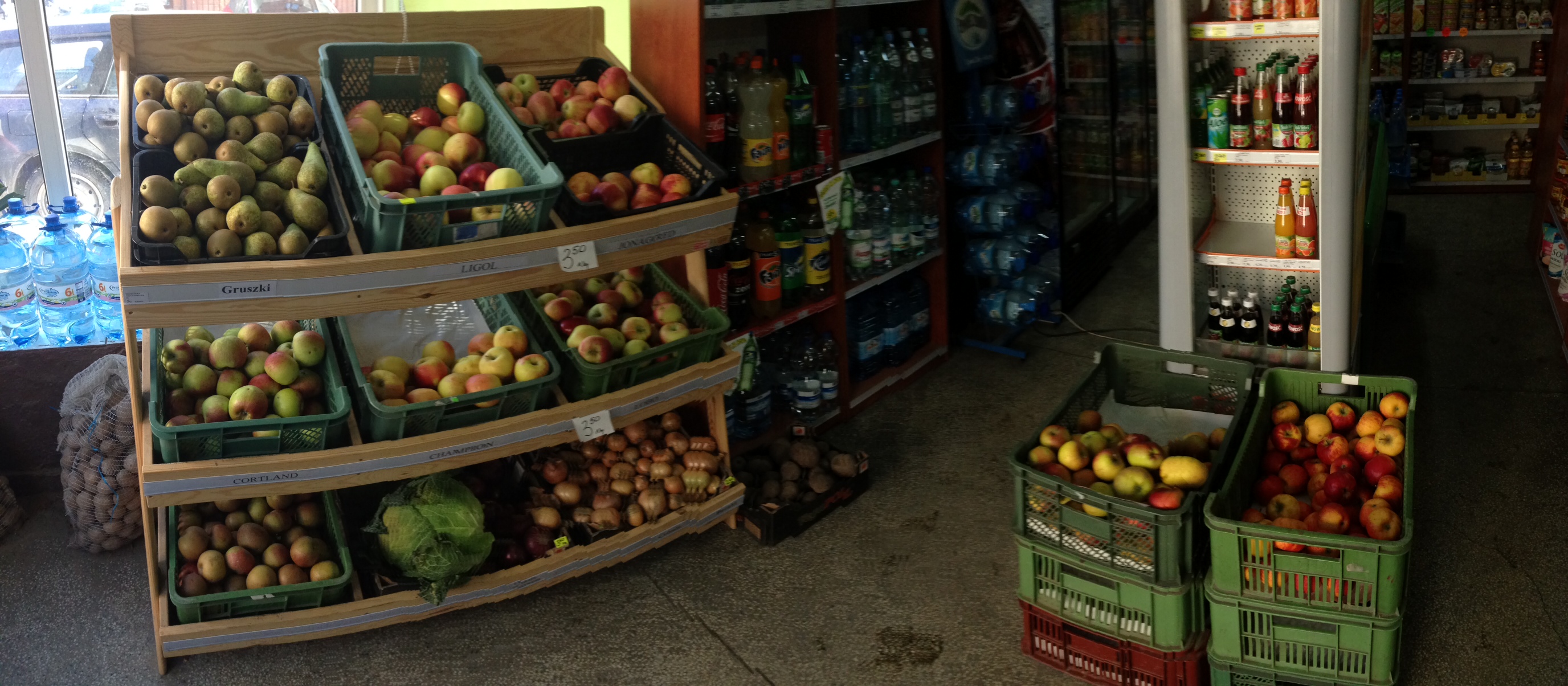
You may have noticed a certain slackness in our blogging last week. That’s because we were both travelling for work, Jeremy holed up at an undisclosed location with lots of copy and a red pen, myself in Warsaw, trying to drum up support for genebanks. It was my first time in Poland, and much too short a visit, but I learned a lot. Like that Poland is a huge apple exporter. It also, and perhaps not coincidentally, has a lot of apple diversity, and Poles are very proud of it. Even a small corner grocery shop in Warsaw will have half a dozen and more distinct varieties on display.
That, I was told, is at least partly due to the tireless efforts of the famous apple breeder Prof. Szczepan Pieniążek, founder and long-time head of the Research Institute of Pomology in Skierniewice. The apple genebank there has maybe a thousand accessions still. Prof. Pieniążek has obviously left quite a legacy, despite being, if I understand the Google Translate rendition of his Polish Wikipedia entry, a proponent of quasi-Lamarckian theories, after the fashion of the equally famous Russian breeder Ivan Vladimirovich Michurin. I guess, in breeding, practice is much more important than theory.
Nibbles: Quinoa, Millet, Prize, Agroforestry, Herdwick sheep, Plant breeding, Potato breeding book, Taro varieties, Hot chocolate, Spices
- Oh no! Super-writer Bittman condemns yet more Bolivian farmers to destitution with yummy quinoa recipes.
- Can Geoff Tansey help the poor millet farmers of the Deccan Plateau to avoid that fate?
- Maybe he should enter that millet “initative” for The Equator Prize.
- We’re deafened by the buzz in advance of the World Congress on Agroforestry.
- For example, better nutrition associated with trees in urban environments and rural tree cover.
- Today’s genome of passing interest: Herdwick sheep. They’re primitive, y’know.
- Realfood.org – a name to strike apparently undeserved fear into the hearts of the cynical – offers an encomium to conventional modern plant breeding.
- Which is apparently a lost art, at least as regards potatoes.
- But not taro, if latest news from Pacific is to be believed. Ignore the title, BTW.
- How they made hot chocolate in the olden days, the really olden days.
- Another stunner from the Botanist in the Kitchen: Spices and phylogeny.