- Backyard chickens too much hassle? We have the solution for you.
- Supplies go up, prices go down. Those pesky speculators had nothing to do with it.
- Prices go up … The story for India’s agrciultural labourers.
- Colombia’s loss will Ecuador’s gain. Predictions for bananas in the 2060s.
- Conventional farmer loves cover crops. Shurely shome mishtake.
- Building the pyramids. It’s a tough job, but at least you eat well.
- Beans with benefits. On the road with a breeder in Rwanda.
- Chinese maize diversity explored, a bit.
- Massive diversity of all sorts of thing, in German.
- Rhizowen has another favourite underutilised legume crop: Amphicarpaea bracteata subsp edgeworthii.
- It’s vino, but is it natural?
- How is a fig like a mulberry? The Botanist in the Kitchen explains.
- Capturing wild relative and landrace diversity for crop improvement. A conference, in June 2014.
- Agricultural Biodiversity Community @ Work. A conference, in June 2013. PENHA was there.
- Preparations are underway for Kew’s Great Seed Swap. Call me dumb, but I cannot see a date anywhere there.
- Purple sweet potatoes to dye for.
- Oh boy! A regional genebank for bamboo. A bambusetum, no less.
Brainfood: Identifying GMOs, European beans, Palm distribution, Croatian cattle, Beta biodiversity, Apple pollination, Chinese foxtail millet, New Brassica, Pennisetum & latitude, Egusi oil
- Next-Generation Sequencing as a Tool for Detailed Molecular Characterisation of Genomic Insertions and Flanking Regions in Genetically Modified Plants: a Pilot Study Using a Rice Event Unauthorised in the EU. A rice event? They mean GMOs.
- Genetic Diversity and Dissemination Pathways of Common Bean in Central Europe. Slovenia is mainly Andean, Austria a mixture of Andean and Mesoamerican.
- Spatial distribution and environmental preferences of 10 economically important forest palms in western South America. It’s the water, stupid.
- Genetic variability of microsatellites in autochthonous Podolian cattle breeds in Croatia. Istrian cattle and Slavonian Syrmian Podolians are similar, but not identical. I dunno, I just hope someone is keeping track of all this stuff.
- Biodiversity Assessment of Sugar Beet Species and Its Wild Relatives: Linking Ecological Data with New Genetic Approaches. Where to find them, and how to use them. EcoTILLING is the way to go, apparently.
- Biodiversity ensures plant–pollinator phenological synchrony against climate change. The more pollinators, the better.
- Molecular diversity and population structure of Chinese green foxtail [Setaria viridis (L.) Beauv.] revealed by microsatellite analysis. Domesticated has geographical structure, wild does not. Origin in N China.
- A new species of Brassica sect. Brassica (Brassicaceae) from Sicily. It never ends.
- Latitudinal patterns of diversity in the world collection of pearl millet landraces at the ICRISAT genebank. Aim for 15°–20°.
- Genetic Mapping of Seed Traits Correlated with Seed Oil Percentage in Watermelon. Egusi, to be precise. Aim for bigger seeds.
Nibbles: Lathyrism, Ancient maize, Sustainable cacao, Bioversity on agrobiodiversity, Weird fruits, Carrot seed, Palm wine, Buckwheat, Halophytes issue, Weird(ish) crops, Urban malnutrition, Old oranges, Molasses, Indian tree institute
- An ODAP detective story.
- Ancient maize gets a map.
- Diversity is the key to sustainable cacao.
- New Bioversity DG answers the tough questions.
- Be the first on your block with an unusual fruit tree.
- How to grow awesome carrot seed.
- The hard life of Nigerian wine tappers.
- Bringing back buckwheat in Bhutan.
- Annals of Botany to do halophytes.
- Come down to earth with the realization that most people have never heard of cowpea and cassava. Would they have heard of black-eyed peas and tapioca, though?
- Big report on urban malnutrition. Maybe cassava (see above) can help?
- The last orange grove in the San Fernando Valley. No word on what the variety might be.
- All about molasses.
- Indian tree breeding institute, and accompanying genebank, get a write-up.
- Yes, I know that I could have done a better job of pointing out the connections among some of these things, but it’s been a long week.
Hari Upadhyaya of ICRISAT genebank recognized by CSSA
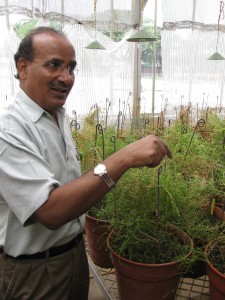 Congratulations to Dr Hari Upadhyaya, head of the ICRISAT genebank, on being awarded the Frank N. Meyer Medal for Plant Genetic Resources by the Crop Science Society of America. If you’re going to the award breakfast, you’ll be able to hear Hari talk in person about “Crop germplasm to overcome challenges to global food and nutritional security.” If you’re not going, here’s a taste of what you’ll be missing. Well done, Hari!
Nibbles: ICRAF meet, Genome meet, Websites redux, Breadfruit video, Livestock project, Data, Kansas wheat, Chief scientists pontificate, Medieval melons, Peruvian foodiness, Whiskey
- ICRAF are having their Science Week. Follow it on Twitter. And let us know if you’re there and want to write about anything agrobiodiversity related that comes up.
- Plant Genome Evolution 2013 has been and gone, alas, but Chris Pires has storified the whole thing, pretty much. Lots of crops in there. But it’s disappeared now, of course.
- Bioversity and FAO redesign their websites. Tell them what you think.
- Diane Ragone talks breadfruit. With video goodness.
- Aussie researcher talks about landing Gates grant to improve African livestock. Hopefully some conservation in there somewhere.
- Decentralizing data: to empower communities; and to empower geeks.
- Data, you said? Here’s data on why Kansas needs wheat breeders.
- The world’s chief agriculture scientists want to share genetic resources. Good of them.
- Europe used to have more melons.
- Enough with the Peruvian superfoods meme, please.
- I may have said this before, but it’s still valid: I need a drink.