- Big Oil vs Big Corn. The Economist says End the ethanol tax.
- Grow edamame, young farmer.
- Agri experts call for a comprehensive food policy in Pakistan. Not gonna happen. There or anywhere else.
- But is this where it would start?
- Utterly confused by second-hand sources, I’m sending you straight to the horse’s mouth for information on Plant genetic resources and seeds: Community resilience in the face of change, a three week course in November 2013.
- Yeah, but will they teach you about Terralingua’s Vitality Index of Traditional Environmental Knowledge?
- CIMMYT doubles its haploids centrally now, at least in Africa.
- He coulda been a contender, but instead he breeds pigeons. Which is just as good, in my estimation.
- Photo essay on Sudan’s gum arabic industry.
- ILRI spell out the pros and cons of livestock. Always good to have the data.
- Who needs a national seed bank when you can have local ones like this one in Spain?
- Remember that draft SADC seed law RAFI didn’t like yesterday? Well, they’re not alone.
- Remember that Syngenta tomato that won that award yesterday? Well, now try these.
Nibbles: Property rights, Dryland crops, New tomato, CGIAR genebanks, Quinoa in US, Wasps and figs, Ancient New World agriculture, Allium CWR, SADC seed law, ESA, Coconut pollination
- Why tenure matters. And why it doesn’t.
- Book on alternative crops for dry areas. Not that alternative, settle down. And anyway, how do they do in mixtures?
- And the award for Best New Variety of the Year goes to…
- CGIAR Consortium hires private sector biotech expert to oversee genebanks et al.
- US set to grow more quinoa. Shame on you, taking the bread out of the mouths of Andean peasants!
- Save our figs!
- Malanga and cassava important on Mayan menu. And maize maybe not so much on Pueblan one as thought.
- New onion wild relative spotted in Central Asia.
- GRAIN objects to new one-size-fits-all SADC seed law.
- Ecological Society of America discovers agriculture.
- Indian institute trains first female coconut pollinators.
Brainfood: Farming systems, Connectivity, Neolithic China, Paleolithic China, Wheat genomes, Litter domestication, Arabian relatives, Pepper composition, GMOs vs agrobiodiversity
- Using biodiversity to link agricultural productivity with environmental quality: Results from three field experiments in Iowa. Diversify any way you can. Even in Iowa.
- Improving conservation planning for semi-natural grasslands: Integrating connectivity into agri-environment schemes. Connect any way you can. Even in Europe.
- Early millet use in northern China. Very early. Starch grains push broomcorn millet use in China back 1,000 years, and foxtail millet 2,000.
- Paleolithic human exploitation of plant foods during the last glacial maximum in North China. And ten thousand years before millets, there were wild grasses, roots, tubers and gourds.
- Draft genome of the wheat A-genome progenitor Triticum urartu. Can be used to find agronomically important genes. But settle down, it’s only one of the 3 wheat genomes, after all.
- Aegilops tauschii draft genome sequence reveals a gene repertoire for wheat adaptation. Not so fast, here comes the D genome too…
- Side-effects of plant domestication: ecosystem impacts of changes in litter quality. Domestication led to higher quality, more easily decomposed litter.
- Crop wild relatives from the Arabian Peninsula. 400 of them.
- Compositional Characterization of Native Peruvian Chili Peppers (Capsicum spp.). There’s much variation, but not that much.
- Feeding the world: genetically modified crops versus agricultural biodiversity. Guess which one is drinking the other’s milkshake. And a similar blast from the past.
Healthier maize available for development
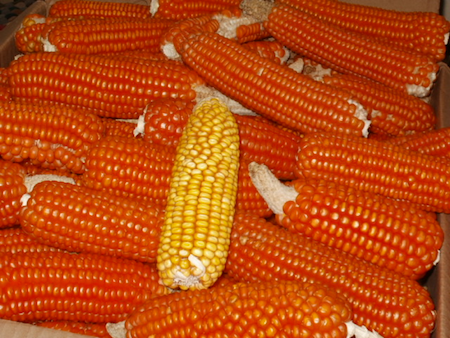
The real subject of this picture is not the yellow ear front and centre, but the orange ones in the background. They represent a high-carotene variety that could add to the arsenal of foods targeted at vitamin A deficiency. This orange maize was bred by a backyard breeder who is looking to share the variety with people who could help to take it further. The variety is “particularly suited to 30-36 degrees of latitude,” so any researchers in South Africa, Namibia, Botswana, Mozambique, India, Pakistan, Afghanistan and elsewhere who might be interested in continued development, leave a comment here. The breeder is being supported by Seed Matters, and they’ll be keeping an eye on this post to follow up directly.
Nibbles: Agroforestry, Genomics conference, Weed propagation, Potato gene, Potato Bean, Seeds, Chilli breeding, University, Prize, Arroz etc, Sinai, Maple syrup, Raw milk, Cacao
It’s Easter. A bigger than usual haul to see you safely through the lean times ahead.
- Simons says, plant a tree. And here’s how.
- FAO had an e-conference on “Impacts of genomics and other ‘omics’ for the crop, forestry, livestock, fishery and agro-industry sectors in developing countries” and all I got was this pdf.
- I personally think The Dude would prefer seeds.
- That potato day-length gene paper deconstructed. A bit.
- Owen’s
Potato beanhopniss seeds have sprouted. Can a new variety be far away? - No doubt he’ll be contributing to a list of US seed suppliers for perennial veg.
- There are perennial peppers, you know. A new weapon as the pepper breeding wars heat up?
- And enthusiasm for Kerala Agricultural University cools down.
- “Attention responsible gene stewards!” You had me at Attention. (But you lost me at responsible gene stewards.) On the other hand, if you are “diligent about developing or releasing durable varieties that will ensure long-term global wheat security” stick with it.
- Arroz, trigo, maíz y patata. The usual story: Casi todos los esfuerzos de la Revolución Verde se han enfocado hacia la mejora de los denominados cultivos principales.
- Farming in the Sinai is 5000 years older than it used to be.
- How to get genuine maple syrup.
- Raw milk is fine. No it’s not.
- Nestle and Mars commit to equality for women cocoa farmers. Mondelēz has not yet responded to Oxfam-inspired consumer pressure. Perhaps because few people know they’re Cadbury and Suchard and Toberlone and … what’s with that stupid ē anyway?
Enjoy that Creme Egg!