- Cassava gets a makeover in Brazil. And another, of a different kind, in East Africa.
- Revolution turns into Terror. Where’s our Napoleon?
- Designating Costa Rican cheese.
- Conserving poverty?
- No poverty for bean breeders in the US.
- The uses of Oregon Grape. Which is of course not a grape.
- Chaffey Style.
- Coconut water is a major conservation issue for 2013. It says here.
- Fewer farmers, more fires. In the Amazon. It says here.
- Yeah, what is balsam anyway?
- So the Next Big Thing in African ag development is agricultural growth corridors. What could possibly go wrong? Will they learn from wildlife corridors? Will they be using these four apparently key technologies? Or bolstering extension? And will it all mean a decrease in bush meat consumption?
- Heritage foods book. Yummie.
- Like potatoes in Peru, I guess. And various street foods in West Africa.
- Conference on native seed use in the US. Probably even some crop wild relatives in there.
Going wild at Asilomar
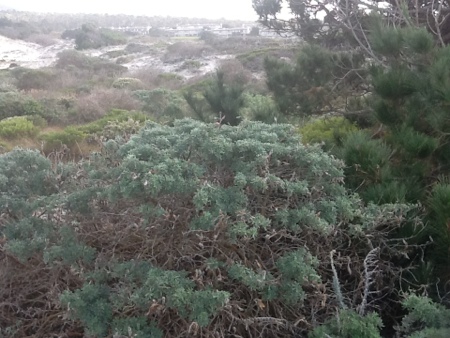
Breeders and genomics researchers are meeting at the Asilomar Conference Grounds, Pacific Grove, California to discuss how genomics can facilitate the use of crop wild in crop improvement. Follow on Twitter using #cwrgenomics. The wild lupin in the photo is found on the sand dunes just outside the conference facilities. There’s also a smaller, rarer one, but I haven’t found it yet.
Nibbles: Invest in farmers, Invest in cassava, Invest in a writer
Nothing to see here, move along edition:
- FAO calls for “farmer-centred approach to investment for agriculture”. I.e. more money for us.
- Cornell gets US$25.2M for “Next Generation Cassava Breeding”. I.e. more money for research.
- IITA clones Cornell press-release, knocks out hyperlinks.
Brainfood: Core collections, Romanian pigs, Commons, Valuation, Biofortification, Yam characterization, Pompeii diet, Rice grain genetics
- Maximizing genetic differentiation in core collections by PCA-based clustering of molecular marker data. It works. In simulations, to be fair.
- Study of rare traditional pork breeds concerning the aspect of biodiversity conservation. Mangalitsa is what you want, apparently.
- Open Variety Rights: Rethinking the Commodification of Plants. A “protected commons”? Sounds a bit like the ITPGRFA to me.
- Natural and cultural heritage in mountain landscapes: towards an integrated valuation. Yeah, but does your cultural heritage include things like agricultural biodiversity?
- Fortifying plants with the essential amino acids lysine and methionine to improve nutritional quality. Conventional breeding hasn’t worked. But has it been for want of trying? Just askin’.
- Genetic and phenotypic diversity in a germplasm working collection of cultivated tropical yams (Dioscorea spp.). Relationships among species, synonyms, duplicates, yada yada.
- Roman food refuse: urban archaeobotany in Pompeii, Regio VI, Insula 1. Romans ate a Mediterranean diet. Still no cure for cancer.
- Genetic bases of rice grain shape: so many genes, so little known. Why bother? Just askin’.
The value of Natura 2000
Speaking of return on conservation actions, which we sort of were a couple of days back:
A new study has produced the first indicative estimate of the overall economic benefits provided by the Natura 2000 network. It suggests that the value could be currently between €200 and €300 billion per year, or 2% to 3% of the EU’s Gross Domestic Product.
That’s from one item in a special Thematic Issue of the European Commission’s news alert organ Science for Environment Policy which focuses on “Management and Monitoring of the NATURA 2000 Network,” (pdf) a network of protected areas that is described in the editorial introducing the issue as the “cornerstone of EU biodiversity policy.”
- What does ‘wilderness’ mean?
- First EU-wide economic valuation of Natura 2000 network
- Improved local management needed for the Natura 2000 network
- Natura 2000 Case Study Hoge Kempen: from coal mining landscape to oasis of biodiversity
- Improved communication about Natura 2000 may help resolve landowner conflicts
- Ecotourism: protecting the nature of Natura 2000 in Latvia
- Natura 2000 Case Study Slitere National Park: sustainable tourism in a Natura 2000 site
- Natura 2000 Case Study Eurosite – Adaptive Management of Natura 2000 sites
- Protected areas act as stepping stones for nature in the face of climate change
- New Belgian approach to favourable conservation status for habitats and species of European interest
- Sustaining the Natura 2000 network through LIFE
We’ve talked before about Natura 2000 in the context of conservation of crop wild relatives. I’m willing to bet that return on investment doesn’t take into account any species important in crop improvement that the network happens to be protecting. But if you know better, let us know.