Brainfood: Wild soybean, Leafy vegetables collection gaps, Banana drought tolerance screening, Chinese soybean breeding, Malagasy coffee collections, Bacteria on beans

Illustrated catalog of potato varieties launched in Peru

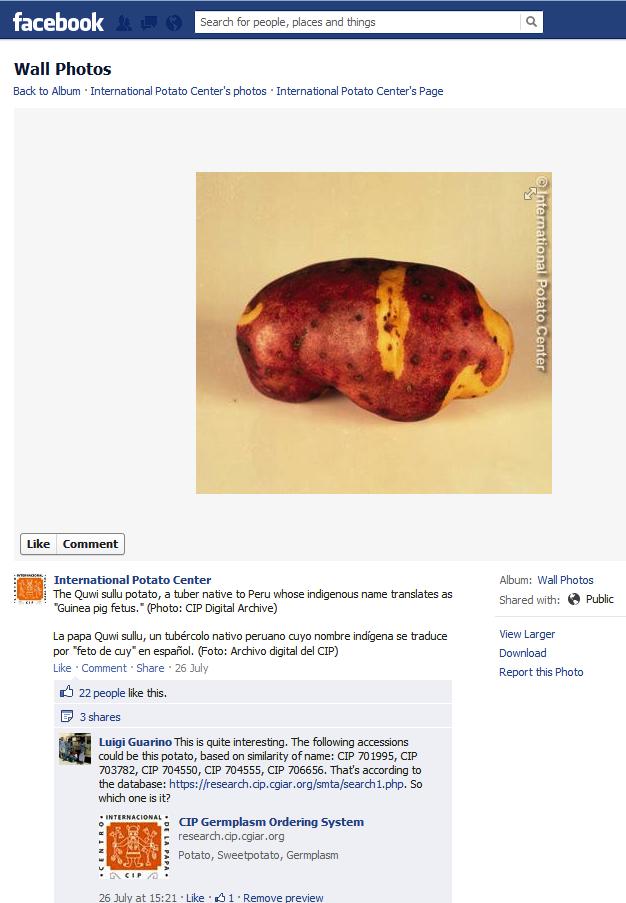
The International Potato Center has been running an Andean Potato of the Day feature on Facebook. And yes, they are potatoes, stop sniggering at the back there. Anyway, they’re really professional photos of often very weird and attractive traditional potato varieties, many of them with extremely weird names, and it made me curious as to what extent all this diversity is in CIP’s genebank. It turns out the photos were taken in 1999-2000 during a field trip into the Andes organized to provide high quality illustrations for the book “La Papa: Tesoro de los Andes.” CIP’s genebank curators were asked to help with the spelling and translation of the local names, but the photographs are of material freshly harvested from farmers’ fields, not the genebank. Most (not all, alas) of the varieties illustrated are in fact in the genebank, as you can check by searching for the local name (as I did for the “Quwi sullu” potato shown here), though it is occasionally tricky to be certain, due to variation in the spelling of the local name. This is another version of the problem we encountered in an earlier post dealing with rice, where it was not possible to be sure of the identity of material used in a particular piece of research because only the local name was quoted, rather than the accession number. Anyway, I bring all this up now because CIP has just announced the publication of an illustrated catalog of new potato varieties for Peru, with the now obligatory shout-out on Facebook. I haven’t seen the catalog yet, but I do hope it includes accession numbers.

Jersey shored up

We have often pointed out on this blog that it would be advisable to collect and stick into genebanks the local varieties found in a particular locality, 1 especially the ones found only at that locality, before introducing new diversity, no matter how much “better” that new diversity might be considered to be just now. In fact, I kind of made that point just a couple of days ago for sweet potato. So it is gratifying to find an example of just that, and nevermind that it’s from the livestock world.

The story is from an article by Dr Harvey Blackburn in the July issue of Hoard’s Dairyman. It’s kind of difficult to access online, but Corey Geiger, Assistant Managing Editor at Hoard’s, kindly allowed us to publish some excerpts. Dr Blackburn is coordinator of the USDA’s National Animal Germplasm Program (NAGP), based at the National Center for Genetic Resources Preservation in Ft. Collins, Colorado. His article is entitled “Isolated Jersey genetics are a treasure trove” and tells the story of how the Royal Jersey Agriculture and Horticultural Society entered into a partnership with NAGP to safegueard the genetic integrity of the Jersey cattle breed.

Jersey dairy cattle are found in at least 82 countries where they have made substantial contributions to animal agriculture. The progenitors of these cattle can still be found on Jersey Island. For over 219 years these cattle have been kept in genetic isolation from non-Jersey Island cattle — but this situation changed in 2008. The Royal Jersey Agriculture and Horticultural Society (RJA&HS) promoted and after evaluation by the States of Jersey parliament concluded that Jersey genetics could be imported and used on island Jersey cattle, with a proviso that they have an enhanced pedigree status of seven generations of recorded ancestry and no known other breed in the pedigree.

But that wasn’t the only proviso.

An important consideration in allowing the importation of Jersey genetics was the need to have semen safely cryopreserved and stored in a secure facility. By having such a reserve the RJA&HS could reintroduce the pre-importation genetic composition of Jersey cattle, if so desired. The RJA&HS found a secure facility and willing partner with the National Animal Germplasm Program (NAGP) located at the National Center for Genetic Resources Preservation in Ft. Collins, Colorado and part of USDA’s Agricultural Research Service. The NAGP has been developing germplasm collections for all livestock species for over 10 years and has amassed over 700,000 samples from more than 17,000 animals representing approximately 130 livestock breeds and over 100 commercial and research lines. Currently the collection has over 600 bulls from U. S. and Canadian Jersey populations. The program has also been used by researchers and industry alike to characterize and reestablish animal populations.

Samples from 400 Jersey bulls were sent in January 2012.

The States of Jersey and RJA&HS decision to allow importation while ensuring pre-importation genetics was safely preserved provides a model for how genetic variability can be preserved while enabling the livestock sector to make necessary changes to meet existing and future production challenges. In addition it is an example of how countries can be mutually supportive in conserving animal genetic resources through gene banking.

Amen to that.
OFSP steal the show

OFSP conspicuous by their absence in a Nairobi supermarket.
I said yesterday that orange-fleshed sweet potatoes (OFSP) were all the rage in early August, and I wanted today to provide the evidence. HarvestPlus mounted a well-coordinated and extremely effective media blitz. In addition to regular posts on Facebook and Twitter, there was a press release, an infographic and a brief. This all really paid off in terms of coverage. In particular, hardly a piece on the Global Hunger Event organized by the UK Prime Minister David Cameron to cement the legacy of the Olympics failed to mention OFSP. I don’t begrudge them this: OFSP are important .

The wife tucks into an OFSP grown by her mother.
But mostly missing among all the hoopla, alas, was any reference to the diversity of sweet potatoes available in the world’s genebanks, including as regards colour and nutrient content. And the possible effect of introducing these new varieties on the old ones still in farmers’ fields, and perhaps not yet safeguarded in said genebanks.

What I read on my summer holidays

Yeah, summer is over and I’m back at work. Maybe you noticed I haven’t contributed much here in the past month or so. Or maybe you didn’t. Jeremy kept up a steady stream of agrobiodiversity nuggets pretty much all through August. But my lack of activity on the blog doesn’t mean I haven’t tried to keep up, as you would know if you followed us on Facebook, Twitter or Scoop.it. Anyway, for those that don’t, and would like to catch up on my summer reading, here is, in nibble form, what caught my eye during the past month or so: