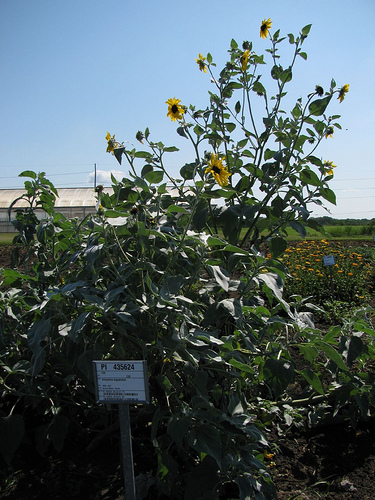
I recently learned in a throw-away comment during the Q&A after a talk about the Vavilov Institute (VIR) genebank that until just a few years ago a single accession was the main source of early maturity in peanut, a line called Chico. And that variety supposedly traced back to Russia, not a place I for one usually associate with groundnut cultivation, or indeed breeding. Worth a little digging (pun intended).
Let’s start with Chico’s significance. Our go-to guy for groundnut genetic resources confirmed that it was indeed one of the most important sources of early maturity, together with Gangapuri and JL 24. It was used extensively at ICRISAT and various other breeding program for many years, although a number of other sources have now been identified in the mini-core collection.
Next, where did it come from? It is clear in the registration notification that it was in fact a selection from a line from a Russian breeding programme:
Chico was developed by line selection from PI 268661, an introduction into the United States in 1960 from Rhodesia. It had come originally from Krasnodar, USSR, where it was designated Arachis Line No. 370 from ‘VNIIMK 8459.’
PI 268661 is still available in GRIN. That links to the original entry in the plant introduction book for 1960, which reads like this:
268661. SB52. ‘Apaxuc 370’. From U.S.S.R.
This was part of a large consignment of peanuts from what was then Northern Rhodesia and is now Zambia.
268491 to 269135. ARACHIS HYPOGAEA L. Fabaceae. Peanut.
From Rhodesia. Seeds presented by the Mount Makulu Research Station, Chilanga. Received Oct. 11, 1960.
AB denotes alternate branching bunch variety.
AR denotes alternate branching runner variety.
SB denotes sequential branching bunch variety.
BC denotes from Tozi collection, Sudan.
IN59 denotes a 1959 introduction into Rhodesia.
SR denotes Southern Rhodesia strain collected in 1959.
Mount Makulu, incidentally, is still where the Zambian national genebank is housed.
So somehow or other a peanut variety called Apaxuc 370 from a place called Krasnodar, which was in some way derived from VNIIMK 8459, ended up in Northern Rhodesia and, along with many other peanuts, was in due course sent to USDA in 1960 by staff of Mount Makulu. Where it no doubt hung around for a while, but was eventually evaluated and identified as being interesting. A line was then selected and released in 1973 by the Georgia, Virginia and Oklahoma Agricultural Experimental Stations. And the rest is history.
But can we go any further back in time? I asked our friends at VIR and it seems not, unfortunately. “Krasnodar” is in fact the Research Institute of Oil Crops in Krasnodar (VNIIMK is its Russian acronym).
Their names very often consist of the abbreviation “VNIIMK” plus a breeding number. However, there are no accessions numbered “8459” in the collection. Varietal names include numbers of 4 digits, but they always begin with “1”.
Oh dear. What about that Apaxuc 370? First, “apaxuc” is clearly just a rendering of the Russian for peanut (арахис). From VIR again:
There are no lines numbered 370 in VIR’s collection as well. In our peanut catalogue No. 307 corresponds to the variety Stepnyak bred at VNIIMK and used for oil production purposes. It was registered with the catalogue in 1945. The pods of this variety are quite different from those of var. Chico in size and shape: they are larger and have a deep constriction between seed vessels.
Another dead end. VIR does have Chico in its genebank (catalogue No. 1199), but that came in 1980, from the US, with no further information about its history. Bit of a mystery, though, about how its progenitor got from Krasnodar to southern Africa.
There are no data in our documentation on any germplasm exchange with Rhodesia in the middle of the 20th century. Neither there were any additions to the collection from South African countries whether by collecting missions, seed requests or research visits.
And an even bigger mystery about where that progenitor came from in the first place. Was it something Vavilov himself collected on his South American travels, perhaps. I’d like to think so, but I fear we may never know. Not from the existing passport data, anyway. Maybe someone has done some molecular work, though?