- BBC says we can feed the world through technology. And why not. The Times of India, meanwhile, didn’t get the memo.
- Bill Gates at the IFAD Governing Council will probably say the same thing today. And put his money where his mouth is.
- CIMMYT Director General said the same recently at an Economist conference. Funny how genebanks are rarely among the saviour technologies being touted.
- It’s all about the scaling up, isn’t it?
- Tell that to the Lake Chad fisherfolk who are now turning to farming.
- And, in another universe, sushi seeks protection.
- Buffel vs Rhodes in the Arabian peninsula.
Getting to the root of the Ceora family tree
Those of you who remember our little discussion here recently of grasspea breeding, and in particular the importance (or otherwise) of breeding for low values of the neurotoxin β-N-oxalyl-L-α,β-diaminopropionic acid (β-ODAP) in its seeds, will not be surprised to learn that a press release a few days ago announcing a new(ish) promising low-ODAP variety called Ceora sent me scurrying around in Genebank Database Hell.
Grass pea is a hardy annual legume with a growth habit similar to field pea, characterised by resistance to both drought and waterlogging. Its low cost, low input nature makes it a prime feed crop.
It has been restricted in use, however, due to the presence of neurotoxin ODAP, which causes paralysis of the lower limbs (lathyrism).
This was overcome by the breeding of cultivar Ceora (Lathyrus sativus) by Dr Colin Hanbury, Prof Kadambot Siddique and Dr Ashutosh Sarker of the Centre for Legumes in Mediterranean Agriculture (CLIMA).
With an ODAP level of 0.04 to 0.09 percent, Ceora virtually eliminates the toxin’s effects, making it safe for animal consumption.
Dr Gusmao has delved deeper into the plant’s benefits.
Those benefits are a suite of adaptations to cope with, and indeed also avoid, water deficits. Promising indeed. But how was this miracle plant concocted?
Ok, so googling pretty quickly revealed that Ceora, which incidentally “is the first grass pea (Lathyrus sativus) cultivar to be bred and released in Australia” …
…was derived from a cross made in 1994 at Northam, Western Australia (WA), using female parent K33 (originating from Pakistan) x male parent 8604 (originating from Bangladesh).
That’s from its official registration note. So all we now have to do is trace K33 and 8604. And that’s where I hit a wall. Because apart from finding that 8604 was also subsequently called ATC 80723 (see page 425 here), I could make no further headway. 1 Sure, 8604 might be this accession in GRIN. But then again it might not be. And of a K33 (in its various permutations) from Pakistan I could find no mention in any database. There’s a grasspea labelled K33 cv Zubryak from Russia in VIR’s database, but that’s coincidence, surely.
So I was reluctantly forced, and not for the first time, to enlist the help of a Virgil, in this case Dirk Enneking, who has commented here frequently on grasspea and other pulse breeding issues. To cut a long story short, he used his global network of grasspea contacts to discover (or re-discover, as he also found some of this stuff buried in his old notes), that 8604 is a breeding line developed by crossing the Indian line Pusa-24 (as male) with the Bangladeshi landrace “Jamalpur local” (female). Both P-24 (as it is also known) and Jamalpur local have a history of use in grasspea improvement. The former in particular is known for its low ODAP content. As for, K33 its origin seems to lie with Pakistani researcher Hafeez I.T. Khawajas, but little is know beyond that.
Anyway, all this is of any conceivable interest to anyone only if they can get hold of the germplasm. 2 Ceora is of course commercially available, although a reference sample is also stored in the USDA system. So too is P-24, although it is presumably also in the Indian genebank at NBPGR (and perhaps ICARDA, though I couldn’t find it on Genesys). Hopefully all this stuff is at Horsham, but I cannot be sure because they, like NBPGR, are not online. For now.
P.S. And here’s a final thought. This took a couple of weeks and endless emails to unravel. The much more complicated Wita 9 pedigree story just a few clicks. Once we get genebank databases sorted out, we’ll have to link them to breeders’ databases. Once.
P.P.S. Now, speaking of grain legume breeding in Australia, did someone mention the Afghan pea accession PS998?
Who should we thank for Wita 9?
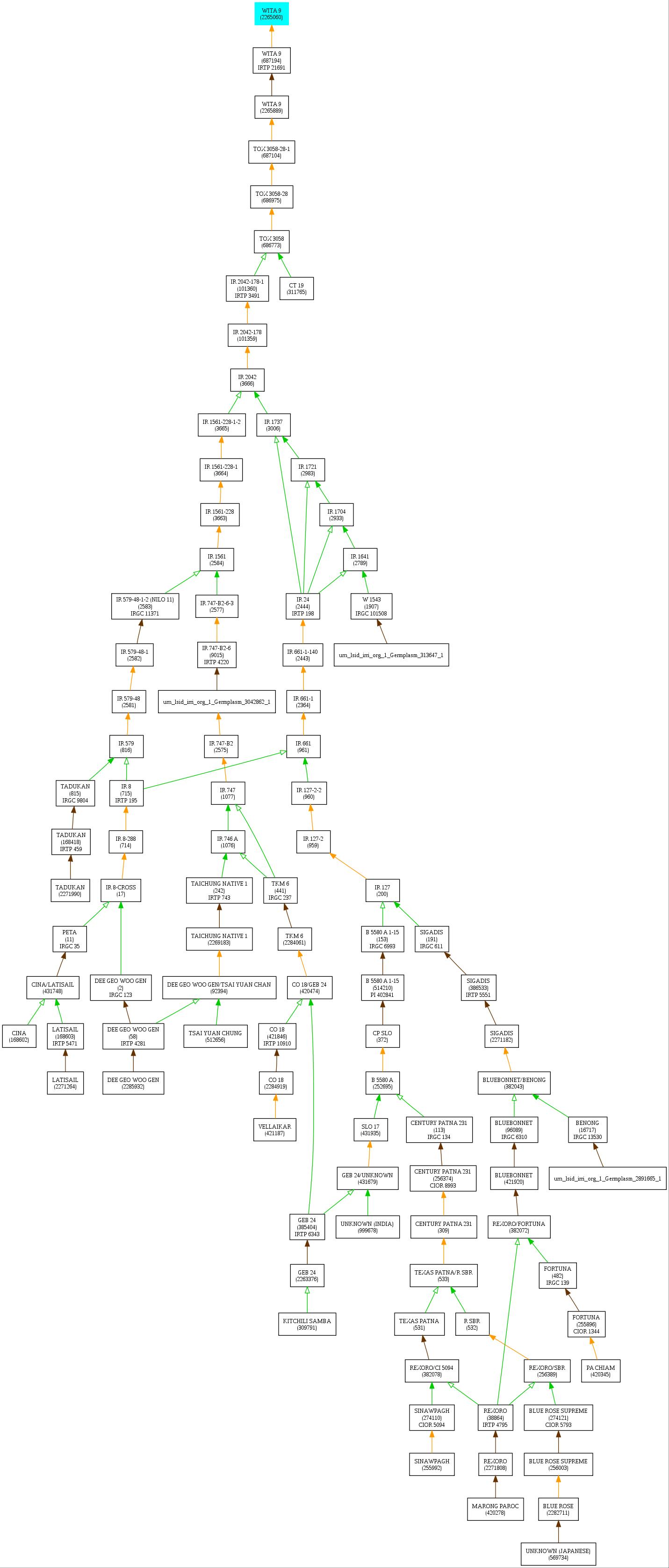 A tweet by the FAO Media Center alerted us to a feel-good story about women and rice in Côte d’Ivoire. unfortunately, I couldn’t catch the name of the variety, but the folks at FAO explained it was something called WITA 9. That turns out to be an oldish (1998) Oryza sativa variety that’s been tested quite a bit in West Africa, for example in comparison to NERICAs. With a little help, I looked it up in IRRI’s germplasm management system (see its pedigree at the side) and it turns out that those Ivorian ladies have researchers in three CGIAR Centres (IRRI, CIAT and AfricaRice), germplasm from half a dozen countries and of course the IRRI genebank to thank for their new livelihood option.
Brainfood: Chestnut restoration, Zoo legislation, Millet landraces, Cassava in Congo, Agroforestry in Philippines, Baobab (again), Silvopastoral system taxonomy
- Modelling chestnut biogeography for American chestnut restoration. As all 7 species have very similar climatic niches, if you could get a blight-resistant hybrid, it would probably be adapted to North American conditions.
- Ex situ conservation programmes in European zoological gardens: Can we afford to lose them? No, and therefore the EU needs to step in. Whoa, talk about a non sequitur.
- The Fine Scale Ethnotaxa Classification of Millets in Southern India. Malayali farmers can consistently recognize more phenotypes than DNA analysis, and some of the cryptic landraces might be really useful.
- Diversity of cassava (Manihot esculenta Crantz) cultivars and its management in the department of Bouenza in the Republic of Congo. High, but decreasing, at least in some villages. But overall? Any collections made?
- Indigenous agroforestry in a changing context: The case of the Erumanen ne Menuvu in Southern Philippines. Despite being divinely-sanctioned, the pengegnewiran swidden system is changing, in response to socio-economic changes. It needs to, and blaming the people because you don’t like the result is not very helpful.
- Variation in biochemical composition of baobab (Adansonia digitata) pulp, leaves and seeds in relation to soil types and tree provenances. Soil has a big effect. At least in Benin.
- Comparing silvopastoral systems and prospects in eight regions of the world. They’re all going to need more active management.
Triple-grained rice news
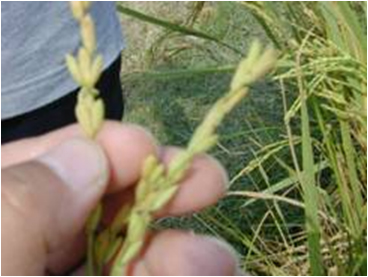
What it is to have friends, especially knowledgeable friends. Bhuwon Sthapit, local rice wallah extraordinaire, 3 responded quickly and in depth when asked what he knew about triple-grained rice.
Unique local rice landraces in Nepal are being lost, replaced by modern varieties. At least two of these are multi-seeded: Laila Majnu (the name refers to a pair of famous lovers, never separated until death) and Amaghauj (which means cluster of mango). Until 1999 Amaghauj was grown by one farmer on 3 katha of land, but was discontinued as the land was sold to another farmer. This local variety has a cluster of spikelets (at least 3 potential grains) originating from the same base; this heritable trait could potentially be used to breed new rice types offering increased yield. It is currently saved in community seed banks.
As Bhuwon also notes:
There is great potential to link community seed bank and national seed bank to harness such untapped and unknown resources.
And if you want even more, another friend, Ruaraidh Sackville Hamilton, Head of the IRRI genebank, points to Morphological Observations on Many Kerneled Grains in Rice. Don’t be scared by the Chinese; English follows.
LATER: For completeness, the name of the Bangladeshi variety which started all this, Biram Sundori, means “beautiful girl from Birampur,” which is the place where it is grown. Thanks to Zakir Sor for leading us all on this journey of discovery.