In the wake of recent news of successes in biofortifying root and tuber crops like sweet potato and cassava, it is as well to remind ourselves that grains also provide micronutrients, 1 and a paper in Plant Genetic Resources: Characterization and Utilization does a good job of just that for the somewhat neglected cowpea. 2
The authors assessed 1541 accessions from the IITA genebank for the crude protein, Fe, Zn, Ca, Mg, K and P content of the grains. They found fairly wide diversity, but recognized some 9 groups of accessions within which the nutrient profiles were relatively similar. The “best” 50 accessions belonged to only three of these groups, and seven of the best 10 accessions to just one group. While admitting that “increased mineral content in the grains does not guarantee increased nutrient status for the consumer,” they concluded that
…members of some groups such as G5 and G9, which included TVu-2723, TVu-3638 and TVu-2508, would be potential sources of genes for enhancing protein and mineral concentrations in improved cowpea varieties. These lines would therefore be selected and used in crossing for generating segregating populations from where selections can be made for newly developed nutrient-dense cowpea varieties.
It may be the subject of another paper, but what Ousmane Boukar and his co-authors do not do in this one is investigate whether groups G5 and G9, which as I say are based on mineral composition, also hang together morphologically or geographically. Here’s the geographical distribution of the IITA collection, based on data in Genesys (you’ll see it better if you click on it):

The top 10 accessions in fact come from Benin, India (2), Mali, Nigeria, Puerto Rico, the US (3) and Zaire, so the latter is probably unlikely. Unfortunately, only the Mali and Benin accessions are georeferenced, but look at the nighbourhood of one of them, TVu-8810 from Benin, shown here in red:
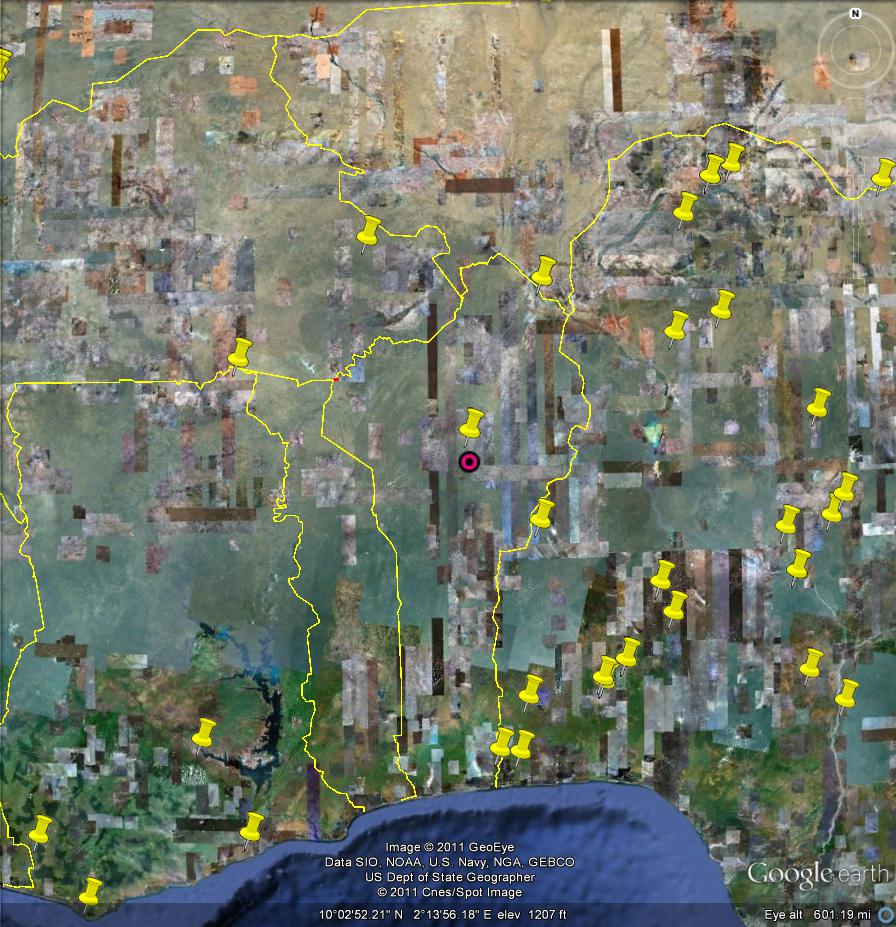
Worth collecting a bit more around the village of Borgou?