- “[R]ice plants in hotter and drier parts of Australia tend to be more genetically diverse“. Which means, natch, that they’re “a bulwark against climate change”.
- USDA tests wholewheat flour from 14 different varieties for their value in baking. Which varieties? They aren’t saying.
Brainfood: Cassava in Colombia, Tubers in Peru, Breadfruit diversity, Hominins and elephants, Evolution, Domestication, Mongolian sheep, Roads, Econutrition, South Asia food composition
- Informal “Seed” Systems and the Management of Gene Flow in Traditional Agroecosystems: The Case of Cassava in Cauca, Colombia. Farmers move cassava around a lot.
- Ecological and socio-cultural factors influencing in situ conservation of crop diversity by traditional Andean households in Peru. Farmers should be supported in moving tubers around more.
- Nutritional and morphological diversity of breadfruit (Artocarpus, Moraceae): Identification of elite cultivars for food security. There’s a lot of it.
- Man the Fat Hunter: The Demise of Homo erectus and the Emergence of a New Hominin Lineage in the Middle Pleistocene (ca. 400 kyr) Levant. Disappearance of elephant led to replacement of Homo erectus. Quite a difference from the more recent hominin-elephant dynamic.
- Fitness consequences of plants growing with siblings: reconciling kin selection, niche partitioning and competitive ability. All agriculture is about reconciling kin selection.
- Cultivation and domestication had multiple origins: arguments against the core area hypothesis for the origins of agriculture in the Near East. Revisionism rules.
- Tracing genetic differentiation of Chinese Mongolian sheep using microsatellites. Five populations clustered by fancy science into, ahem, five populations.
- Road connectivity, population, and crop production in Sub-Saharan Africa. Fancy science reveals better roads would be good for agriculture. Hell, my mother-in-law could have told them that.
- Econutrition: Preventing Malnutrition with Agrodiversity Interventions. Home gardening is the way to go.
- Carotenoid and retinol composition of South Asian foods commonly consumed in the UK. Palak paneer is not just good, it’s good for you.
Mining the minerals in cowpea
 In the wake of recent news of successes in biofortifying root and tuber crops like sweet potato and cassava, it is as well to remind ourselves that grains also provide micronutrients, 1 and a paper in Plant Genetic Resources: Characterization and Utilization does a good job of just that for the somewhat neglected cowpea. 2
The authors assessed 1541 accessions from the IITA genebank for the crude protein, Fe, Zn, Ca, Mg, K and P content of the grains. They found fairly wide diversity, but recognized some 9 groups of accessions within which the nutrient profiles were relatively similar. The “best” 50 accessions belonged to only three of these groups, and seven of the best 10 accessions to just one group. While admitting that “increased mineral content in the grains does not guarantee increased nutrient status for the consumer,” they concluded that
…members of some groups such as G5 and G9, which included TVu-2723, TVu-3638 and TVu-2508, would be potential sources of genes for enhancing protein and mineral concentrations in improved cowpea varieties. These lines would therefore be selected and used in crossing for generating segregating populations from where selections can be made for newly developed nutrient-dense cowpea varieties.
It may be the subject of another paper, but what Ousmane Boukar and his co-authors do not do in this one is investigate whether groups G5 and G9, which as I say are based on mineral composition, also hang together morphologically or geographically. Here’s the geographical distribution of the IITA collection, based on data in Genesys (you’ll see it better if you click on it):

The top 10 accessions in fact come from Benin, India (2), Mali, Nigeria, Puerto Rico, the US (3) and Zaire, so the latter is probably unlikely. Unfortunately, only the Mali and Benin accessions are georeferenced, but look at the nighbourhood of one of them, TVu-8810 from Benin, shown here in red:
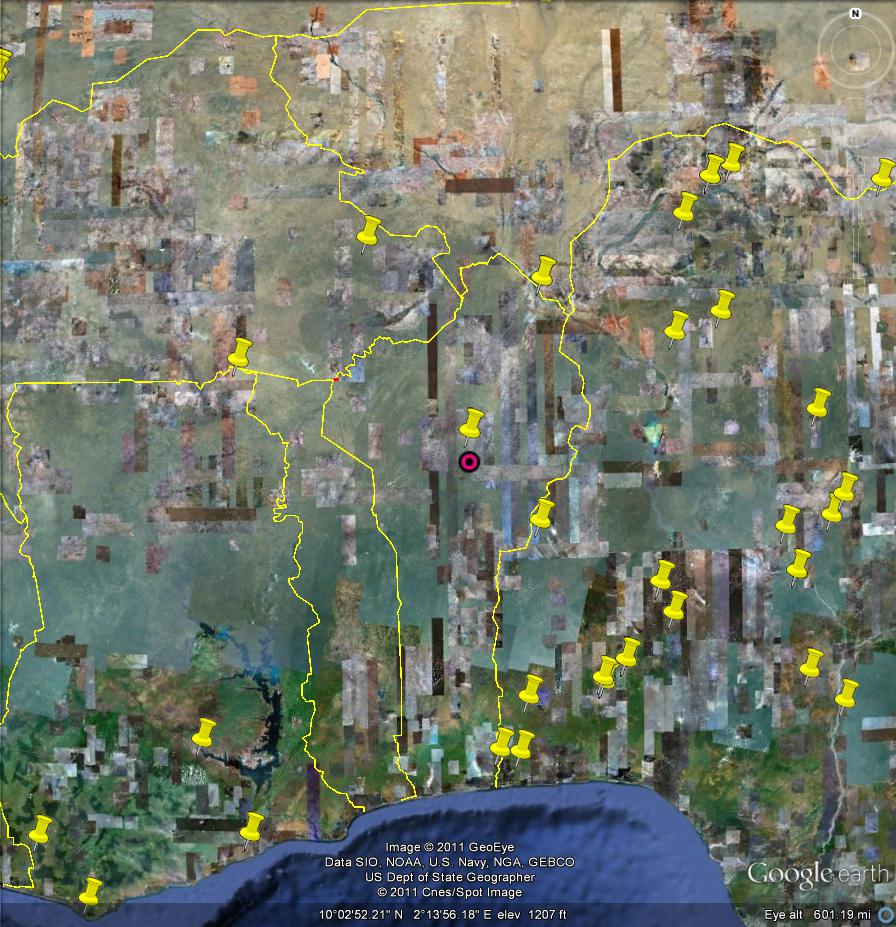
Worth collecting a bit more around the village of Borgou?
Nibbles: Coffee cryo, Potato catalogue, Chickpea Revolution, Community seed bank, Livestock gifts, Mexican grinding, Agroforestry in Pakistan, CGIAR, Japanese mint
- The value of conserving coffee diversity? Actually more like the cost, but anyway.
- CIP publishes a hardcopy variety catalogue. How quaint.
- The latest installment of the Consortium’s pean to the CG at 40 is all about chickpeas.
- Indian farmer to set up “collective seed bank for climate emergencies and future generations.” No word on whether he’s using Climate Analogues.
- I All African Horticultural Congress proceedings online.
- The case for and against livestock handouts.
- Mexican men do not grind.
- World Livestock 2011 out online as bunch of PDFs. How quaint.
- Pakistanis told to turn to agroforestry before it’s too late.
- Head of CGIAR says we need agricultural research to feed the world. Well he would, wouldn’t he.
- There’s money in them thar mints.
Where Burundi’s new rice comes from
Farmers in Burundi will soon sow the seeds of hard work and international cooperation with the release of two new rice varieties set to boost rice production and meet the rapidly growing demand for rice in Burundi.
Want to know how hard was the work? And how international? All you have to do is type “IR77713” into IRRI’s International Rice Information System. After some fiddling, you’ll get the following pedigree, which you’ll definitely need to click on to read properly. Remember that wherever you see IRGC or the TT Chang Genetic Resources Center mentioned that means the material came from the IRRI genebank.
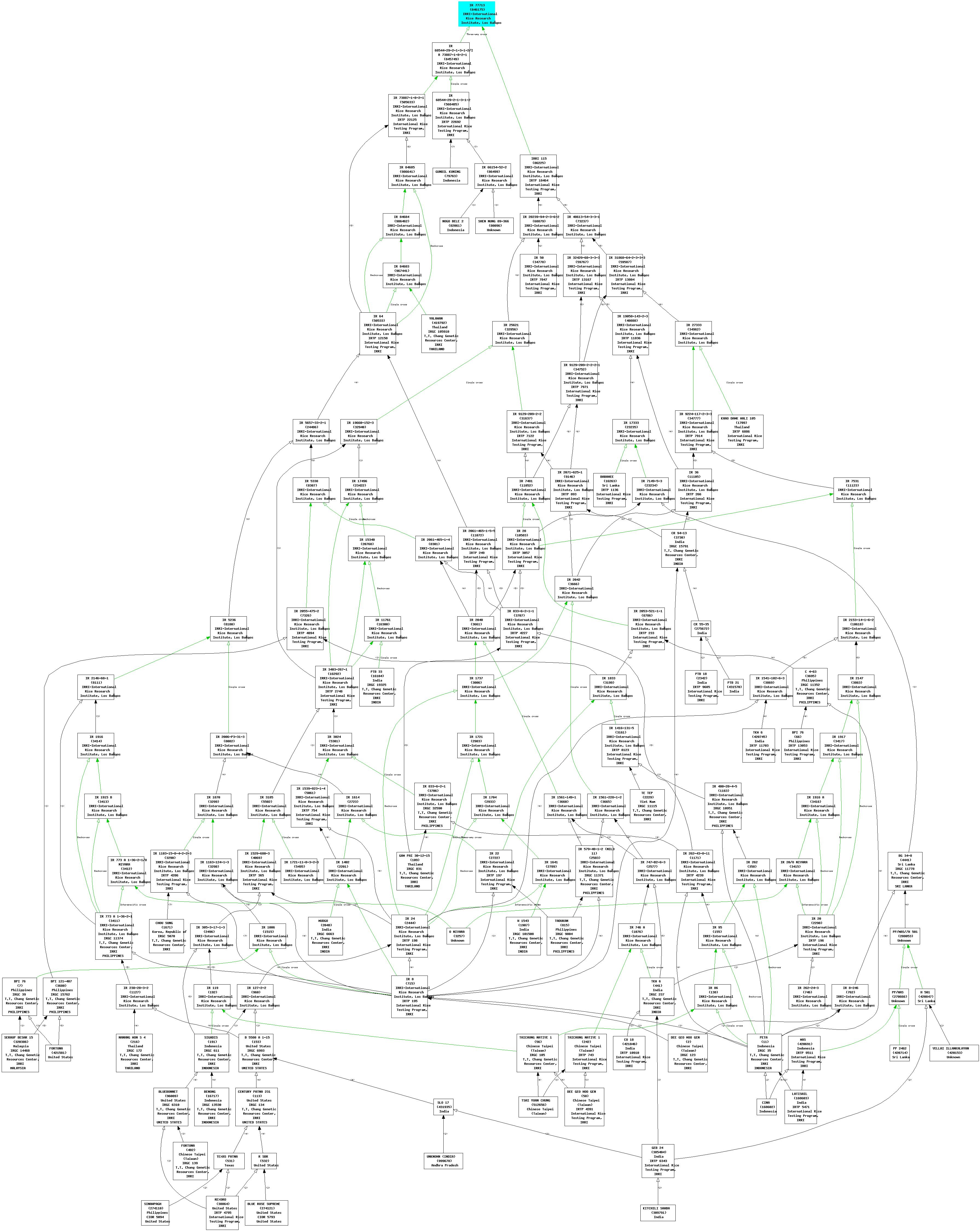
And that, dear reader, is why a multilateral system for access and benefit sharing is such a good idea.
One of the farmers who helped pick the new varieties, Ms. Scolastique Simbandumwe, shared, “I am happy that the varieties I selected are now released. I would like to get seeds now, to be among those who will multiply seeds, so that my income can increase.”
Not to mention genebanks.
“We congratulate IRRI for this achievement,” concluded Director General of Agriculture Sebastien Ndikumagenge, Burundi Ministry of Agriculture and Livestock. “By releasing these two varieties, IRRI contributes a lot to our efforts to find food for Burundians. We encourage IRRI to go forward.”