- Cattle do the wild thing in Vietnam.
- West African Ruminant Livestock: The Movie.
- An interesting new botanical blog on me.
- Who says working in a genebank is unrewarding? Technician is honoured with award, and that is not an oca she’s fondling?
- Back40 dissects the trouble with agriculture; it isn’t dignified. Well, it is, but …
- Forests are really, really good for economies.
- Andy Jarvis pulls it all together: looking forward to a climatically less diverse world.
Climate change and agrobiodiversity seminar report online
IISD’s report on the special information seminar that was held last Saturday at FAO headquarters in Rome, under the title “Climate Change and Genetic Resources for Food and Agriculture: State of Knowledge, Risks and Opportunities,” is out.
I must say I just don’t know what to make of stuff like this:
On conservation, several participants called for stronger focus on in situ conservation, with panelists noting that ex situ and in situ conservation are complementary strategies. Cock added that conservation must also ensure accessibility to realize appropriate deployment.
Surely we had that debate twenty years ago? Anyway, here’s the bottom line, in case you don’t want to plough through the whole pdf:
…Hodgkin said the morning session had shown that there is increasing acceptance of the ecosystem approach and the concept of ecosystem services in addressing linkages with climate change. Other messages included the: importance of accessibility of genetic resources and availability of information, especially in developing countries; different roles of in situ and ex situ conservation in addressing risks and enabling responses; need for an inter-sectoral approach to adaptation and mitigation; and recognition that climate change leads to the movement of agricultural biodiversity and creates a need for informed decisions of deliberate movements of germplasm.
The key messages from the afternoon session were: while climate change is being embedded in many agricultural strategies and plans, agriculture still needs to be embedded in climate change measures; there is a need for institutions and mechanisms to supply seeds to users; and there is a great need for capacity building activities for adaptation, such as evaluation and characterization.
Chair Mozafari added that participants had recognized the need: for the agriculture community to take action to ensure that GRFA are properly reflected in climate change efforts; to improve the knowledge base, in particular national knowledge on wild crop relatives and wild species; to reconcile efforts in all aspects of food security to ensure coherence; for global partnerships in research, evaluation and characterization; to prioritize the needs of the most vulnerable; and for financial resources. He suggested that CGRFA 13 reflect on how to communicate these needs to the UNFCCC and other instruments to put GRFA on the global climate change agenda.
LATER: And the report on day 1 of the regular session is out too now.
Climate change in the dry areas
You may remember I blogged from a conference in Amman over a year ago. It was about how climate change would affect food security in the dry areas. Well, the conference proceedings has been out for a while, courtesy of ICARDA, but I only just found out about it. Lots of interesting stuff in there. Thanks, Colin.
Heat vs Water: the death match
Although we write about the impact of climate change on agricultural biodiversity, and the need for biodiversity in plans to adapt agriculture to climate change, this is not a climate change blog. If it were, I’d be writing at length about some strange stuff going down.
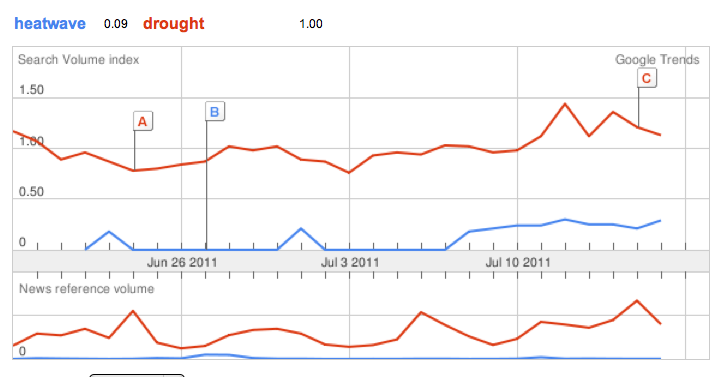
The US is facing both a drought and a heatwave. The drought is getting a lot of attention, the heatwave, not so much. The thing is, as Michael J. Roberts points out, the drought isn’t as bad as it looks, partly because there is irrigation where it seems worst, and partly because “standard drought indicators don’t predict crop outcomes especially well”.
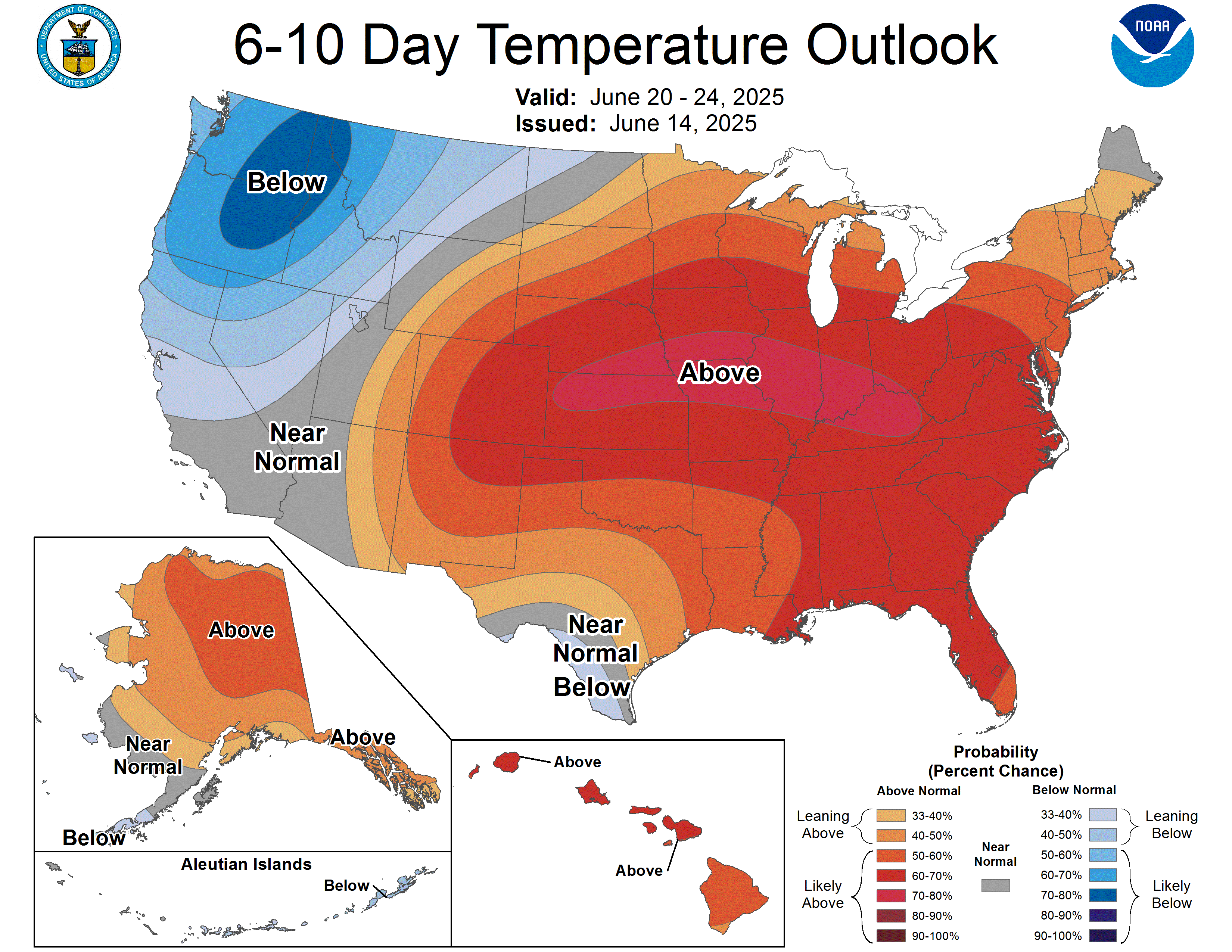
The heat may be far more important for crop yields especially coming, as it is, at a sensitive time, as the corn (maize) begins to blossom.
Roberts, an economist, is thus “much more bullish” about corn prices. That is, he expects them to go up, not because of speculation but because the supply is likely to fall short.
All of which raises some questions.
Is there a reliable heat danger index or forecasting tool for any crop?
Is anyone in the US breeding maize to withstand higher extremes of temperature?
How about switching to something more heat tolerant, like sorghum or a millet?
Especially for biofuel, if they really think that’s a good use for maize?
If they did switch, would people eat it?
I don’t want to belabour the point, but all the things we say people in Africa ought to think about doing, people in the US might want to consider too.
Climate change and PGRFA discussed, and discussed again
Jeremy and/or Andy will no doubt correct me if I’m wrong, because they’re there and I’m not, but I believe it is the very presentation embedded below that was made a matter of only minutes ago by our friend and colleague Andy Jarvis of CIAT at the Special Information Seminar on CLIMATE CHANGE AND GENETIC RESOURCES FOR FOOD AND AGRICULTURE: STATE OF KNOWLEDGE, RISKS AND OPPORTUNITIES at FAO. How’s that for timeliness. If not, then Andy will probably give it at the CGRFA-13 side event on pretty much the same subject on Tuesday. Or maybe both? No online sign of the other presentations yet, but I’ll get the scoop on the event from the boys this evening, I expect.