- Saving the scrub lupine. Well, it’s a crop wild relative of sorts.
- Dietary approaches to reduction of belching. No, not less beer and peanuts in front of the TV.
- “Governments and institutions should strongly promote new agricultural technologies suitable for smallholders through increased investment in crop breeding and livestock research.” That would be IFPRI on the actions needed to prevent recurring food crises. Hope that includes supporting the genebanks.
- “Can’t nutritionists make up their minds? They keep changing things!” Nuff said.
- Carrots are exotic? In Canada? Yes indeedy.
- Rachel dissects the cost of proper poi in Hawaii.
- Behold Barhal, relative of breadfruit.
- High yielding mung-bean repatriated to Somalia. Genebanks protect and serve?
- Do your bit for conservation, eat an invasive. Or, perhaps, a bison?
- Bad news for Indian mangoes. What I want to know is whether there are any varieties that are doing really well.
- Mediterranean forests going up in smoke. Bad for the crop wild relatives in them too, no doubt
Brainfood: Chia, Lentils, Bambara groundnut, Cacao, Amaranths, Rwanda, Cherimoya, Conservation, Drought, Plasticity, Phenology
- Extending the range of an ancient crop, Salvia hispanica L.—a new ω3 source. So we can grow it in the US, natch.
- Characterization of the lentil landrace Santo Stefano di Sessanio from Abruzzo, Italy. In the market, some are not what they claim to be; I’m shocked.
- Genetic diversity in Bambara groundnut (Vigna subterranea (L.) Verdc.) as revealed by phenotypic descriptors and DArT marker analysis. They’re pretty diverse, especially in Cameroon/Nigeria, which may be where they were domesticated.
- Genetic diversity and spatial structure in a new distinct Theobroma cacao L. population in Bolivia. They’re different from other cacao populations, and probably indigenous to Bolivia.
- Systematics and taxonomic delimitation of vegetable, grain and weed amaranths: a morphological and biochemical approach. Relationships? It’s complex.
- First and second millennium a.d. agriculture in Rwanda: archaeobotanical finds and radiocarbon dates from seven sites. Earliest pearl millet (Pennisetum glaucum), finger millet (Eleusine coracana) and sorghum (Sorghum bicolor) in the region, but do they really mean AD?
- The use of consecutive micrografting improves micropropagation of cherimoya (Annona cherimola Mill.) cultivars. It does, what more can I tell you?
- Social and ecological synergy: Local rulemaking, forest livelihoods, and biodiversity conservation. Big meta-analysis reveals complexity and the importance of participation by “local forest users.”
And here are a trio of rhyming couplets, if you see what I mean:
- The relative importance of drought and other water-related constraints for major food crops in South Asian farming systems. Drought and water constraints are widespread in South Asia. Though they contribute no more than 20-30% of current yield gaps, investment in genetic solutions needs to continue. Alas, there are significant Challenges in breeding for yield increase for drought. Nothing that can’t be overcome, though.
- Rethinking species’ ability to cope with rapid climate change. It’s the plasticity, stupid.
- Meta-analyses suggest strong selection on flowering phenology both in plants in general and in chickpea in particular.
Nibbles: Tomatoes, African rice, Entebbe, Coconuts, Wild relatives, Economic botany
- “On the contrary, ‘doesn’t come true from seed’ is another way of saying ‘has lots of exciting diversity’.” Rebsie rounds up her tomatoes.
- Domestication of African rice explored at the Vaviblog.
- Entebbe Botanical Gardens has a genebank. That’s all I know.
- Roland continues to dream of a South Sea genebank paradise; one island, one coconut variety.
- “Cary Fowler explains the vital importance of crop wild relatives to address the future challenges to agriculture,” it says at the Trust website.
- Let them eat bread. Foreign Affairs on food riots. h/t Rachel, who has some interesting things to say on the subject.
- Fascinating behind the scenes insights into Economic Botany collections at Kew and elsewhere.
Nibbles: Sake, Wine, Kew, Climate change, Canada, Banana processing
- To a hammer, everything is a nail; Decanter magazine bemoans loss of sake breweries in Japan.
- One door closes, another one opens; “price winning” Croatian wines.
- Why go to Kew when you can tour with Google streetview?
- Slideshow on genebanks and climate change adaptation in Ethiopia. Wish I could hear the words.
- Canadians! Your heritage crops and breeds need you.
- How best to dry banana slices in Ethiopia.
The climate–demography vulnerability index of my mother-in-law
 Another dispatch from the outer reaches of GISland. Yesterday’s post on the likely consequences of climate change around my mother-in-law’s farm in Kenya got me thinking that it would be nice to see where that locality fits in the global vulnerability scene. One can actually do that thanks to a recent paper in Global Ecology and Biogeography. 1
The authors start by calculating something they call Global Climate Vulnerability Index (CVI)
…by combining climate change forecasts with current relationships between human density and climate. We further refined the CVI by contrasting predicted vulnerabilities with demographic growth rates to create a climate–demography vulnerability index (CDVI) reflecting the spatial disparities between demographic trends and climate-consistent population growth.
The global map of CDVI is Fig. 5 in the paper. But how to get that into Google Earth? Thanks to the raw GIS files from one of the authors, and some R magic from friend and occasional contributor Robert, I now have a kmz file of CDVI, on top of which I can easily plot the location of the mother-in-law’s spread at Gataka near Limuru. In the map below, dark blue is bad, light blue less so.
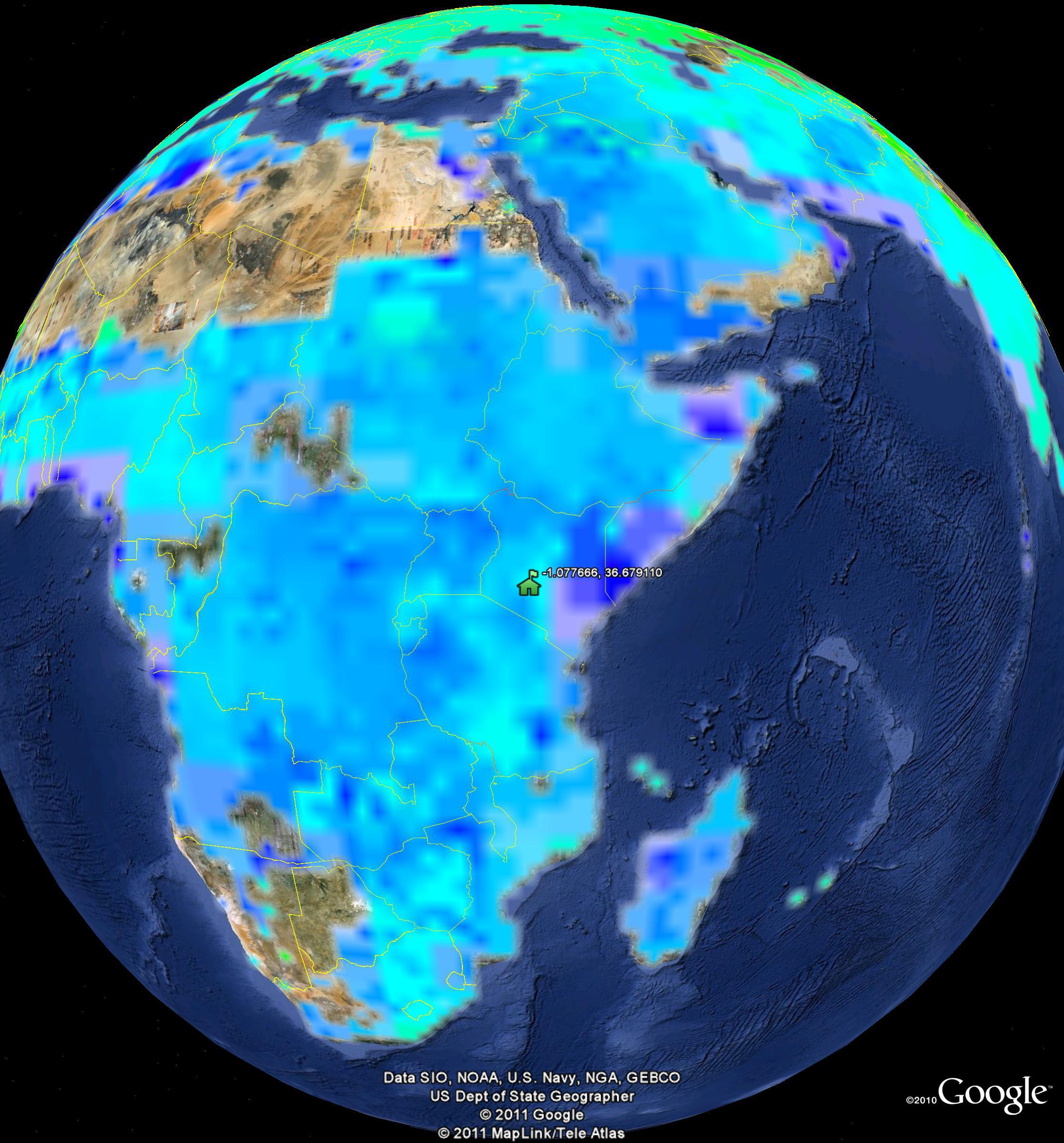
Gataka turns out to have a slightly positive CDVI.
Highly negative values [of CDVI] … represent low-vulnerability situations where current demographic growth is much lower than climate-consistent population growth, while highly positive values … represent high-vulnerability situations where current demographic growth vastly exceeds climate-consistent population growth.
So, bad news for the mother-in-law, but not actually as bad as I feared. I wonder if I can persuade her to diversify. Perhaps into indigenous leafy greens. And sorghum, as maize seems to be heading for trouble. SPAM says sorghum should be the main crop here anyway. It may yet turn out to be right.