As adaptation starts to come in from the, er, cold, a paper in Philosophical Transactions of the Royal Series A looks at what a possible 4°C warming will mean for African agriculture. It isn’t pretty.
…maize production is projected to decline by 19 per cent and bean production by 47 per cent, all other things (such as area sown) being equal…
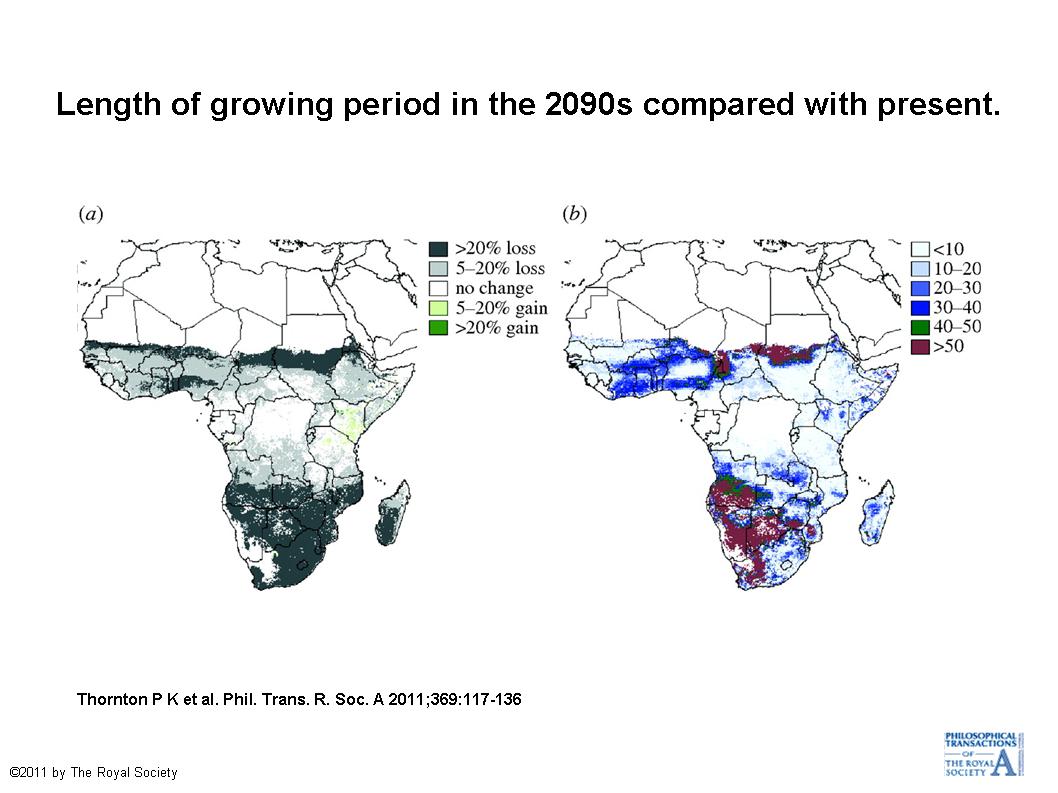
But the authors do have some ideas about what to do, policy-wise:
Thornton and colleagues highlight four areas for immediate policy attention: supporting farmers’ own risk-management strategies, strengthening basic data collection in agriculture, investing seriously in genebanks, and improving governance of food systems so that poor people can get affordable food.
This is what the authors say about genebanks in particular:
…concerted action is needed to maintain and exploit global stocks of crop germplasm and livestock genes. Preservation of genetic resources will have a key role to play in helping croppers and livestock keepers adapt to climate change and the shifts in disease prevalence and severity that may occur as a result. Genetic diversity is already being seriously affected by global change. Genetic erosion of crops has been mostly associated with the introduction of modern cultivars, and its continuing threat may be highest for crops for which there are currently no breeding programmes. Breeding efforts for such crops could thus be critically important. For livestock, about 16 per cent of the nearly 4000 breeds recorded in the twentieth century had become extinct by 2000, and a fifth of reported breeds are now classified as at risk. Using germplasm in SSA will need technical, economic and policy support. Revitalizing agricultural extension services, whether private or in the public sector, is key: no farmers will grow crops or raise livestock they do not know, are not able to sell, and are not used to eating.
Well, I find that a bit confused, in truth, but it is nice to see genebanks (and, incidentally, their databases) getting their due. They are all too often taken for granted. 1 But well-run genebanks on their own are not enough, though they are definitely necessary. The material in them must also be easily accessible, and for that you need the sort of political infrastructure provided by the International Treaty on Plant Genetic Resources for Food and Agriculture.