- An ultra-high density genetic linkage map of perennial ryegrass (Lolium perenne) using genotyping by sequencing (GBS) based on a reference shotgun genome assembly. Zzzzzzz.
- Future Risks of Pest Species under Changing Climatic Conditions. We’re doomed.
- Antioxidant capacity variation in the oregano (Origanum vulgare L.) collection of the German National Genebank. It’s huge. Fantastic. The best variation you’ve ever seen, I guarantee it.
- The distribution of cultivated species of Porophyllum (Asteraceae) and their wild relatives under climate change. New one on me.
- Biodiversity analysis in the digital era. Using the Atlas of Living Australia as an example.
- Large-scale evaluation of pea (Pisum sativum L.) germplasm for cold tolerance in the field during winter in Qingdao. 214 out of 3672, mainly coming from, wait for it, the winter production regions.
- Conservation priorities for the different lines of Dutch Red and White Friesian cattle change when relationships with other breeds are taken into account. 5 out of 7 genetic lines don’t need to be conserved.
- Domesticated Animal Biobanking: Land of Opportunity. “…journals should apply the same standard to samples and associated data, as they currently apply to molecular data, in terms of storage in formalized repositories prior to publication.”
- Neglecting legumes has compromised human health and sustainable food production. Includes nice summary of genebank holdings, using Genesys as a source of information.
- Crop Diversity and Land Simplification Effects on Pest Damage in Northern China. Diversity to the rescue. But…
- Ethnic Fermented Foods and Alcoholic Beverages of Japan. Just one chapter in a whole book on fermentation in Asia.
Brainfood: Drones, Taxonomy, Nigerian diets, Chinese mung bean & millets, Indian chickpea, Polyploidy, Oca seed system, Agroforestry sequestration
- A direct comparison of remote sensing approaches for high-throughput phenotyping in plant breeding. Drones are best.
- Intraspecific taxonomy of plant genetic resources — Important for differentiation of medicinal and aromatic plants? It depends.
- Effects of development on indigenous dietary pattern: A Nigerian case study. Teenagers are rebellious.
- Nutritional composition and antioxidant activity of twenty mung bean cultivars in China. Good news for hipsters everywhere.
- Production and genetic improvement of minor cereals in China. And they’re good for you too. But will the rest of the world benefit from them?
- Characterization of chickpea germplasm conserved in the Indian National Genebank and development of a core set using qualitative and quantitative trait data. 1,103 are representative of 14,651, if you pick them right.
- Whole-genome duplication as a key factor in crop domestication. Comparing within genera, 54% of crops are polyploids on average, versus 40% of the wild species.
- Effect of the management of seed flows and mode of propagation on the genetic diversity in an Andean farming system: the case of oca (Oxalis tuberosa Mol.). Richer farmers conserve and exchange more.
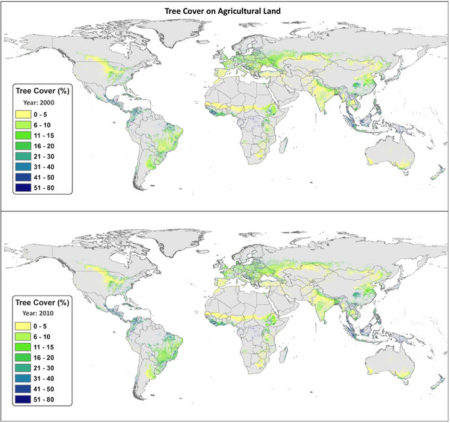
- Global Tree Cover and Biomass Carbon on Agricultural Land: The contribution of agroforestry to global and national carbon budgets. Almost half of agricultural land has a significant number of trees on it, which sequester a lot of C.
Agroforestry around the world
I’ve been looking for an excuse to play around with the Database of Places, Language, Culture and Environment (D-PLACE), which “contains cultural, linguistic, environmental and geographic information for over 1400 human ‘societies’”. It finally arrived today, in the form of a monumental study of carbon sequestration on farmland in Nature. The authors used remote sensing and fancy spatial modelling to work out the amount of tree cover, and hence the levels of biomass carbon, on agricultural land around the world. This is the global map they got for % tree cover in 2000 and 2010.
I was curious to see whether one could predict the areas of highest tree cover (or highest biomass C) from the much coarser data on agriculture that D-PLACE brings together from ethnographic studies. This is what the distribution of “major crop type” looks like, from D-PLACE.
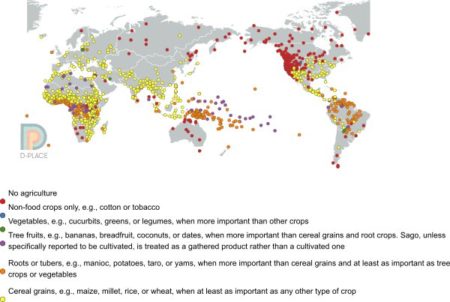
So the answer is no, I guess. It’s difficult to see any association between the amount of trees on farms and the main types of crops grown there, at least just by eyeballing the maps. There may be a hint of a preference for roots and tubers, but nothing really jumps out. I’ll keep playing though, there’s a whole range of cultural and ecological variables you can tweak.
Nibbles: Post-Roman Britain, World grapes, Ghana food security, Sheep stomachs, Alpaca trouble, CIMMYT genebank
- Anglo-Saxons may not have dropped spelt as quickly as we thought.
- The history of South Africa’s Kristaldruif grape. And where to find it.
- It was colonization that messed up Ghana’s food security. Boris take note.
- The brotherhood of manouls. They can keep it.
- Alpaca farmers out in the cold.
- CIMMYT annual report highlights the genebank.
Nibbles: African fruits, Old apple, Ancient barley, GRAIN study, Desertification, Biodiversity loss
- ICRAF helps us understand little-understood African fruit trees.
- The apple is pretty well understood, but this one important, 200-year-old tree is dying. Tissue culture to the rescue.
- I see your 200-year-old-tree and I raise you 6000-year-old barley.
- GRAIN takes aim at FTAs.
- Desertification may not be a thing.
- Biodiversity loss is, though, right?