After USAID, it’s now the turn of CGIAR to push climate smart agriculture without even a mention of the crop diversity that is surely its sine qua non. Oh well.
Climate smart agriculture = diverse agriculture, and vice versa
USAID is seeking feedback on the climate smart agriculture (CSA) strategy of its Feed the Future programme. Recall that CSA has three objectives 1
- Sustainably increasing agricultural productivity and incomes.
- Adapting and building resilience to climate change.
- Reducing and/or removing greenhouse gas emissions, where appropriate.
So it’s that triple-win we’re after, and it’s good to see diversification being highlighted in that context by the strategy document:
In general, Mission FTF programs work within diversified production systems that reflect farmer choice around crops, livestock or fish although one value chain may be the focus. Diversification includes not only the number of crops, but also using a wider range of improved varieties and staggered planting times for a given crop. Over a longer time period, crop choices by farmers may shift as risks with one crop rise while another crop option is viewed as a safer bet. Thus diversification can be a strategy for managing risk and optimizing returns, particularly when informed by information on potential shocks, seasonal forecasts and long term climate trends. Ultimately, it will be farmers who directly determine their risks, but FTF programs can help widen the array of appropriate options that confer greater resilience as well as more efficient production with a concomitant reduced GHG footprint.
But why a wider range of only improved varieties? Don’t landraces or varietal or other types of mixtures have any role to play at all? And why mention staggered planting times, but not intercropping, say?
And, most importantly, why no mention at all of conservation of crop diversity as a prerequisite for diversification, and the role of genebanks in that? After all…
…it is likely that some (if not all) countries will need germplasm that is currently grown elsewhere to adapt.
And where is that going to come from if not genebanks? You can let USAID know until noon on August 14, 2015.
Brainfood: Weed collection, Japan vs China wheat, China wheat, Indian maize, Aromatic rice, African cattle, Food system vulnerabilities, SDGs & nutrition, Suitable days, Setaria phenotyping
- Genetic Resources of Cannabis sativa L. in the Collection of the Gene Bank at INF&MP in Poznan. I’d pay money to see this in the field at evaluation time.
- Specific median flour particle size distribution of Japanese common wheats; Comparison with Chinese common wheats. Japanese diversity is a small fraction of Chinese diversity. Also, can you really have semicolons in titles?
- Association and Validation of Yield-Favored Alleles in Chinese Cultivars of Common Wheat (Triticum aestivum L.). And among Chinese wheats, the modern cultivars are a small subset of the diversity in the mini core collection.
- Diversity among maize landraces in North West Himalayan region of India assessed by agro-morphological and quality traits. I like it when specific accessions are highlighted as being special in some way. But will breeders around the world have access to them?
- Genetic Diversity and Population Structure in Aromatic and Quality Rice (Oryza sativa L.) Landraces from North-Eastern India. More than just basmati. But will breeders around the world have access to them?
- African Indigenous Cattle: Unique Genetic Resources in a Rapidly Changing World. At least 150 breeds, many endangered, all important.
- Sustainable Sourcing of Global Agricultural Raw Materials: Assessing Gaps in Key Impact and Vulnerability Issues and Indicators. We don’t know the vulnerabilities well enough.
- Can the sustainable development goals reduce the burden of nutrition-related non-communicable diseases without truly addressing major food system reforms? No.
- Suitable Days for Plant Growth Disappear under Projected Climate Change: Potential Human and Biotic Vulnerability. Tropical areas are screwed.
- A versatile phenotyping system and analytics platform reveals diverse temporal responses to water availability in Setaria. Fancy equipment picks out differences among genotypes.
We are so screwed
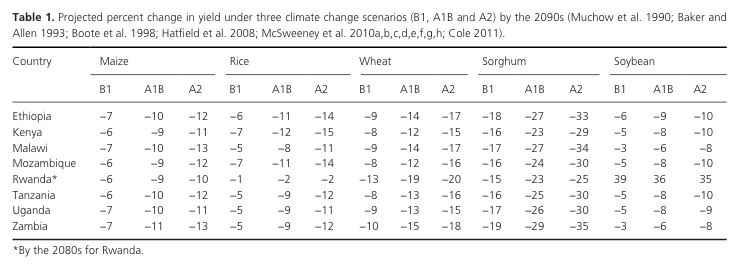
Well, all except soybean farmers in Rwanda.
Nibbles: Organic research, Plant models, Tabasco peppers, Andean shepherds, Weird pigs, Wild rice harvesting, Heritage ducks, Nutrient content
- An investment in organic research. At last.
- Plant models go online. Not those kinds of models.
- Where the peppers for Tabasco sauce come from.
- Apparently, “[w]hite alpacas have been overbred.” But not that kind of breeding, I think.
- Pigs are weird.
- Learn how to make poles. Yes, those kinds of poles.
- Even ducks can be heritage.
- Higher carbon dioxide bad for nutrition.