- The oldest pig in the world is Vietnamese-Canadian.
- Why plant scientists should tweet. And draw.
- Trifecta of apples and other heirloom fruit. Make that four.
- And nuts.
- Making civet crap coffee sustainable.
- Dutch animal genebank moves.
- Will the inmates be fed seaweed? There’s a collection of those, you know?
- More money for to make sweet potato more nutritious.
- Or, you could empower women. Or both.
- Trouble with citrus? No problem, grow peaches.
- World’s coolest garden.
- And why we need even the less cool ones.
- Testing present plants in future climates.
- Who’s who in edible insects.
- Big Food suddenly realizes it has a climate change problem.
Brainfood: Ethiopian landuse history, Linum diversity, Chinese melons, Organic cauliflower, Mexican mission citrus, Saline mungbeans, Saving the elm, Future Fusarium, Wheat biofortification, PPB and public value
- Dynamics and driving forces of agricultural landscapes in Southern Ethiopia – a case study of the Chencha and Arbaminch areas. It’s the population pressure, stupid. No word on what expansion of agriculture and decrease in holding size is doing to agricultural biodiversity. Or wild relatives, for that matter.
- The potential of pale flax as a source of useful genetic variation for cultivated flax revealed through molecular diversity and association analyses. Levels of diversity similar in wild and cultivated, but strong differentiation between the two.
- Microsatellite analysis of genetic relationships between wild and cultivated melons in Northwest and Central China. For the true wild melons, go to the NW. Others may be escapes and introgressions.
- Evaluation of cauliflower genebank accessions under organic and conventional cultivation in Southern Germany. Genotype performance differs depending on cultivation method. But if you want to breed specifically for organic conditions, here’s what to use.
- Mission and Modern Citrus Species Diversity of Baja California Peninsula Oases. Lots of unique types in the mission oases and surrounding ranches. For how long? Well, here’s the baseline. I’d like to know about the agritourism potential.
- Evaluation of mungbean genotypes for salt tolerance at early seedling growth stage. From the Indian core collection. Some good stuff found.
- Implementing the dynamic conservation of elm genetic resources in Europe: case studies and perspectives. Genebanks are not enough. But then again, nobody ever said they were.
- Future distributions of Fusarium oxysporum f. spp. in European, Middle Eastern and North African agricultural regions under climate change. Some countries are in big trouble.
- Use of wheat genetic resources to develop biofortified wheat with enhanced grain zinc and iron concentrations and desirable processing quality. CIMMYT has used a range of wild species to increase the Zn and Fe content of high-yielding, high-quality bread wheat lines.
- Expressing the public value of plant genetic resources by organising novel relationships: The contribution of selected participatory plant breeding and market-based arrangements. PPB can help smallholders manage the indirect and option value of agrobiodiversity, but it needs new types of property rights and networked governance. Whatever that is, it can take a variety of forms. All this from China, of all places.
Brainfood: Tea cores, Amazonian domestication, Sicilian remedies, Odisha wild veggies, Insect biomass, Energy crops, Adoption, Field size, Rye diversity, Crab breeding
- Worldwide core collections of tea (Camellia sinensis) based on SSR markers. From 788 to 192 doesn’t seem like a great deal.
- Crop Domestication in the Amazon. The first arrivals were not just hunter-gatherers.
- Plant genetic resources and traditional knowledge on medicinal use of wild shrub and herbaceous plant species in the Etna Regional Park (Eastern Sicily, Italy). 71 wild species are used for medicine, but the properties of most are known by only a few informants.
- Traditional knowledge on wild edible plants as livelihood food in Odisha, India. 86 wild species are eaten. No word on the pattern of distribution of knowledge, at least in the abstract.
- Insects in the human food chain: global status and opportunities. The real potential is in animal feed production.
- Energy crops: Prospects in the context of sustainable agriculture. They have a role in Europe to reduce effects of climate change while supporting food security and preserving the environment, but most are in early stages of domestication, and we’ll need more efficient enzymatic systems for the conversion of cellulose, and the development of multiple products.
- Are there systematic gender differences in the adoption of sustainable agricultural intensification practices? Evidence from Kenya. Not for improved seeds, apparently.
- A contemporary decennial global Landsat sample of changing agricultural field sizes. Nine hotspots of field size change, driven by different factors, and not all in same direction. I wonder if you can use this as a proxy for levels of agricultural biodiversity?
- Genome-wide characterization of genetic diversity and population structure in Secale. Limited diversity in improved material, and no structure. Need those genebanks.
- Comparison of the culture performance and profitability of wild-caught and captive pond-reared Chinese mitten crab (Eriocheir sinensis) juveniles reared in grow-out ponds: Implications for seed selection and genetic selection programs. Wild is best. For now.
Taro on display at SIDS meeting
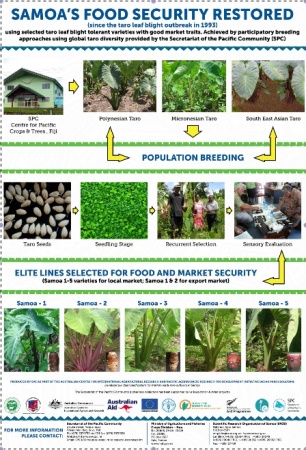 The UN Conference on Small Island Developing States has just ended in Apia, Samoa. Lots of talk about partnerships for the sustainable development of these particularly vulnerable countries, although it’s unclear to me, as ever, how much of the money announced is actually new. Be that as it may, my old colleagues at SPC were very much involved, and took the opportunity of showcasing their work on the conservation and use of taro genetic resources in the poster reproduced here. An excellent example of the kind of partnerships made so much of in the media release.
Brainfood: Goat diversity, Sheep diversity, Camel keeping, Weird Zambian cattle, Pepper diversity, Strawberry diversity, Breeding wheat, Sustainable cacao, Food supply diversity
- The characterization of goat genetic diversity: Towards a genomic approach. A single Neolithic origin.
- Genome-wide patterns of adaptation to climate-mediated selective pressures in sheep. Adaptation to local climates has been important.
- Characterisation of camel breeding practices in the Ansongo Region, Mali. Diversity of practices, diversity of breeds.
- Gynomimicry in the Dwarf Gwembe breed from Zambia. The males mimic the secondary sexual characters of females, presumably because they’ve been selected to do so.
- Evaluation of a diverse, worldwide collection of wild, cultivated and landrace peppers (Capsicum annuum) for resistance to Phytophthora fruit rot, genetic diversity and population structure. No completely resistant lines out of 177, 2 pretty good ones, the better ones confined to 2 of 4 genetic clusters.
- Evaluation of strawberry (Fragaria L.) genetic resources on resistance to Botrytis cinerea. Out of 107 accessions in the German national genebank, 5 were pretty good, 4 of them F. vesca.
- Redesigning the exploitation of wheat genetic resources. Allele mining is out, genome-wide selection is in.
- Making biodiversity-friendly cocoa pay: combining yield, certification and REDD for shade management. Even if you increase yields by 50%, that may not be enough to stop farmers converting from traditional agroforestry. Enter ecolabelling and REDD.
- Measuring nutritional diversity of national food supplies. Production diversity is a good predictor of dietary diversity, but only for low income countries; otherwise income and trade are better. Dietary diversity associated with key health outcomes.