- Assessment of genetic relationships between cultivated arracacha (Arracacia xanthorrhiza Bancr.) and its wild close relatives in the area of domestication using microsatellite markers. Lots more variation in the wild, natch.
- Exploring Relationships between Biodiversity and Dietary Diversity in the Mediterranean Region: Preliminary Insights from a Literature Review. There has been an increase in dietary diversity, but of the wrong sort of diversity.
- Special issue Of Small Ruminant Research on “Genetic diversity of small ruminants in Asia”. From the Punjab Urial sheep to the goats of Myanmar.
- Genetic diversity of flax accessions originating in the Alpine region: a case study for an ex situ germplasm evaluation based on molecular marker. Past genebank conservation hasn’t been perfect.
- Enhancing genetic gain in the era of molecular breeding. It all starts with genetic variance. Hello, genebanks!
- Crops In Silico: Generating Virtual Crops Using an Integrative and Multi-scale Modeling Platform. Factor in gene editing and goodbye genebanks.
- Unconscious selection drove seed enlargement in vegetable crops. And not only vegetables, cereals too. But remember African rice?
- Palm economic and traditional uses, evolutionary history and the IUCN Red List. Globally, the more threatened palms are the less used.
- Impact of Climate Change, Weather Extremes, and Price Risk on Global Food Supply. The effect is not just on production, but also price.
- Identifying the landscape drivers of agricultural insecticide use leveraging evidence from 100,000 fields. In Kern County, California, crop diversity decreases insecticide us. But…
Nibbles: Wheat-barley hybrid, Father of Wheat Revolution, Medieval bread, Tomato history, SOWP2, Domestication, Red Data, Taro benefits, Hummus!, Textile book, Healthy rice, Avocado Wars
- Tritodendrum hits the market.
- DS Athwal would have approved. RIP.
- Medieval bakers too, I bet.
- Want some cherry tomatoes on your bread? No? Try these then.
- Lots of crop wild relatives among newly discovered plants. See (some of) them on the new State of the World’s Plants report from Kew. And no, Kew, none of them are “miserable.”
- Early farmers unintentionally produced vegetables with larger seeds simply by cultivating them. And cereals too.
- Head of IUCN Red Data List Unit in impassioned plea for IUCN Red Data List process.
- What is taro good for? I’m glad you asked.
- I missed International Hummus Day? How could this happen?
- Textilia Linnaeana! What do you mean I’ve just had my birthday?
- Lowering the glycemic index of rice for the Chinese market.
- Fighting for avocados. Literally.
Kew helping protect your morning joe
Remember a short blog post from seven years back saying how Ethiopia had just protected some wild coffee forests?
We Nibbled yesterday a UN press release saying that a Biosphere Reserve had been created in Ethiopia to protect wild coffee. But actually it turns out that it is no less than TWO reserves that have just been selected by UNESCO, Kafa and Yayu. Many thanks to Tadesse Woldemariam Gole for the tip.
No, I didn’t think so. But anyway, here’s the latest on that, courtesy of the coffee team at Kew.
In April 2015 we started the three year project ‘Mainstreaming biodiversity conservation and climate resilience at Yayu Biosphere Reserve (Ethiopia)’. In this project, poverty alleviation, biodiversity, and climate resilience, are inextricably linked.
…
The project has now been running for almost two years, and despite a few surprises, is achieving considerable success. Catch-up on our progress in the second part of this post, available in the coming months.
Previous experience in this sort of thing has been mixed, so I’m looking forward to hearing more. In the coming months.
Brainfood: Canola model, Saline dates, High rice, Perennial wheat, European cowpea, Mesoamerican oil palm, Seed viability, Citrus identity, Poor cassava, Horse domestication, Wild tomatoes, Tea genome, Veggie breeding, Classical brassicas
- Development of a Statistical Crop Model to Explain the Relationship between Seed Yield and Phenotypic Diversity within the Brassica napus Genepool. Look for primary raceme area.
- Screening of Date Palm (Phoenix dactylifera L.) Cultivars for Salinity Tolerance. In Oman, Manoma and Umsila are particularly tolerant.
- Genetic structure and isolation by altitude in rice landraces of Yunnan, China revealed by nucleotide and microsatellite marker polymorphisms. Geneflow is horizontal, adaptation vertical.
- Breeding Perennial Grain Crops Based on Wheat. By adding a wild genome.
- European cowpea landraces for a more sustainable agriculture system and novel foods. 24 of them, no less. But you have to start somewhere, I suppose.
- Genetic diversity of Elaeis oleifera (HBK) Cortes populations using cross species SSRs: implication’s for germplasm utilization and conservation. From 532 palms in 19 populations to 34 individuals.
- Large-Scale Screening of Intact Tomato Seeds for Viability Using Near Infrared Reflectance Spectroscopy (NIRS). Good-bye germination tests?
- Genetic identification of ‘Limau Kacang’ (Citrus sp.), a local mandarin cultivated in West Sumatra by sequence-related amplified polymorphism (SRAP). It’s a ponkan.
- Cassava haplotype map highlights fixation of deleterious mutations during clonal propagation. Cassava is decaying genetically, but breeders are helping.
- Ancient genomic changes associated with domestication of the horse. The ancient DNA of immediate post-domestication horses suggests that the stallion bottleneck happened later.
- Genetic Diversity and Population Structure of Two Tomato Species from the Galapagos Islands. They mirror island formation.
- The Tea Tree Genome Provides Insights into Tea Flavor and Independent Evolution of Caffeine Biosynthesis. It evolved caffeine independently of coffee but not cacao. And flavour is down to a whole genome duplication.
- The contribution of international vegetable breeding to private seed companies in India. It can still make one, but for traits rather than varieties.
- Domestication, diversity and use of Brassica oleracea L., based on ancient Greek and Latin texts. Their use as a hangover cure has a long and august pedigree. No word on their raceme area.
The price of tea in Kenya
“When countries change their trade policies to protect themselves against price falls, small farmers – particularly those in developing countries – tend to lose profits,” said Will Martin, senior research fellow at IFPRI. “This platform gives governments access to the most recent information available, so they can make informed decisions on food policy that avoid creating global price instability.”
“This platform” is Ag-Incentives, and it’s just been launched by IFPRI.
Policies that affect incentives for agricultural production, such as those that raise prices on domestic markets, can artificially distort the global market, which then undermine market opportunities for small farmers in the world. Ag-Incentives allows users to compare indicators, such as nominal rates of protection, across countries and years.
At the moment, it seems that it is only “nominal rates of protection” (NRP) that are being compared, across countries and years, but that will no doubt change as the platform evolves. What are NRPs?
…the price difference, expressed as a percentage, between the farm gate price received by producers and an undistorted reference price at the farm gate level.
The “undistorted price” being “generally taken to be the border price adjusted for transportation and marketing costs.”
If I understand this correctly, if NRP is negative, the commodity is being taxed, positive and it is being subsidised. This is the picture for tea in Kenya, as an example.
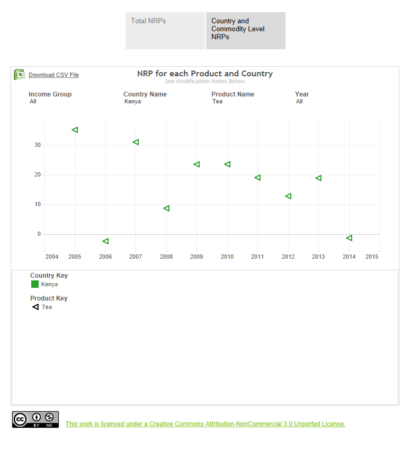
I’ll run it by the mother-in-law to see if she can make some sense of it, in particular what happened in 2006 and 2014.