- A Wheat Germplasm Database To Rule Them All. No, not from CGIAR.
- New livestock maps of the world. Yes, from CGIAR.
- Kashmir ponders an apple genebank.
- More from Game of Strawberries.
- Wanna study the population genomics of cheese fungi? Course you do.
- Domesticating local fruit trees good for nutrition, but need secure tenure and good planting material.
- Building better broccoli, the genome way.
- Early domesticated dogs helped in mammoth hunts.
- Current extinction rate about 1000 times higher than background. Databases can help with that, believe it or not.
- Building a national PGRFA system in Bolivia. When will they ratify the ITPGRFA, though?
Nibbles: Linux lettuce, Climate intelligence, European ag & CC, Italian forests, Sweet potato chains, Aroid podcast, Beer trifecta, CWR everywhere
- Totally forgot if we already linked to this latest pean to open source seed.
- Climate-smart agriculture described in three paragraphs.
- Hope someone explains it to European farmers, and soon.
- Italy is increasingly wooded. But only because farms are being abandoned. Maybe not climate-smart enough?
- If only those farms had better links to markets, like in E. Africa…
- Dutch food writer on the Jewish (maybe) origins of the Surinamese national dish. Gotta love edible aroids. Jeremy does his podcast thing.
- Step 1: Breed your hops.
- Step 2: Find a funky yeast.
- Step 3: Crack the Kenyan beer market.
- Back to real life: USAID’s brand new multisectoral nutrition policy. Now, then, what’s the betting that the agricultural interventions supported by USAID avoided the risks that such things often hold for nutrition (incomes, prices, types of products, women social status and workload, sanitary environment and inequalities)?
- SeedMap.org breaks down crop wild relatives.
- Somebody mention crop wild relatives? Yes, Sandy Knapp.
- Somebody mention parientes silvestres de cultivos? Yes, Nora Castañeda.
- How many CWR will go the way of Arabidopsis? Because southern populations of that species in genebanks are already doing better than local populations in northern sites.
- How many crop wild relatives in Kew’s meadows?
Nibbles: Seed drying, Yield gap trap, African fermentation, Rice & temp, Cultural exchange, Youth, Syria and ICARDA
- How to keep seeds dry. Don’t do this at home, folks! No, wait…
- Don’t get trapped in the yield gap, researchers told.
- Diana Buja breaks down banana brewing.
- Night temperatures cross important threshold for rice.
- Cultural change does not have to mean genetic erosion and loss of agrobiodiversity knowledge.
- Getting youth back into agriculture. Not just about the money.
- Latest from the tragic ICARDA situation
Nibbles: Nepal goat project, Kenyan camels, Sustainable diet metrics, Agri-informatics centre, Cassava dishes, CC & nutrients, Yield is all, African CC hotspots, AGRA seed enterprises, PlantVillage blog, Medieval weeds, French reserve, Black garlic, Australian tree tool
- Sometimes all it takes is a goat.
- Or a camel.
- I wonder how either would figure into a metric for a sustainable diet. Wonder if these people will be interested in those metrics.
- Cassava figures in lots of different ways.
- No word on whether carbon dioxide will affect its nutrient content the way it does with other crops.
- Who cares, it’s yield we’re after. Well, that’s in trouble too in some parts of Africa.
- That’s the only way those African seed start-ups are going to survive.
- Yeah, but disease resistance is important, Shirley. PlantVillage gets a blog.
- And weeds? Don’t forget the weeds. Although of course some of them you can eat. Put that in your metrics.
- Meanwhile, France starts to re-wild. Would love to see some wild relatives in the Bois du Boulogne. Livestock wild relatives, not your crazy cousin on his gap year.
- And now we can figure out what climate change might do to them. I guess this thing might work for European animals. Says here it works for Australian trees.
- Speaking of France, garlic is quintessentially French, isn’t it? Well, maybe, but it’s also very Korean, in its black, cured form.
My happy liver I cover with a garment fit for a queen
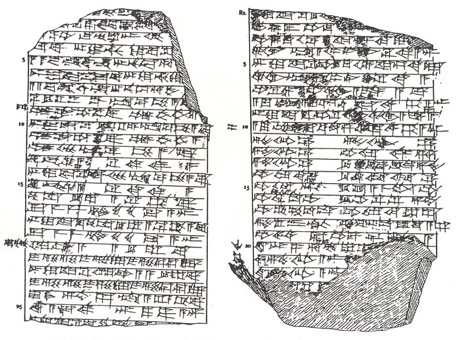 Since we’re on the subject of agricultural biodiversity and poetry, let’s also deal with that Sumerian ode to beer that featured in another article I linked to recently. It’s called the “Hymn to Ninkasi,” and it was found on a 19th century BC cuneiform tablet. Ninkasi means “lady who fills the mouth,” and was, aptly enough, the goddess of brewing. I found a longer version of the poem online, along with a recipe for the beer it describes, a “light, unhopped, unfiltered barley beer.” There’s some really detailed scholarship on Sumerian beer out there. What I don’t quite understand is why this stanza
While I circle around the abundance of beer,
While I feel wonderful, I feel wonderful,
Drinking beer, in a blissful mood,
Drinking liquor, feeling exhilarated,
With joy in the heart [and] a happy liver—
While my heart full of joy,
[And] [my] happy liver I cover with a
garment fit for a queen!…
which is rather fun, is found in some sources but not in others. Some disagreement among Sumerian poetry experts? I’d like to think so.
Incidentally, there’s a thing called the Pennsylvania Sumerian Dictionary Project which has come up with an entirely horrible but endlessly intriguing online resource. It took me like an hour, but I finally figured out what I think is the Old Akkadian cuneiform for Ninkasi.

You’re welcome.