- AVRDC’s 30th International Vegetable Training Course Vegetables: From Seed to Table and Beyond.
- Cameron Peace’s excellent presentation on genomics and fruit genebanks at the recent PAG symposium organized by NPGS staff Chris Richards (Ft. Collins) and Clare Coyne (Pullman).
- Kew’s latest Samara newsletter does crop wild relatives.
- Exploring the need for specific measures for access and benefit-sharing of animal genetic resources for food and agriculture. Results of a workshop.
Is lack of sex really the problem for grapes?
There’s a very interesting article in the New York times reporting on a major investigation of the molecular diversity among grape cultivars.
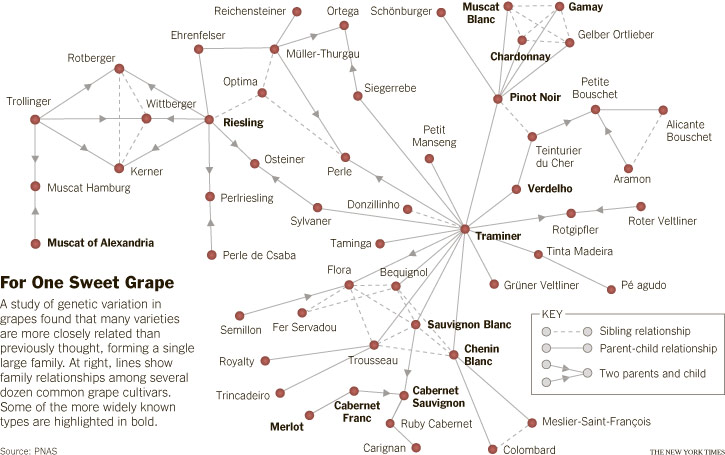
The report is based on a big paper in PNAS, which I confess I have not had time to read carefully. That said, a few things about the NYT’s coverage confuse me. One is the whole depiction of “relatedness”.
Thus merlot is intimately related to cabernet franc, which is a parent of cabernet sauvignon, whose other parent is sauvignon blanc, the daughter of traminer, which is also a progenitor of pinot noir, a parent of chardonnay.
This web of interrelatedness is evidence that the grape has undergone very little breeding since it was first domesticated, Dr. Myles and his co-authors report in the Proceedings of the National Academy of Sciences.
So how did those varieties arise? Maybe breeding means only “deliberate crosses made by a breeder”. Are they saying that the molecular data support the breeding records? Or are actual breeding records, especially for the older and better-known varieties, too sketchy to know? There’s more too, but I’m going to have to find time to read the PNAS paper properly. Or maybe you already have, in which case, feel free to comment.
Nibbles: IK, Fragaria, Citrus, Millet breeding, Vitis, Agricultural biodiversity, Satellite imagery, Subsistence
- Indigenous knowledge of agrobiodiversity makes the news in Indonesia.
- Reconstructing the strawberry.
- And reconstructing the history of cultivated citrus fruits.
- ICRISAT millet breeders get an a new toy.
- Plenty of diversity in the cultivated grape still. And it’s going to need it.
- Biodiversity (and agrobiodiversity?) needed for farm productivity. Well I never! But more mixed results available too. What’s a poor boy to think?
- SPOT 5 imagery can be used to identify crops. In Texas. But in Tanzania?
- Agricultural biodiversity and subsistence traditions, Part 2. In the Ozarks. But in Omo? (And here’s Part 1.)
Plant and Animal Genome meeting unactionable?
We briefly noted Greg Baute’s thoughts on the genebank session of the Plant and Animal Genome Conference just ended. 1 For another point of view, here’s the take-home message from Pat Heslop-Harrison, editor of Annals of Botany.
[U]nlike the previous meetings, this week, I’m finding it hard to see what NEW areas we will be publishing from results being presented.
And lest you think that’s overdramatic, Pat’s list of areas that did emerge from the previous 18 PAG conferences is pretty astonishing. Not having been there, I can’t say whether there is indeed a big idea that somehow eluded Pat; it seems very unlikely. If, however, the big idea is how to stay afloat on the sea of genome data, then yes, I guess we are still waiting for the liferafts to inflate.
Of cattle and people. And barley
Dienekes, a blogger who specializes in molecular anthropology, has a quick note today on a paper on the molecular genetics of cattle in Europe. The main story is one of distinction between North and South.
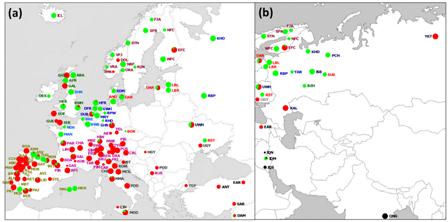
Apparently, the expansion of the dairy breeds have created, or largely maintained, a sharp genetic contrast of northern and southern Europe, which divides both France and Germany. It may be hypothesised that the northern landscapes, with large flat meadows, are suitable for large-scale farming with specialised dairy cattle (Niederungsvieh, lowland cattle), whilst the mixed-purpose or beef cattle (Höhenvieh, highland cattle) are better suited to the smaller farms and hilly regions of the south. However, it is also remarkable that in both France and Germany the bovine genetic boundary coincides with historic linguistic and cultural boundaries. In France, the Frankish invasion in the north created the difference between the northern langue d’oïl and the southern langue d’oc. The German language is still divided into the southern Hochdeutsch and northern Niederdeutsch dialects, which also correlates with the distribution of the Catholic and Protestant religions. On a larger scale, it is tempting to speculate that the difference between two types of European cattle reflects, and has even reinforced, the traditional and still visible contrast of Roman and Germanic Europe.
It doesn’t seem that the strong latitudinal genetic differentiation in cattle is matched by one in human populations. Here the pattern is much more gradual and clinal. 2 However, there may be a similar “sharp genetic contrast of northern and southern Europe” (or at least between the Mediterranean and the rest of Europe) for barley. 3
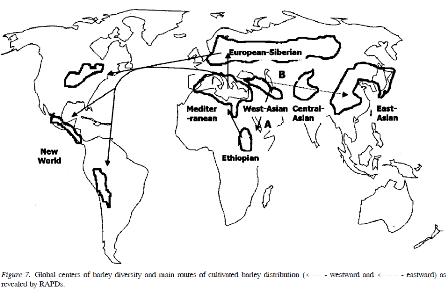
I’d dearly love to have the time to find out whether other livestock and crops show a similar pattern.