- Data integration enables global biodiversity synthesis. Biodiversity data is not enough.
- Review of congruence between global crop wild relative hotspots and centres of crop origin/diversity. Vavilov is enough.
- Feralization: Confronting the Complexity of Domestication and Evolution. Centres of diversity are not enough.
- De novo domestication of wild species to create crops with increased resilience and nutritional value. Conservation is not enough.
- Evaluating plant genetic diversity maintained by local farmers and residents: A comphrehensive assessment of continuous vegetable cultivation and seed-saving activities on a regional scale in Japan. Economic incentives are not enough.
- Beyond subsistence: the aggregate contribution of campesinos to the supply and conservation of native maize across Mexico. Small farmers could be enough.
- Unlocking the Patterns of the Tunisian Durum Wheat Landraces Genetic Structure Based on Phenotypic Characterization in Relation to Farmer’s Vernacular Name. Small farmers could be enough.
- Linkages between dietary diversity and indicators of agricultural biodiversity in Burkina Faso. Production of diverse crops could be enough.
- Seed longevity of two nutrient-dense vegetables (Amaranthus spp.). 5°C and aluminium packets are enough.
- Phytosanitary Interventions for Safe Global Germplasm Exchange and the Prevention of Transboundary Pest Spread: The Role of CGIAR Germplasm Health Units. Genebanks are not enough.
Brainfood: Bird shit, Ancient Greece, Maize adaptation, Resistant peanut, Adaptive variation, Crop models, AA bananas, Wild wheat, Wild tomatoes, Switchgrass diversity, Phytosanitation, Rice breeding, Seeds 4 Needs double, Wild palm, Threatened biodiversity
- ‘White gold’ guano fertilizer drove agricultural intensification in the Atacama Desert from ad 1000. And maize was at the heart of it.
- What’s new during the first millennium BCE in Greece? Archaeobotanical results from Olynthos and Sikyon. Not maize, alas, but what you’d expect, plus pine and sesame.
- Local adaptation contributes to gene expression divergence in maize. Stress-response genes are the ones which have been selected. No word on whether any of them were important in the Atacama.
- Genotyping tools and resources to assess peanut germplasm: smut-resistant landraces as a case study. Ok, so it sounds like the resistant line that was previously used is virtually identical to an accession in the USDA collection.
- Do We Need to Identify Adaptive Genetic Variation When Prioritizing Populations for Conservation? No, but we’ll need it to prioritize use, surely?
- Incorporating Realistic Trait Physiology into Crop Growth Models to Support Genetic Improvement. We’ll need better growth models too.
- Wild to domesticates: genomes of edible diploid bananas hold traces of several undefined genepools. 3 of them, in fact, in both SE Asia and New Guinea.
- Evolution of the bread wheat D-subgenome and enriching it with diversity from Aegilops tauschii. Three lineages were involved in the hybridizations that led to bread wheat. Coincidence?
- De novo genome assembly of two tomato ancestors, Solanum pimpinellifolium and Solanum lycopersicum var. cerasiforme, by long-read sequencing. Thousands of genes not found in the cultivated crop, apparently.
- Genomic mechanisms of climate adaptation in polyploid bioenergy switchgrass. Introgression from the northern genepool (one of three) was really important in adaptation after the glaciers retreated. Gene duplication also involved in adaptation.
- Economic Studies Reinforce Efforts to Safeguard Specialty Crops in the United States. Where “safeguard” means “provide clean planting material.”
- Comparative analysis of genetic diversity of rice (Oryza sativa L.) varieties cultivated in different periods in China. Diversity went up, then down, between the 1980s and the 2010s.
- Wheat Varietal Diversification Increases Ethiopian Smallholders’ Food Security: Evidence from a Participatory Development Initiative. Why the diversity in breeding programmes is important, and how farmer participation can help maintain it.
- The tricot citizen science approach applied to on-farm variety evaluation: methodological progress and perspectives. How to do the above.
- Biodiversity and conservation of Phoenix canariensis: a review. A wild relative in trouble, and what to do about it.
- Tropical and Mediterranean biodiversity is disproportionately sensitive to land-use and climate change. As can be seen from the above.
Tweeting beans
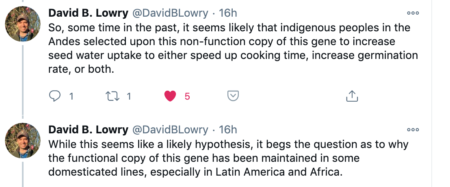
Twitter is often a hellsite, but every once in a while, it really comes through. Case in point is this cool summary of a recent paper on the genetics and physiology of seed dormancy in common beans posted by one of the authors, Dr David Lowry.
https://twitter.com/DavidBLowry/status/1353358445710172161
Now, I know some of you are not going to want to click on the above, so here it is in ThreadReader. And if you just want the bottom line…
Brainfood: Pollinator decline, Diet diversity, Collectors, CBD indicators, Herbaria, Fusarium wilt, Genomic breeding, Niche markets, Study design, American CWR, Domestication limits
- No buzz for bees: Media coverage of pollinator decline. Nobody cares. Unless it’s linked to climate change.
- Climate impacts associated with reduced diet diversity in children across nineteen countries. Something else that’s linked to climate change and too few care about.
- People are essential to linking biodiversity data. Seriously, get an ORCID ID.
- Why European biodiversity reporting is not reliable. It’s the free indicator choice in CBD reporting is what it is. Also, not enough attention to genetic diversity. Now, where have I heard that before?
- Reversing extinction trends: new uses of (old) herbarium specimens to accelerate conservation action on threatened species. Not just useful in generating new knowledge (including on genetic diversity), can also be used as seed sources and in public awareness.
- Ex Ante Assessment of Returns on Research Investments to Address the Impact of Fusarium Wilt Tropical Race 4 on Global Banana Production. Conventional breeding for resistance could lift almost a million people out of poverty. That would be quite the indicator.
- Genomic resources in plant breeding for sustainable agriculture. Would help with the above.
- Can Niche Markets for Local Cacao Varieties Benefit Smallholders in Peru and Mexico? Maybe. Read it, it’s not that long.
- Quantifying and addressing the prevalence and bias of study designs in the environmental and social sciences. Everyone should use randomised designs and controlled observational designs with pre-intervention sampling. No, you did not just waste your time reading the above.
- Crop wild relatives of the United States require urgent conservation action. 60% of 600 native taxa need urgent help.
- Limits and constraints to crop domestication. Most of the world’s 2000 crops are not fully domesticated, for reasons such as trait architecture, lack of diversity in domestication traits, accumulation of genetic load and gene flow from the above. But something can be done about it.
Brainfood: Sweet cassava, Iranian wheat, Wild tomato, Ethiopian sorghum, Portuguese beans, Wild Algerian oats, Angolan Vigna, Apple tree, Regeneration, Robusta climate, Bronze Age diets, Maize domestication, Veld fruits, Red yeasts, Remote sensing
- Large‐scale genome‐wide association study, using historical data, identifies conserved genetic architecture of cyanogenic glucoside content in cassava (Manihot esculenta Crantz) root. Two loci explain about a third of variation in HCN content.
- Strategic use of Iranian bread wheat landrace accessions for genetic improvement: Core set formulation and validation. Not much structure, but some accessions are good for multiple traits.
- Population studies of the wild tomato species Solanum chilense reveal geographically structured major gene-mediated pathogen resistance. Not all populations of a crop wild relatives will be equally useful in breeding.
- Genetic diversity of Ethiopian sorghum reveals signatures of climatic adaptation. 12 sub-populations, with about 10% of the variation explained by either agroecology or geography.
- Common bean SNP alleles and candidate genes affecting photosynthesis under contrasting water regimes. And all in just 158 Portuguese accessions.
- Genetic Diversity and Population Structure of Algerian Endemic Plant Species Avena macrostachya Bal. ex Cross. et Durieu. Collecting sites need to be visited again. I can vouch that doing so would be very interesting.
- Conservation priorities for African Vigna species: Unveiling Angola’s diversity hotspots. It’s a huge collecting gap.
- Remote sensing enabled essential biodiversity variables for biodiversity assessment and monitoring: technological advancement and potentials. The Remote Sensing enabled Essential Biodiversity Variables are a work in progress. Would like to see it applied to those Vignas.
- Genomic consequences of apple improvement. …are relative genetic uniformity.
- Genome-Wide DArTSeq Genotyping and Phenotypic Based Assessment of Within and Among Accessions Diversity and Effective Sample Size in the Diverse Sorghum, Pearl Millet, and Pigeonpea Landraces. Optimal sample size for regeneration of genebank accessions varies from 50-200 among crops.
- Not so robust: Robusta coffee production is highly sensitive to temperature. Looking at historical production data from 800 farms in SE Asia suggests optimal temperature is below 20°C, a lot lower than suggested by the species’ home range in the Congo Basin.
- Exotic foods reveal contact between South Asia and the Near East during the second millennium BCE. Bronze Age Levantines ate bananas and soya, according to dental calculus. No word on coffee.
- Archaeological Central American maize genomes suggest ancient gene flow from South America. Pre-domesticated maize was taken to South America, where is was finished off away from introgression from pesky wild relatives, and then taken back home.
- Fruits of the Veld: Ecological and Socioeconomic Patterns of Natural Resource Use across South Africa. South Africans collect and eat a lot of wild fruits, but could plant and eat them more.
- Exploring the Biodiversity of Red Yeasts for In Vitro and In Vivo Phenotypes Relevant to Agri-Food-Related Processes. Which is interesting because they can delay food spoilage and also provide nutritional supplements. Though personally I’d prefer veld fruits.