- Warty pig saved by genomics.
- So apparently there’s a Biodiversity Barometer. Via the Biodiversity Indicator Partnership.
- Traditional crops survive, but under threat, in Ethiopian highlands. And a whole issue of Farming Matters on why it’s important that they do survive.
- More on that purple wheat heirloom variety coming back from the brink.
- Going back to the original European strawberry. No, I’m not going to make any jokes about that.
- There’s going to be a Nobel for chefs. If they can make use of breadfruit, they’ll deserve it.
- Yes, sorghum rotis can taste good. And they’re good for you.
- Big Moringa shill makes case for next superfood :)
- Did I already say that FAO’s Nonwood Forest Products Newsletter seems to have been resurrected? Do subscribe.
- On my work blog, I say genebanks could be a bit more like supermarkets.
- Collecting trees.
Brainfood: Maize domestication, Eastern European grazing, Silk Road, Hybridization, European agroforestry, Japanese pears
- Recent demography drives changes in linked selection across the maize genome. Only a small part of teosinte contributed to maize.
- Changing year-round habitat use of extensively grazing cattle, sheep and pigs in East-Central Europe between 1940 and 2014: Consequences for conservation and policy. Animals don’t graze as much, or the same habitats, as they used to, which may not be altogether good for conservation of either plants or livestock because grazing was an important management intervention for thousands of years.
- Between China and South Asia: A Middle Asian corridor of crop dispersal and agricultural innovation in the Bronze Age. Wheat goes east, millets go west.
- Hybridization and extinction. Genetic swamping can happen, but hybridization can rescue a species too.
- Do European agroforestry systems enhance biodiversity and ecosystem services? A meta-analysis. Yes.
- Estimation of loss of genetic diversity in modern Japanese cultivars by comparison of diverse genetic resources in Asian pear (Pyrus spp.). The modern cultivars are variations on “Nijisseiki.”
Brainfood: Yam protection, Gleditsia distribution, Seed systems, Conservation narratives, Roselle diversity, Hassawi extinction, Apple GWAS, Dog domestication
- Disease risk perception and diversity of management strategies by farmers: The case of anthracnose caused by Colletotrichum gloeosporioides on water yams (Dioscorea alata) in Guadeloupe. Farmers gauge the disease pretty much the way scientists do, and use a diversity of mitigation measures, including diversity.
- Ghosts of Cultivation Past – Native American Dispersal Legacy Persists in Tree Distribution. “In the southern Appalachian region, honey locust distributions are more a reflection of Native American cultural practices.”
- Good year, bad year: changing strategies, changing networks? A two-year study on seed acquisition in northern Cameroon. In bad years, women call on extended networks.
- Conservation narratives in Peru: envisioning biodiversity in sustainable development. In terms of the relationship between conservation and development, there are biodiversity protectionists, traditionalists, localists, pragmatists, and capitalists.
- Diversity analysis based on agro-morphological traits and microsatellite based markers in global germplasm collections of roselle (Hibiscus sabdariffa L.). Nicely complementary datasets show that fibre type more diverse than calyx type.
- Extinction probabilities of Hassawi cattle from Saudi Arabia using Population Viability Analysis. Fancy maths gives it 20 years.
- Genome to Phenome Mapping in Apple Using Historical Data. Going back to old phenotype data in GRIN allowed identification of SNPs for color, fruit firmness, and harvest time.
- Genomic and archaeological evidence suggest a dual origin of domestic dogs. Independent domestications from different wolf populations in East Asia and in Western Europe, with the latter partially displacing the former.
Nibbles: Heirloom rice, Kava traditions, State turnip, Japanese paper, Potato Day, Madagascar invasion
- There’s Carolina Gold in them thar hills. Latest in a long list…
- Kava in the Pacific, island by island.
- A really ugly heirloom turnip is Vermont’s state vegetable. In other news, there are state vegetables.
- This video will make you want to make your own paper, I guarantee it.
- Oh come on, we missed Peru’s National Potato Day?
- Crop remains confirm Malagasy origins. But was Carolina Gold among them? Here’s the paper.
As American as apples
Gayle Volk and Adam Henk of USDA recently published a fascinating article on “Historic American Apple Cultivars: Identification and Availability.” Gayle kindly agreed to summarize it for us. Thanks, Gayle. Oh, and by the way, if you like old pictures of old apples (and other fruits), there’s a mesmerizing Twitter feed for you.
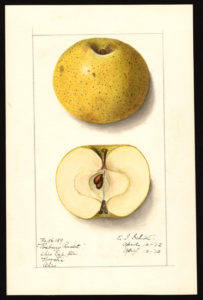
In this work, historic books, publications, and nursery catalogs were used to identify the cultivars that were propagated and grown in the United States prior to 1908. Synonyms, introduction dates, and source country for 891 historic apple cultivars were recorded in total. We then classified them based on their availability over time and popularity in nursery catalogs. We considered the highest priority cultivars for conservation to be those that were actively propagated and sold through multiple nurseries, as well as those that were grown and documented in more than one of the three time periods recorded (pre-1830, 1830-1869, and 1870-1907).
We found that, overall, 90% of the 150 highest priority cultivars are currently available as a result of conservation efforts in genebanks, private collections, and nurseries. Overall, it’s quite remarkable (and likely due in part to the longevity of apple trees) that these trees remain available, since the USDA National Plant Germplasm System Clonal Repository, where apple cultivars are conserved, wasn’t established until the 1980s. Cultivars that are not currently protected within genebanks but considered high priority were identified and suggested for inclusion in genebanks in the future. There were 51 high priority cultivars identified as possible additions to genebank conservation efforts, many of which may be available from the National Fruit Collection in Brogdale, England, and the Temperate Orchard Conservancy in Oregon.
This information will be useful for the many landholders who have historic apple trees on their properties. Identification efforts may make use of lists of historic cultivars to help determine identities based on either DNA fingerprinting or phenotypic traits.