- So there’s a “celebrity pork expert.” No, not David Cameron, Carl Blake.
- Nevermind about resurrecting pig breeds, how about resurrecting “America’s best tomato“?
- Mapping biofortification outreach.
- CG writes letter to heads of state on SDGs. But will they listen?
- How they store wine in Georgia.
- US needs more veggies. Don’t we all.
- Kenya is a nutrition star.
- The Equator Prize 2015 winners are in.
- Article on wheat illustrated with picture of millet labelled sorghum
Brainfood: Cowpea evaluation, Varietal mixtures, Eragrostis core, Nigerian cassava diversity, Turkish alfalfa, Italian wild grapes, Cleome veggie, AnGR history
- Genotypic difference in salinity tolerance during early vegetative growth of cowpea (Vigna unguiculata L. Walp.) from Myanmar. 3 out of 21 seems a pretty good proportion.
- Epidemiological and evolutionary management of plant resistance: optimizing the deployment of cultivar mixtures in time and space in agricultural landscapes. Best to combine with rotations.
- Barnyard millet global core collection evaluation in the submontane Himalayan region of India using multivariate analysis. Three groups: India, Japan, and everything else.
- Determinants of on-farm cassava biodiversity in Ogun State, Nigeria. Experience and size of farm.
- Historical Alfalfa Landraces Perform Higher Yield Under Dry Farming in Turkey. At least at these two locations in Kars. One does wonder why breeders bother, though.
- Identification and characterization of Vitis vinifera subsp. sylvestris populations in north-western Italy. Was thought to be lost in Piedmont, but 5 small wild populations found, in danger of contamination from the crop.
- Cleome viscosa: a promising underutilized minor crop. Worth a try, though the name is hardly promising.
- Changing values of Farm Animal Genomic Resources. From historical breeds to the Nagoya Protocol. Everything is political now. Welcome to my world.
Nibbles: Beautiful downtown Burbank, Oz rice weed and nuts, Teff embargo, Kew Gardens, Cherokee seeds, Vegetables semantics, MLN progress, Fishy chart, Inuit fishy diet, Bioversity photo fix, African food security, ICIPE cashes in, Root & tuber congress, Smallholders, EU agroecology, Sackville Hamilton, Kiwifruit history, USDA pathogen collection
- Luther Burbank “…was willing to cross just about anything that had leaves…”
- No, rice did not originate in northern Australia. Not in the sense those words are usually used.
- Aussies to embrace cannabis. But not in the sense those words are usually used.
- Australian exporters nuts for more than just macadamia. Ah, interdependence…
- Meanwhile, Ethiopian teff exporters licking their lips in anticipation.
- Kew is bigger than the sum of its parts.
- Cherokee Nation genebanker gets award.
- Yes, BBC, vegetables exist, let’s move on.
- Maize Lethal Necrosis on its last legs? Well, “progress is being made” at any rate.
- The Economist’s daily chart is on declining fish stocks. Why have they gone all warm and fuzzy lately? Something in the zeitgeist?
- Inuit are genetically adapted to their fishy diet.
- Damn it, I lost! Probably fixed.
- Africa sets up a new institution for food security. Which is not the same as hunger, we are told. But is it malnutrition.
- ICIPE scales up and out. More impact than any “new institution” is going to achieve.
- World Congress on Root & Tuber Crops has a new website.
- It’s the smallholders, stupid. Like the ones growing tea in Kenya, frinstance.
- The EU to discuss agroecology. Yesterday, alas.
- IRRI and Plant Treaty to share an IT-savvy genebank manager.
- How kiwifruit became kiwifruit.
- Microbes have collections too.
Brainfood: Olive oil composition, Storing rice, Fair Trade, Red List, Farmer seed systems, Dipterocarp genetic structure, Italian bread wheat, Nepal crop diversity, Rice origins
- In situ evaluation of the fruit and oil characteristics of the main Lebanese olive germplasm. Some may have levels of ∆-7-stigmastenol which are on the high side. This is a chemical used in fraud detection, apparently.
- Viability monitoring intervals for genebank samples of Oryza sativa. Wait for fail (<85% germination) in the active collection before testing the corresponding seedlot in the base collection.
- Fair Trade and Free Entry: Can a Disequilibrium Market Serve as a Development Tool? Busted.
- Green Plants in the Red: A Baseline Global Assessment for the IUCN Sampled Red List Index for Plants. 20% of species assessed are threatened with extinction, mainly from tropical rain forest, mainly as a result of conversion to agriculture and harvesting of natural resources.
- Farmer seed networks make a limited contribution to agriculture? Four common misconceptions. They’re not inefficient, they’re not closed and conservative, and they’re not doomed. But they could work better and in a more egalitarian way.
- Understanding local patterns of genetic diversity in dipterocarps using a multi-site, multi-species approach: Implications for forest management and restoration. In most of these species, genetically similar individuals cluster together, resulting in inbreeding, especially after fragmentation due to logging. But you can do something about that through management.
- Morpho-physiolological and qualitative traits of a bread wheat collection spanning a century of breeding in Italy. The ideotype has changed significantly in Italy over the past 100 years.
- Assessing links between crop diversity and food self-sufficiency in three agroecological regions of Nepal. Whether greater crop diversity translates into more stable livelihoods depends on access to markets.
- A Population Genomics Insight into the Mediterranean Origins of Wine Yeast Domestication. Closest wild population to wine yeast comes from Mediterranean oak, and diverged at about the right time.
- Modelling the Geographical Origin of Rice Cultivation in Asia Using the Rice Archaeological Database. Two centres of origin, in Middle Yangtze and Lower Yangtze valleys.
The right tree in the right place
Much excitement at the World Forestry Congress yesterday over the launch of the World Agroforestry Center’s fancy-shmanzy new app.
New app 4 identifying+selecting the right tree launched today! Try it. http://t.co/kLUCvjFJAN #Forests2015 pic.twitter.com/mPq4EG7lpw
— CIFOR-ICRAF (@CIFOR_ICRAF) September 7, 2015
Long story short, it’s version 2 of a potential natural vegetation map of eastern and southern Africa. 1 You can consult it in a browser, including on mobile devices, in Google Earth, or in your own GIS. Once you know where you are, or where you’d like to grown some trees anyway, you can get an idea of the natural vegetation there, and of what species might do well, for a variety of different purposes (honey production, say, or firewood).
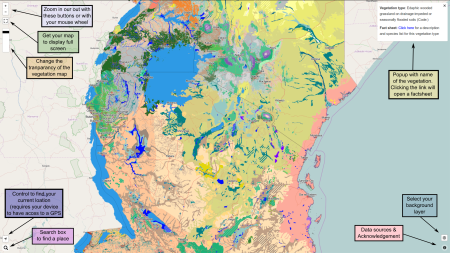
Once you’ve selected a likely tree, you can get more information on it from ICRAF’s Agroforestry Species Dashboard. It’ll need a bit more road-testing than I have time for just at the moment, but it looks promising at first blush. One immediate reaction I do have is that it’s not possible to look for species that fulfil multiple functions: honey production and firewood, in other words. But I may be doing the thing an injustice.